

From my experience with Pory.io, I found it excels at enabling non-technical users to quickly build functional web applications without writing code. The platform’s strong Airtable integration and drag-and-drop editor make it straightforward to create custom portals and internal tools. After spending time with Pory.io, I can say it’s particularly well-suited for small business owners and entrepreneurs who want to launch MVPs or automate workflows without developer resources. However, there is a trade-off: the platform’s customization options can feel limited for highly complex applications, and some useful features require a paid subscription. Overall, if you need a no-code solution to build web apps rapidly with Airtable data, Pory.io delivers solid results.
Pory.io No-Code Platform for Building Custom Web Apps and Portals
Pory.io is a no-code platform that allows users to build custom web applications and portals by integrating Airtable data and using a drag-and-drop editor without coding skills.
- Best for
- Build Custom Web Applications
- Key capability
- No-Code Drag-and-Drop Editor
What is Pory.io?
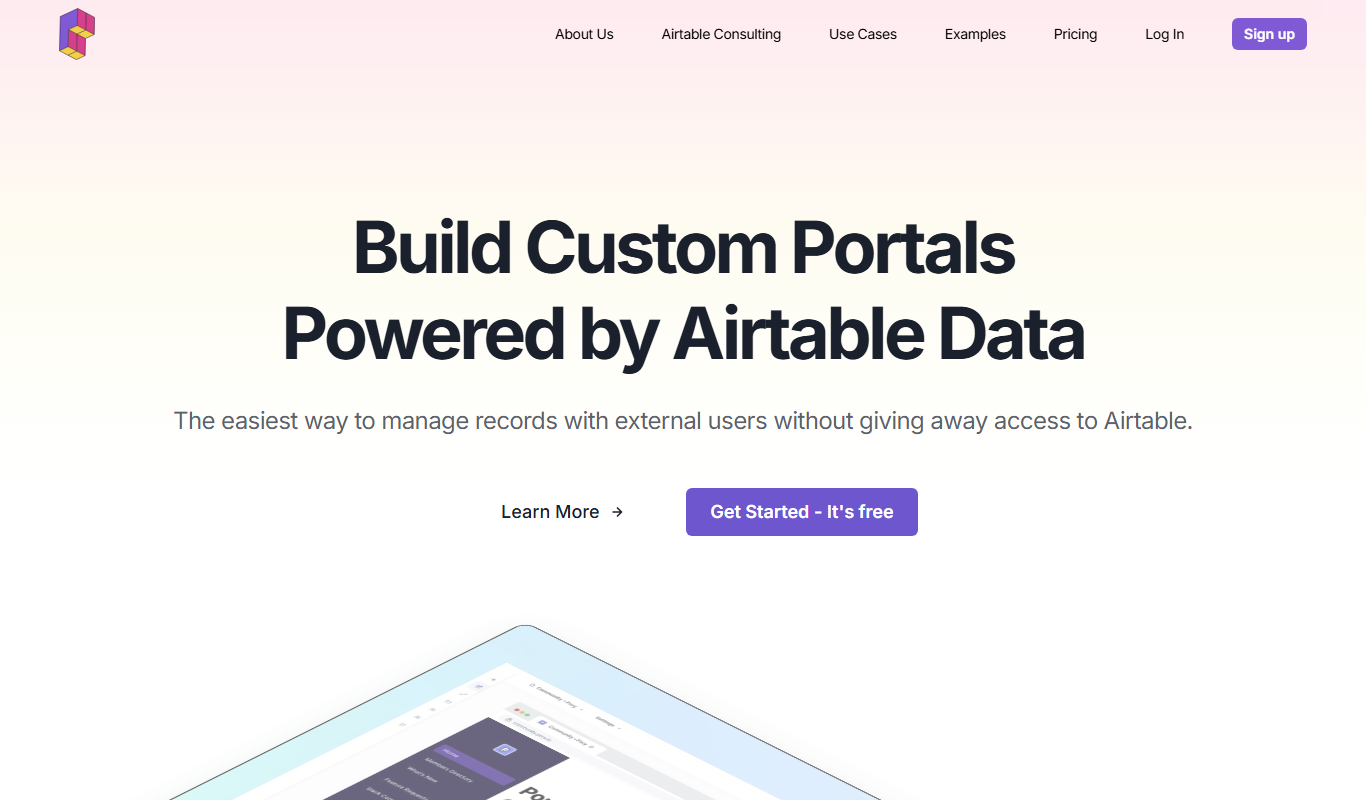
Pory.io is a no-code platform that enables users to build custom web applications, portals, and marketplaces by visually designing interfaces and integrating with data sources like Airtable. It empowers non-technical users to create functional apps without writing code, focusing on ease of use and rapid deployment.
Key features of Pory.io
Pory.io offers drag-and-drop app building, Airtable integration, user authentication, customizable templates, and responsive design to help users quickly launch web apps tailored to their needs.
No-Code Drag-and-Drop Editor
Build app interfaces visually without programming knowledge.
Airtable Integration
Seamlessly connect Airtable databases to power app content and logic.
User Authentication
Enable sign-up, login, and role-based access control.
Customizable Templates
Start quickly with pre-built templates for common app types.
Responsive Design
Apps built with Pory.io work well on desktop and mobile devices.
Pros and cons of Pory.io
Pros
- User-friendly drag-and-drop interface
- Strong Airtable integration
- No coding required to build functional apps
- Responsive design for mobile and desktop
- Affordable pricing with a free tier
Cons
- Limited to web platform only
- Some advanced features require paid plans
- Customization options can be restrictive for complex apps
Key use cases for Pory.io
Build Custom Web Applications
Create fully functional web apps without coding by connecting data sources and designing user interfaces.
Create Member Portals
Develop membership sites with user authentication and personalized content.
Automate Workflows
Integrate with Airtable and other tools to automate business processes and data management.
Launch Marketplaces
Build online marketplaces to connect buyers and sellers with custom features.
Develop Internal Tools
Create internal dashboards and tools to streamline company operations.
How Pory.io works
- 1
Connect Data Source
Link your Airtable base or other supported data sources to Pory.io.
- 2
Design Interface
Use the drag-and-drop editor to build pages, lists, and detail views.
- 3
Configure User Access
Set up user authentication and permissions for your app.
- 4
Publish and Share
Launch your web app with a custom domain and share it with users.
Who is using Pory.io
Pory.io pricing
Free
$0/month
Basic features with limited app usage and Pory branding.
Pro
$29/month
Advanced features including custom domains, more users, and priority support.
Plans and prices are as published by the vendor and can change. Check the official site before you buy. Open the pricing page (opens in a new tab)
Frequently asked questions about Pory.io
No, Pory.io is designed for users without coding experience to build web apps visually.
Yes, Airtable integration is a core feature to power your app’s data.
Yes, Pory.io supports user authentication and role-based access.
Custom domains are available on paid plans.
This tool is designed to help users accomplish its core tasks more efficiently. It is typically used by individuals or teams looking to improve productivity and workflow.
It depends on your specific needs and how you plan to use the tool. The official website and documentation are the best sources for the latest details.
Yes, it can help with that use case depending on how you configure it and what features are available. You’ll get the best results with clear inputs and a defined goal.
Pricing depends on the plan and included features. For the most accurate and up-to-date details, check the official pricing page.
Sign in to review this tool.
Sign In to ReviewNo reviews yet
Be the first to share how this tool worked for you.
Ask about pricing, limits, or how it compares — or answer someone else.
Sign In to AskNo questions yet
Have a question about using or paying for this tool? Be the first to ask.
Featured on TiorAI



Alternative Tools
Explore similar AI tools that might fit your needs

Bubble
Bubble is a no-code platform that enables users to create complex web applications visually without writing code, using drag-and-drop design, workflows, and database management.

Adalo
Adalo is a no-code platform that lets you create mobile and web applications visually without programming, supporting native app publishing and database integration.

Glide
Glide is a no-code app builder that lets you create mobile and web apps by visually designing interfaces connected to spreadsheet data, enabling fast app development without coding.
More Business Management tools
Other tools in the same category, for when this one is not quite the fit.

Roadtrippers
Roadtrippers is a travel planning app that helps users create detailed road trip itineraries by mapping routes, discovering attractions, and optimizing travel plans.

TripIt
TripIt is a travel app that automatically organizes your travel plans into a single itinerary by parsing confirmation emails, providing real-time flight alerts, and allowing itinerary sharing.

FormSwift
FormSwift is an online platform that provides customizable legal and business document templates, PDF editing, and electronic signature capabilities to help users create and manage important documents easily.

TextMagic
TextMagic is a cloud-based SMS marketing platform that enables businesses to send bulk text messages, automate notifications, and engage customers with two-way messaging and API integration.

EZ Texting
EZ Texting is a cloud-based SMS marketing platform that enables businesses to send mass text messages, automate campaigns, and engage customers with two-way messaging.

SimpleTexting
SimpleTexting is a cloud-based SMS marketing platform that enables businesses to send mass text messages, automate SMS workflows, and engage customers with two-way messaging to improve communication and marketing effectiveness.

Spocket
Spocket is a dropshipping platform that helps ecommerce entrepreneurs source products from vetted US and EU suppliers, automate order fulfillment, and integrate with major online store platforms like Shopify and WooCommerce.

Oberlo
Oberlo is a dropshipping app for Shopify that automates product importing, inventory management, and order fulfillment, enabling entrepreneurs to run ecommerce stores without holding inventory.