

From my experience with Nanonets, I found it excels at providing customizable AI-powered OCR solutions that adapt well to specific document types and business needs. The platform’s ability to train custom models makes it particularly well-suited for companies dealing with diverse and complex documents, such as invoices and identity verification forms. However, the pricing is not fully transparent upfront, which can be a consideration for smaller businesses. Overall, if you need reliable automated data extraction with API integration and high accuracy, Nanonets delivers solid results.
Nanonets AI OCR Platform for Automated Data Extraction and Document Processing
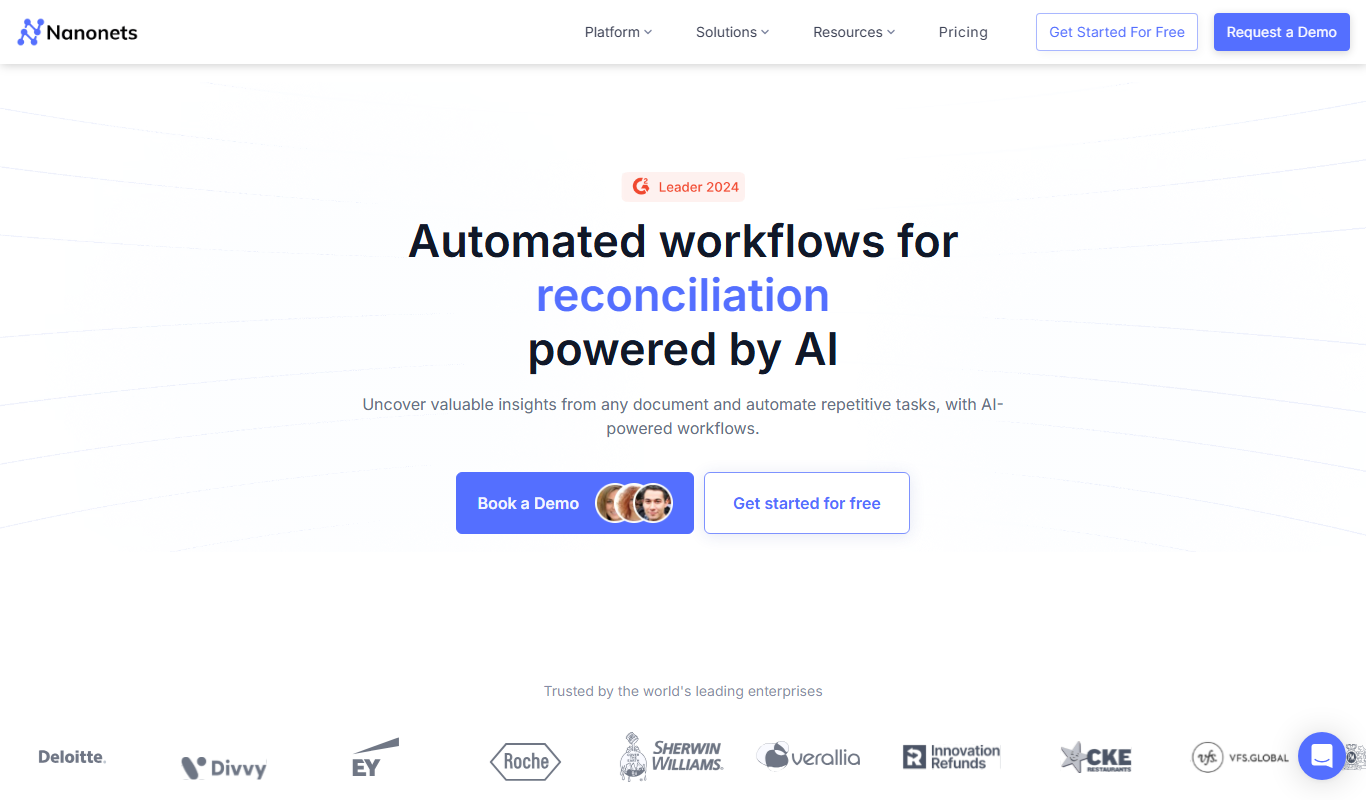
Nanonets is an AI-driven OCR platform that automates data extraction from various document types, enabling businesses to reduce manual entry and improve accuracy through customizable models and API integration.
- Best for
- Invoice Processing
- Key capability
- Customizable OCR Models

Do you recommend this tool?
What is Nanonets?
Nanonets is an AI-powered Optical Character Recognition (OCR) platform designed to automate data extraction from documents. It leverages machine learning models to accurately recognize and extract text and structured data from images, PDFs, and scanned documents. The platform enables businesses to reduce manual data entry, improve accuracy, and accelerate document processing workflows.
Key features of Nanonets
Nanonets offers customizable OCR models, an easy-to-use web interface, API integration, and support for multiple document types. It provides automated data extraction, validation, and export capabilities to various formats and systems, making it suitable for diverse industries.
Customizable OCR Models
Train and fine-tune models specific to your document types and data fields.
API Access
Integrate Nanonets OCR capabilities into existing applications and workflows via RESTful API.
Multi-format Support
Supports images, PDFs, and scanned documents in various formats.
High Accuracy with AI
Leverages deep learning to improve recognition accuracy over traditional OCR.
Data Validation and Export
Includes tools for validating extracted data and exporting to CSV, JSON, or third-party systems.
Pros and cons of Nanonets
Pros
- Highly customizable OCR models for specific use cases
- Easy integration with API access
- Supports a wide range of document types and formats
- Improves accuracy with AI and machine learning
- User-friendly web interface for document management
Cons
- Pricing details are not publicly transparent and require contact
- Limited language support primarily focused on English
- No dedicated mobile app available
Key use cases for Nanonets
Invoice Processing
Automatically extract key data fields from invoices to streamline accounting workflows.
Receipt Digitization
Convert paper receipts into structured digital data for expense tracking and reporting.
Identity Document Verification
Extract and verify information from passports, driver’s licenses, and other ID documents.
Form Data Extraction
Capture data from various forms such as applications, surveys, and contracts to automate data entry.
Logistics and Shipping
Extract shipping labels and tracking information to optimize supply chain operations.
How Nanonets works
- 1
Upload Documents
Users upload images, PDFs, or scanned documents to the Nanonets platform via web or API.
- 2
Train Custom Models
Optionally train custom OCR models by labeling sample documents to improve extraction accuracy.
- 3
Automated Data Extraction
The AI processes documents to extract text and structured data fields automatically.
- 4
Review and Export
Extracted data can be reviewed, corrected if needed, and exported to preferred formats or integrated systems.
Who is using Nanonets
Accounting and finance teams
Logistics and supply chain companies
Healthcare providers
Legal and compliance departments
Small to medium-sized enterprises automating document workflows
Nanonets pricing
Free Trial
$0
Limited usage to test core features with sample documents.
Standard
Custom Pricing
Subscription plan with scalable usage, API access, and support.
Plans and prices are as published by the vendor and can change. Check the official site before you buy. Open the pricing page (opens in a new tab)
Frequently asked questions about Nanonets
Nanonets can process invoices, receipts, identity documents, forms, shipping labels, and many other document types.
Yes, Nanonets allows users to train custom models by labeling their own documents to improve accuracy.
Yes, Nanonets provides a RESTful API for integration with your applications.
Supported formats include JPEG, PNG, PDF, TIFF, and other common image and document types.
It depends on your specific needs and how you plan to use the tool. The official website and documentation are the best sources for the latest details.
Yes, it can help with that use case depending on how you configure it and what features are available. You’ll get the best results with clear inputs and a defined goal.
Integration support depends on the tool and its available connectors or API. Check the official documentation or integrations page to confirm what is supported.
It depends on your specific needs and how you plan to use the tool. The official website and documentation are the best sources for the latest details.
Sign in to review this tool.
Sign In to ReviewNo reviews yet
Be the first to share how this tool worked for you.
Ask about pricing, limits, or how it compares — or answer someone else.
Sign In to AskNo questions yet
Have a question about using or paying for this tool? Be the first to ask.
Featured on TiorAI



Alternative Tools
Explore similar AI tools that might fit your needs

Free Trial
Docparser
Docparser is a cloud-based tool that automates data extraction from PDFs and scanned documents using customizable parsing templates and OCR, enabling businesses to streamline document workflows.

Custom Pricing
Rossum
Rossum is an AI-driven document processing platform that automates data extraction from business documents like invoices and purchase orders using deep learning, eliminating manual data entry and template setup.

Custom Pricing
Hypatos
Hypatos is an AI-powered document processing platform that automates data extraction from invoices and financial documents to optimize accounts payable workflows.
More AI Artificial Intelligence Tools tools
Other tools in the same category, for when this one is not quite the fit.

Freemium
EasyTrip AI
EasyTrip AI is an AI-driven travel planner that generates customized trip itineraries based on your travel dates, destinations, and preferences, helping you organize your trip efficiently.

Freemium
Travel Itinerary AI
Travel Itinerary AI is an AI-powered web tool that creates personalized travel itineraries based on your preferences, helping you plan and manage trips efficiently.

Free
NilgAI Travel
NilgAI Travel is an AI-driven travel planning tool that creates personalized itineraries based on your preferences, travel dates, and budget, helping you efficiently plan trips worldwide.

Custom Pricing
sentiance.com
Sentiance is an AI-powered platform that transforms sensor and contextual data into actionable behavioral insights, enabling businesses to understand user behavior and deliver personalized experiences in real-time.

Contact for pricing
ODESIS
ODESIS is an AI-driven analytics platform that helps businesses transform data into actionable insights through machine learning, visualization, and predictive analytics.

Contact for pricing
QUINETICS
Quinetics is an AI platform that provides businesses with advanced data analytics, workflow automation, and custom machine learning model development to optimize operations and decision-making.

Free
aigclist
AIGCList is a free online directory that aggregates and categorizes AI tools, providing detailed information, user reviews, and AI industry news to help users discover and compare AI solutions.

Free
AI Tool Center
AI Tool Center is a free online directory that helps users discover, compare, and review AI tools across various categories and industries.