

Litmaps Literature Mapping Tool for Research and Academic Discovery
Litmaps is a web-based tool that helps researchers discover and visualize academic literature through interactive citation networks, enabling efficient literature reviews and research trend analysis.
- Best for
- Academic Research Discovery
- Key capability
- Interactive Citation Graphs
Save Litmaps, follow its updates and vote on it — everything stays in your account.
Sign in or create a free account
What is Litmaps?
Litmaps is a web-based literature mapping tool designed to help researchers and academics discover, visualize, and analyze scientific literature through citation networks. It enables users to explore connections between papers, track research trends, and optimize their literature review process.
Key features of Litmaps
Litmaps offers interactive citation network visualization, personalized literature recommendations, and tools for organizing and tracking research papers, making it easier to uncover relevant studies and understand the evolution of scientific topics.
Interactive Citation Graphs
Visualize and navigate citation networks to understand how research papers are interconnected.
Personalized Literature Recommendations
Receive suggestions for relevant papers based on your mapped literature and interests.
Research Trend Analysis
Identify emerging topics and influential works within a scientific domain.
Paper Organization Tools
Create collections and annotate papers to manage your literature efficiently.
Pros and cons of Litmaps
Pros
- Intuitive visualization of citation networks
- Helps uncover relevant and related research efficiently
- Supports personalized literature management
- Free tier available for basic use
Cons
- Limited features on free plan
- Primarily focused on English-language academic papers
- No dedicated mobile app
Key use cases for Litmaps
Academic Research Discovery
Helps researchers discover relevant academic papers and track citation networks to explore related works.
Literature Mapping
Visualizes connections between scientific papers to understand research trends and relationships.
Research Workflow Optimization
Enables users to organize and manage literature efficiently to streamline the research process.
Citation Network Analysis
Analyzes citation patterns to identify influential papers and emerging topics in a research field.
How Litmaps works
- 1
Create an Account
Sign up on the Litmaps website to start building your literature maps.
- 2
Search or Import Papers
Search for academic papers or import your own list to begin mapping citation relationships.
- 3
Visualize Citation Networks
Explore interactive graphs that show how papers cite each other and discover related research.
- 4
Organize and Track
Save papers, create collections, and track new publications relevant to your research interests.
Who is using Litmaps
Litmaps pricing
Free
$0/month
Basic access with limited maps and features suitable for individual researchers.
Pro
$10/month ($120/year for education)
Unlimited inputs, articles and Litmaps with advanced search and configurable literature alerts; education pricing requires an academic email.
Team
Price on request
Unlimited inputs, articles and Litmaps with advanced search, daily or configurable alerts and team-wide collaboration.
Plans and prices are as published by the vendor and can change. Check the official site before you buy. Open the pricing page (opens in a new tab)
Frequently asked questions about Litmaps
Litmaps is used to discover, visualize, and analyze academic literature through citation networks.
Yes, you can import your own list of papers to create personalized literature maps.
Yes, Litmaps offers a free plan with basic features and limited usage.
Litmaps is a web-based tool accessible via modern web browsers.
Yes, it can help with that use case depending on how you configure it and what features are available. You’ll get the best results with clear inputs and a defined goal.
Some tools offer a free plan or trial with limited features. Availability can vary, so confirm on the official website.
Yes, it can help with that use case depending on how you configure it and what features are available. You’ll get the best results with clear inputs and a defined goal.
Yes, it can help with that use case depending on how you configure it and what features are available. You’ll get the best results with clear inputs and a defined goal.
Conclusion
Mapping begins with a search for academic papers or an imported list of the researcher’s own, after which interactive graphs show how those papers cite each other. Suggestions for relevant papers build on the mapped literature, and collections and annotations keep the results organized. New publications relevant to a research interest can be tracked from the same account.
The tool runs in modern web browsers and is designed for academic researchers, graduate students and research librarians. Its stated aim is to help users track research trends and optimize the literature review process. A free plan gives basic access with limited maps, while Pro costs $10/month, or $120/year for education. A Team plan is also available with pricing on request.
Sources
Sign in to review this tool.
Sign In to ReviewNo reviews yet
Be the first to share how this tool worked for you.
Ask about pricing, limits, or how it compares — or answer someone else.
Sign In to AskNo questions yet
Have a question about using or paying for this tool? Be the first to ask.
Featured on TiorAI



Alternative Tools
Explore similar AI tools that might fit your needs

Connected Papers
Connected Papers is a web-based tool that creates visual graphs of academic papers based on citation relationships, helping researchers explore and understand scientific literature efficiently.
More AI Analytics Assistant tools
Other tools in the same category, for when this one is not quite the fit.
Sinequa
Sinequa by ChapsVision is an enterprise AI search and analytics platform for large volumes of structured and unstructured data, with pricing on request.
Anodot
Anodot, now a Glassbox company, is an AI-driven anomaly detection platform that monitors business and operational data and provides alerts and root cause analysis.

Equidam
Equidam is an online platform that automates startup and SME valuations by combining financial data and market benchmarks to generate investor-ready reports and equity distribution models.

WebFX
WebFX is a full-service digital marketing agency offering SEO, PPC, content marketing, web design, and analytics services to help businesses grow online.

SafeGraph
SafeGraph is a data platform for POI, building footprint and address data.

Placer.ai
Placer.ai is a location analytics platform that provides detailed foot traffic and consumer behavior insights using anonymized mobile device data, helping businesses optimize retail site selection, real estate analysis, and marketing strategies.
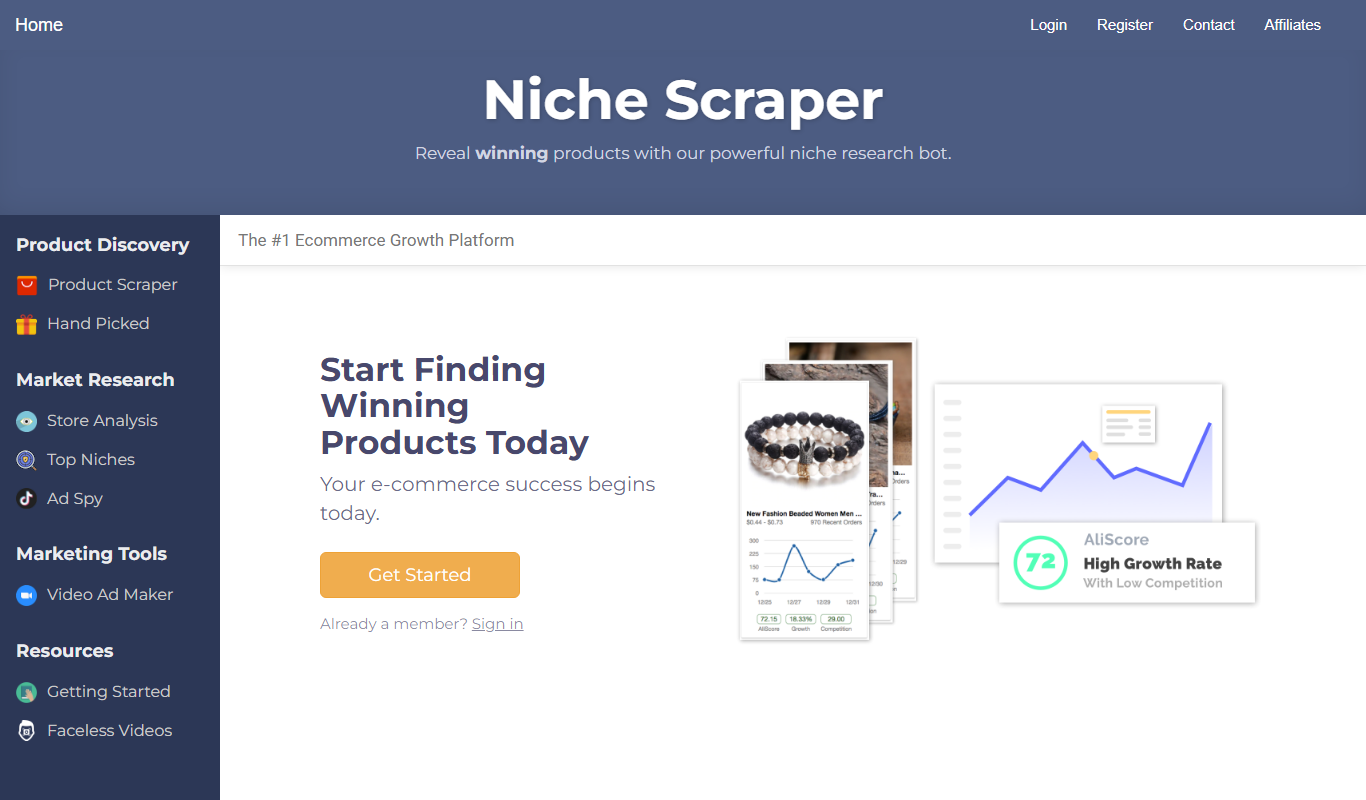
Niche Scraper
Niche Scraper is a web-based tool that helps dropshipping entrepreneurs find trending products and analyze competitor Shopify stores to build profitable ecommerce businesses.
CaptivateIQ
CaptivateIQ is a cloud-based sales commission software that automates incentive compensation calculations, integrates with CRM and ERP systems, and provides real-time dashboards to improve sales performance management.