

From my experience with ChartDB, it stands out as a robust open source time series database that handles high-volume metrics ingestion with ease. Its SQL-like query language makes it approachable for users familiar with relational databases, while its integration with Grafana enables effective visualization. ChartDB is particularly well-suited for DevOps teams and IoT developers who want full control over their data infrastructure without vendor lock-in. The main trade-off is that it requires self-hosting and infrastructure management, which might not suit teams looking for fully managed solutions. Overall, for scalable and customizable time series data storage, ChartDB delivers solid performance and flexibility.
ChartDB - Open Source Time Series Database for Scalable Data Storage
ChartDB is an open source time series database designed for efficient storage and querying of large-scale metrics and monitoring data. It supports high ingestion rates, SQL-like queries, and integrates with visualization tools like Grafana.
Your actions
Save ChartDB, follow its updates and vote on it — everything stays in your account.
Sign in or create a free account

What is ChartDB?
ChartDB is an open source, high-performance time series database designed to efficiently store, query, and manage large volumes of time series data. It is optimized for metrics and monitoring workloads, providing scalable ingestion and fast querying capabilities. ChartDB supports flexible data retention policies and integrates with popular visualization tools, making it suitable for DevOps, IoT, and real-time analytics use cases.
Key features of ChartDB
ChartDB offers scalable time series data storage, high ingestion throughput, efficient querying with SQL-like syntax, data retention management, and compatibility with visualization platforms. Its open source nature allows customization and self-hosting, providing control over data and infrastructure.
High Throughput Ingestion
Efficiently handles millions of data points per second for large-scale time series workloads.
SQL-like Query Language
Provides a familiar query syntax for flexible and powerful data retrieval.
Data Retention Policies
Supports automatic data downsampling and retention to manage storage costs.
Open Source and Self-Hosted
Allows full control over deployment, customization, and data privacy.
Integration with Visualization Tools
Compatible with Grafana and other platforms for real-time data visualization.
Frequently asked questions about ChartDB
Yes, ChartDB is open source and free to use under its license for self-hosted deployments.
ChartDB is optimized for time series data such as metrics, logs, and sensor data.
Yes, ChartDB supports integration with Grafana for data visualization and dashboarding.
ChartDB can be deployed on cloud infrastructure as a self-hosted solution.
This tool is designed to help users accomplish its core tasks more efficiently. It is typically used by individuals or teams looking to improve productivity and workflow.
Some tools offer a free plan or trial with limited features. Availability can vary, so confirm on the official website.
The best alternative depends on your workflow, features you need, and budget. Compare plans, integrations, and output quality to choose the closest fit.
Data handling and security practices vary by provider. Review the official privacy policy to understand how your data is stored and used.
Sign in to review this tool.
Sign In to ReviewNo reviews yet
Be the first to share how this tool worked for you.
Ask about pricing, limits, or how it compares — or answer someone else.
Sign In to AskNo questions yet
Have a question about using or paying for this tool? Be the first to ask.
Featured on TiorAI



Alternative Tools
Explore similar AI tools that might fit your needs

Free
InfluxDB
InfluxDB is a specialized time series database designed to efficiently store and analyze real-time timestamped data from applications, IoT devices, and infrastructure monitoring.
Enterprise
TimescaleDB
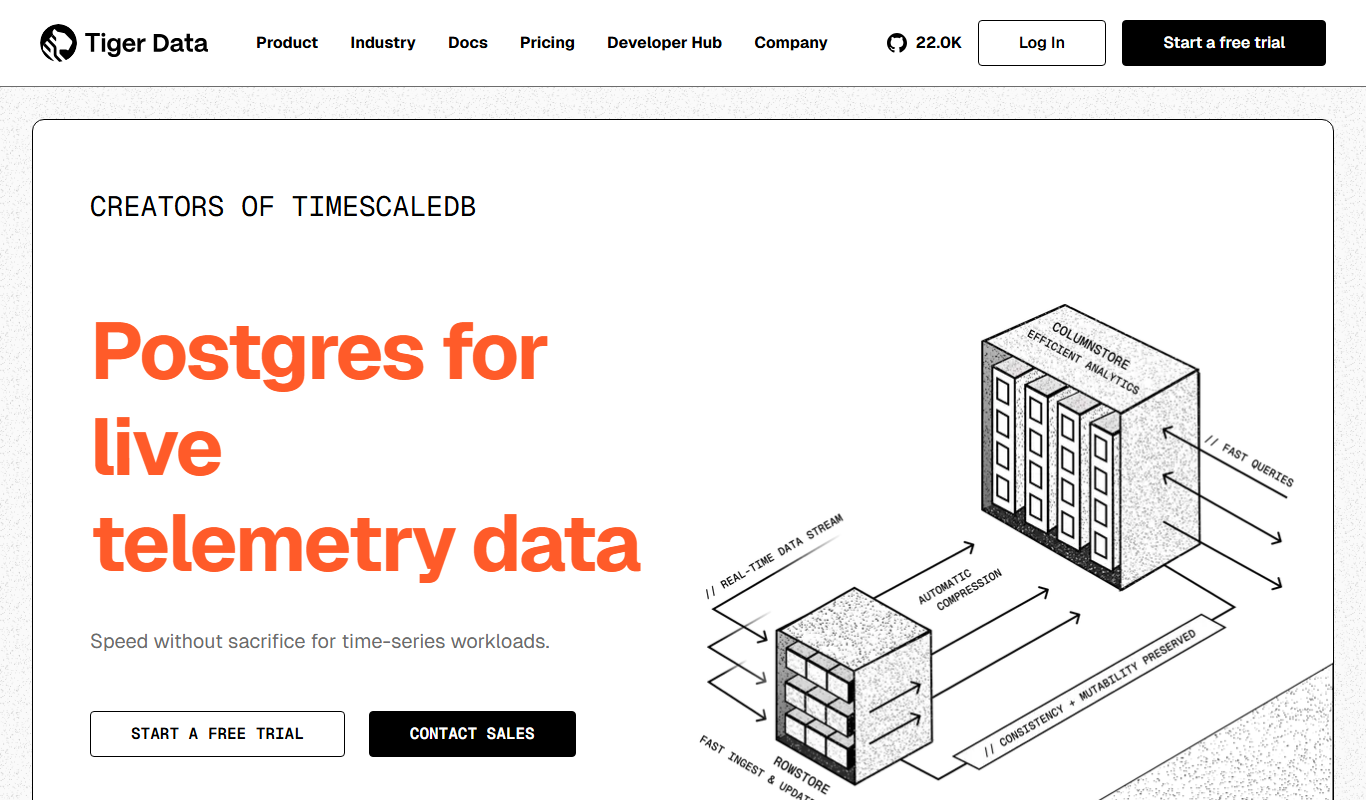
TimescaleDB is an open-source time-series database built on PostgreSQL that enables efficient storage, querying, and analysis of time-stamped data for applications like IoT, monitoring, and financial analytics.
More AI Database & Data Management Tools tools
Other tools in the same category, for when this one is not quite the fit.

Free
Tidb
TiDB Cloud is a fully managed distributed SQL database service by PingCAP that supports scalable OLTP and HTAP workloads with MySQL compatibility, designed for cloud-native applications.

Enterprise
Weaviate
Weaviate is an open-source vector search engine that enables semantic search by storing and querying data using vector embeddings, supporting hybrid search and knowledge graph capabilities.

Enterprise
qdrant.io
Qdrant is an open-source vector search engine that enables scalable, real-time semantic search and AI-powered applications by efficiently managing and querying high-dimensional vector data.