

Almeta ML Personalization AI for Commerce
Almeta ML is personalization AI for ecommerce: real-time product recommendations, cross-sells and customer intent predictions, with no data team required.
- Best for
- Personalized product pages
- Key capability
- Product recommendations
Save Almeta ML, follow its updates and vote on it — everything stays in your account.
Sign in or create a free account
What is Almeta ML?
Almeta ML is a personalization AI for commerce, a machine learning service for predicting customer behavior on websites. It predicts what customers will do next, such as their likelihood to buy, what to recommend and when to reach them, and uses those predictions for real-time product recommendations, cross-sells and upsells and customer intent scoring.
Key features of Almeta ML
Almeta ML offers real-time product recommendations ranked for each visitor, personalized cross-sells and upsells while browsing, in cart and post purchase, customer intent scores, pre-built ML models such as send time optimization, and ML-based audiences for ad networks, all integrated through pre-built connectors, a web tag and an API.
Product recommendations
Ranks products for each visitor individually and refreshes in real time as they browse.
Cross-sells and upsells
Shows products shoppers are most likely to buy while browsing, in cart and post purchase.
Customer intent
Scores each visitor's likelihood to purchase while they are still on the page.
Business-aware recommendations
Matches customer behavior with your product data, inventory levels, profit margins and delivery times.
ML-based ad audiences
Create ML-based audiences on Google Ads, Facebook Ads, Bing Ads, TikTok Ads and other networks.
Pros and cons of Almeta ML
Pros
- No data team or data scientist required
- Recommendations use inventory, margins and delivery times, not only browsing data
- Does not collect personally identifiable information unless you choose to include it
- Real-time model deployment and monitoring
Cons
- Integration typically takes 1 to 2 weeks
- Usage-based pricing; a quote is needed beyond the starting plan
- No publicly available free trial
Key use cases for Almeta ML
Personalized product pages
Show each visitor products ranked for them, refreshed in real time as they browse.
Cart and post-purchase cross-sells
Offer the products shoppers are most likely to buy in cart and post purchase.
Ad audiences and product feeds
Dynamic product feeds for Meta and Google ads.
Send time optimization
Predict the best time to contact a customer.
How Almeta ML works
- 1
Integrate
Connect your store with pre-built connectors, a lightweight web tag or the API; integration typically takes 1 to 2 weeks.
- 2
Set business priorities
You set the priorities, like boosting margins, clearing inventory or promoting new products.
- 3
Predict customer behavior
Pre-built ML models learn from customer behavior and predict likelihood to buy, what to recommend and when to reach each customer.
- 4
Personalize every channel
Predictions update in real time and run on every channel, from product pages to email and ads.
Who is using Almeta ML
Almeta ML pricing
Usage-based
From $99/month
Each plan includes a number of events and recommendations; contact for a quote. 14-day free trial, cancel anytime.
Plans and prices are as published by the vendor and can change. Check the official site before you buy. Open the pricing page (opens in a new tab)
Frequently asked questions about Almeta ML
What your customers will do next: likelihood to buy, what to recommend and when to reach them.
No. Almeta ML handles all the machine learning complexity behind the scenes.
It typically takes 1 to 2 weeks, with full support, pre-built connectors, a lightweight web tag and an API.
Usage-based pricing starting at $99 per month; each plan includes a number of events and recommendations. Contact Almeta ML for a quote.
This tool is designed to help users accomplish its core tasks more efficiently. It is typically used by individuals or teams looking to improve productivity and workflow.
It depends on your specific needs and how you plan to use the tool. The official website and documentation are the best sources for the latest details.
It depends on your specific needs and how you plan to use the tool. The official website and documentation are the best sources for the latest details.
Conclusion
Online stores get a prediction layer here: the service forecasts what each customer will do next, such as their likelihood to buy and what to recommend, and those predictions update in real time across every channel. Recommendations are ranked for each visitor individually, and they draw on inventory levels, profit margins and delivery times as well as browsing behavior. Merchants can push those priorities further, for example toward boosting margins or clearing inventory.
No data team is required, since the machine learning runs behind the scenes, and the docs also cover ML-based audiences for Google Ads and Facebook Ads. Integration uses pre-built connectors, a lightweight web tag or an API and typically takes a week or two with full support. Pricing is usage-based, with plans defined by events and recommendations, and a free trial is offered.
Sources
Sign in to review this tool.
Sign In to ReviewNo reviews yet
Be the first to share how this tool worked for you.
Ask about pricing, limits, or how it compares — or answer someone else.
Sign In to AskNo questions yet
Have a question about using or paying for this tool? Be the first to ask.
Featured on TiorAI



More AI Advertising Assistant tools
Other tools in the same category, for when this one is not quite the fit.

lifemind
Lifemind analyzes a customer report without PII to uncover customer motivations and generate targeting, messaging and partnership ideas that lower CAC across CTV, Meta, Google and TikTok.

Scale Insights™
Scale Insights is Amazon PPC automation software: stack rule-based algorithms for bids, placements, dayparting and negatives across your SP, SB and SD ads.

Strique
Strique is an agentic AI marketing platform for ecommerce brands that plans, executes and compounds marketing work across paid media, SEO and content, without a full marketing team.

IMGPT
IMGPT is AI ad generation that creates campaign-ready creatives in minutes: paste your website or describe your business, see your brand profile before you pay and get paid ads for Meta.

Shakespeare
Shakespeare is an AI marketing platform for Google and Facebook ads, with audience targeting, creative automation and real-time campaign optimization.
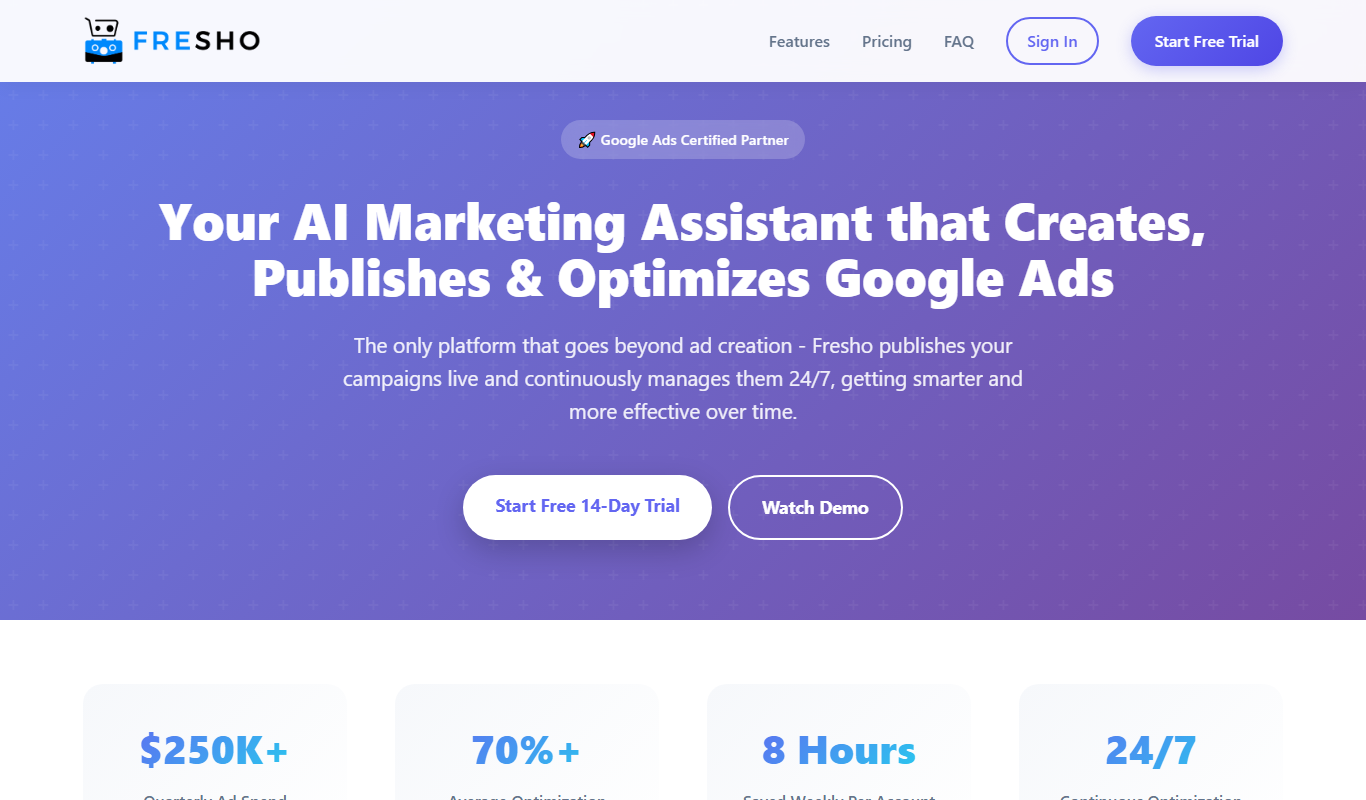
Fresho
Fresho turns your website URL into Google Ads, publishes them and manages them every month, cutting underperformers and scaling winners.

MetaMuse
MetaMuse is a thinking AI agent that helps brands and agencies develop creative advertising concepts, from marketing brief to creative brief and campaign concept.

Bidmatic.io
Bidmatic.io is an ad monetization platform for digital publishers, with an SSP, header bidding, display, video and CTV ads and fully managed ad services.