

Text Readability Analyzer
Transform your text instantly with the free text readability analyzer. Paste any content, apply the tool, and copy the result — perfect for writers, marketers, and content teams.
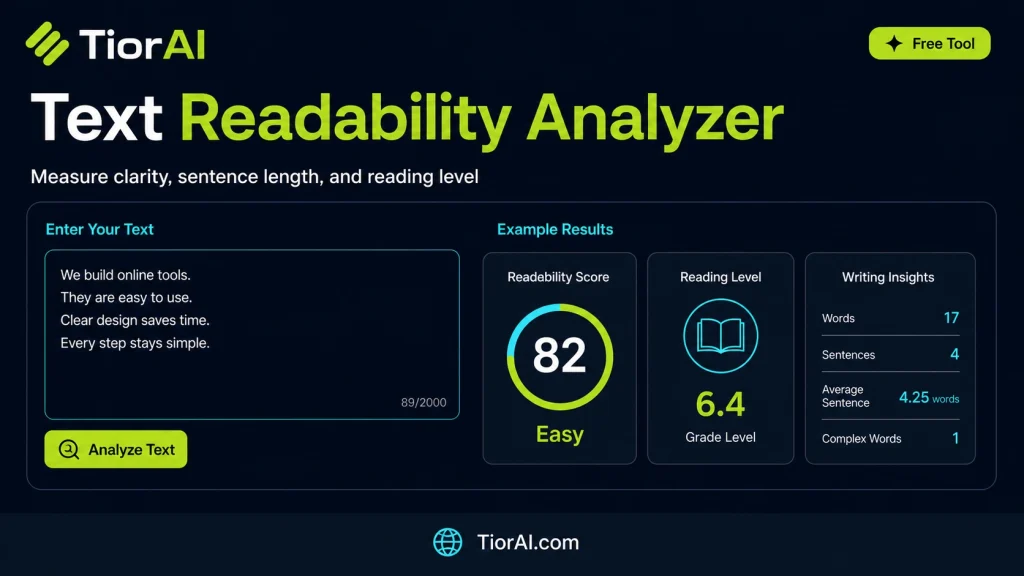
How to use it
- Paste Your Text Paste or type your text into the Text Readability Analyzer. The tool handles content of any length with no character limits.
- Apply the Tool Click the action button to process your text. The transformation is applied instantly to your content.
- Copy the Result Review the transformed text and copy it to your clipboard for use in documents, emails, or projects.
Tip Combine the Text Readability Analyzer with other text tools on TiorAI for a complete content processing workflow.
Understanding Text Readability Analysis
A text readability analyzer is a tool designed to evaluate how easy or difficult a piece of writing is to understand. It uses established readability formulas, such as the Flesch-Kincaid Grade Level, Gunning Fog Index, or SMOG Index, to assign scores based on sentence length, word complexity, and syllable count. These scores estimate the education level required to comprehend the text.
Readability analysis is important because clear communication depends on matching the text complexity to the target audience’s reading ability. For example, technical manuals for experts can use more complex language, while public health information should be accessible to a broad audience.
Common situations where readability analysis is applied include:
- Editing website content to improve user engagement and accessibility.
- Preparing educational materials tailored to specific grade levels.
- Ensuring legal or medical documents are understandable to non-specialists.
- Optimizing marketing copy to maximize clarity and impact.
By quantifying readability, writers and editors can objectively assess and adjust their text to better suit their readers’ needs.
What is Text Readability Analysis?
Text readability analysis evaluates how easy it is for readers to understand a piece of writing. This is done by applying mathematical formulas that analyze sentence length, word complexity, and syllable count. The result is a readability score indicating the education level needed to comprehend the text.
When to Use a Text Readability Analyzer
- Before publishing content aimed at a broad audience to ensure it is clear and accessible.
- When simplifying technical or specialized documents for non-expert readers.
- During editing to identify complex sentences that could be rewritten for better flow.
- To check educational materials for appropriate grade-level suitability.
Common Mistakes to Avoid
- Depending only on readability scores without considering the specific audience or context.
- Overlooking jargon or specialized terms that may confuse readers despite a good readability score.
Readability analysis is a practical method to improve communication by aligning text complexity with reader ability. While it provides valuable insights, it should be used alongside other editing practices to create effective, understandable content.
Frequently asked questions
Reviews and questions
Whether this tool gave people the answer they needed, and what they asked about it.
Sign in to review this tool.
Sign In to ReviewNo reviews yet
Be the first to say whether this tool gave you what you needed.
Ask how to read the result, or what the tool does with an edge case — or answer someone else.
Sign In to AskNo questions yet
Not sure how to read a result? Be the first to ask.
AI tools related to this topic
Tools from the TiorAI directory that work on the same kind of job.

AI Face Analyzer-Beauty Score Calculator
AI Face Analyzer-Beauty Score Calculator is a free web tool that uses AI to analyze facial features and generate a beauty score based on symmetry and proportions.

AI Web Page Analyzer (AI WPA)
AI Web Page Analyzer is an AI-powered tool that evaluates website SEO, performance, and technical issues to provide actionable recommendations for optimization.