

SQL to JSON Converter
SQL databases store data in tables, which are rows and columns. JSON, on the other hand, represents data as nested objects and arrays. Converting SQL query results to JSON means transforming this tabular data into a hierarchical JSON format. This is essential when building modern…
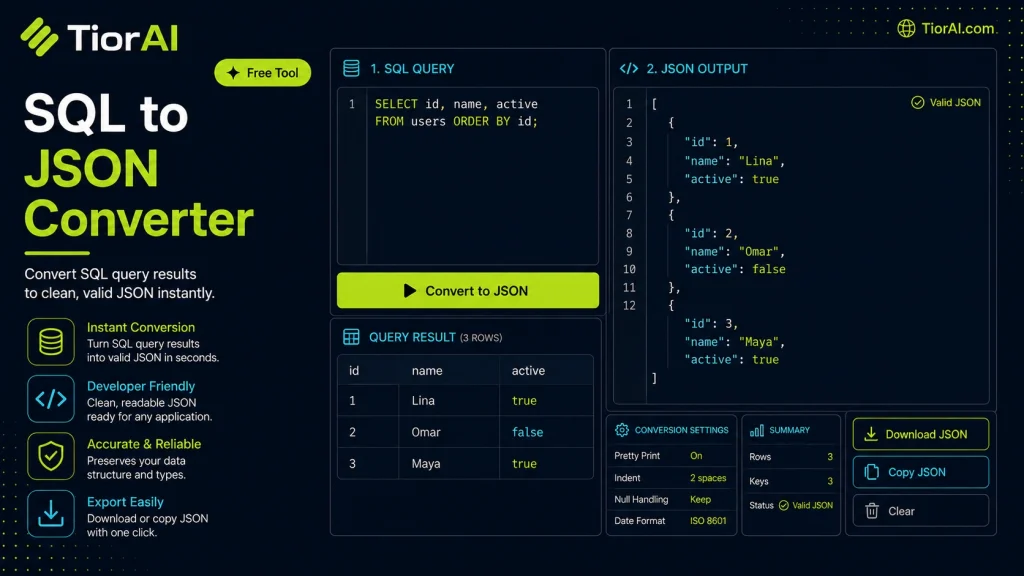
How to use it
- Enter Your Input Value Type or paste the value you want to convert into the input field. The tool accepts any numeric value.
- Select Units and Convert Choose your source and target units from the dropdown menus. The converted result appears instantly.
- Copy or Use the Result Click copy to grab the converted value for use in your project, document, or calculation.
Tip Bookmark this converter - it handles edge cases like zero values and very large numbers accurately.
Understanding SQL to JSON Conversion
SQL (Structured Query Language) is widely used to manage and query relational databases. However, many modern applications, especially web and mobile apps, prefer data in JSON (JavaScript Object Notation) format because it is lightweight, easy to parse, and compatible with JavaScript environments.
SQL to JSON conversion involves transforming the tabular data retrieved from a SQL query into a JSON structure. This process enables seamless data exchange between backend databases and frontend applications or APIs that consume JSON.
Common situations where this conversion is necessary include:
- Building RESTful APIs that return JSON responses from SQL databases.
- Integrating legacy SQL databases with modern JavaScript frameworks like React or Angular.
- Exporting data for use in NoSQL databases or document stores that use JSON.
- Data interchange between different systems where JSON is the preferred format.
By converting SQL query results into JSON, developers can simplify data handling, improve interoperability, and streamline application development workflows.
What is SQL to JSON Conversion?
SQL databases store data in tables, which are rows and columns. JSON, on the other hand, represents data as nested objects and arrays. Converting SQL query results to JSON means transforming this tabular data into a hierarchical JSON format. This is essential when building modern applications that communicate using JSON, such as web APIs or JavaScript frontends.
When to Use a SQL to JSON Converter
- Creating API responses that return JSON data from SQL databases.
- Migrating data from relational databases to JSON-based document stores.
- Integrating backend SQL data with frontend frameworks that consume JSON.
- Exporting data for use in JSON-compatible tools or services.
Common Mistakes to Avoid
- Attempting to convert complex multi-join queries without simplifying the data structure first.
- Expecting the converter to process multiple SQL statements simultaneously.
- Not checking SQL syntax before conversion, which can cause errors or incomplete output.
Understanding these points helps you use SQL to JSON converters effectively, ensuring smooth data transformation and integration in your projects.
Frequently asked questions
Reviews and questions
Whether this tool gave people the answer they needed, and what they asked about it.
Sign in to review this tool.
Sign In to ReviewNo reviews yet
Be the first to say whether this tool gave you what you needed.
Ask how to read the result, or what the tool does with an edge case — or answer someone else.
Sign In to AskNo questions yet
Not sure how to read a result? Be the first to ask.
AI tools related to this topic
Tools from the TiorAI directory that work on the same kind of job.

Wolfram Alpha
Wolfram Alpha is a computational knowledge engine that answers factual queries by performing computations on curated data, offering detailed solutions, visualizations, and an API for developers.

ChatGPT
ChatGPT is an AI chatbot by OpenAI powered by GPT-4o. It handles writing, coding, research, data analysis, and natural conversation. Free tier available, Plus at $20/month.