

Salary to Hourly Calculator
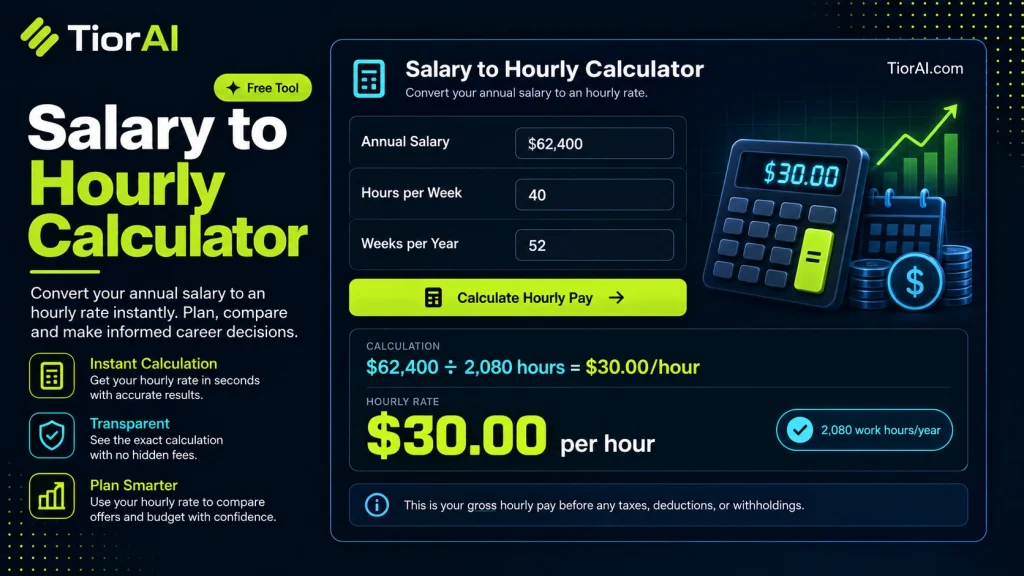
Convert your salary to an equivalent hourly rate based on your work schedule.
Pay Rate Breakdown
| Hourly Rate | |
|---|---|
| Daily Rate | |
| Weekly Rate | |
| Monthly Rate | |
| Annual Salary |
How to use it
- Enter Your Values Input your numbers or parameters into the Salary to Hourly Calculator. Fill in all required fields for an accurate calculation.
- Calculate Results Click the calculate button to process your inputs. The Salary to Hourly Calculator delivers instant, accurate results.
- Review and Use Review your calculated results, explore the breakdown, and copy or share the output for your needs.
Tip Share your Salary to Hourly Calculator results by copying the output — great for reports, homework, or team discussions.
Understanding Salary to Hourly Conversion
Converting an annual salary to an hourly wage is a common calculation that helps individuals understand their earnings on a more granular level. This is especially useful for comparing jobs, negotiating pay, or budgeting personal finances.
The basic formula to convert a salary to an hourly rate is:
Hourly Rate = Annual Salary ÷ (Hours per Week × Weeks per Year)
Where:
- Annual Salary is the total yearly pay before taxes and deductions.
- Hours per Week is the typical number of hours worked each week.
- Weeks per Year usually defaults to 52, representing the full calendar year.
This formula assumes a consistent work schedule without unpaid time off. For example, if you earn $52,000 annually and work 40 hours per week, your hourly wage is calculated as $52,000 ÷ (40 × 52) = $25 per hour.
This calculation matters because hourly rates provide a clearer picture of pay relative to time worked, which is crucial when comparing full-time salaried jobs to part-time or contract work paid hourly. It also helps freelancers and contractors set rates that align with salaried positions.
In real-world contexts, this conversion is used by employees evaluating job offers, employers setting pay scales, and financial planners helping clients understand income streams.
How Salary to Hourly Conversion Works
Converting a salary to an hourly wage helps you understand how much you earn for each hour worked. This is done by dividing your annual salary by the total number of hours you work in a year. The formula is:
Hourly Rate = Annual Salary ÷ (Hours per Week × Weeks per Year)
Knowing your hourly rate is useful for comparing different job offers, setting freelance rates, or budgeting your income.
When to Use a Salary to Hourly Calculator
- Comparing salaried jobs to hourly positions.
- Setting hourly rates for freelance or contract work.
- Budgeting personal finances based on hourly earnings.
- Calculating overtime pay rates.
- Negotiating salary or raises using hourly terms.
Common Mistakes to Avoid
- Including unpaid breaks or overtime hours in your weekly hours, which can distort the hourly rate.
- Assuming 52 working weeks without accounting for unpaid vacation or holidays, which can lead to underestimating your hourly wage.
Understanding these factors ensures your hourly rate calculation accurately reflects your earnings and work schedule.
Common use cases
- Standard Full-Time Salary Conversion
- Part-Time Equivalent Hourly Rate
- Accounting for Unpaid Vacation
Frequently asked questions
Reviews and questions
Whether this tool gave people the answer they needed, and what they asked about it.
Sign in to review this tool.
Sign In to ReviewNo reviews yet
Be the first to say whether this tool gave you what you needed.
Ask how to read the result, or what the tool does with an edge case — or answer someone else.
Sign In to AskNo questions yet
Not sure how to read a result? Be the first to ask.