

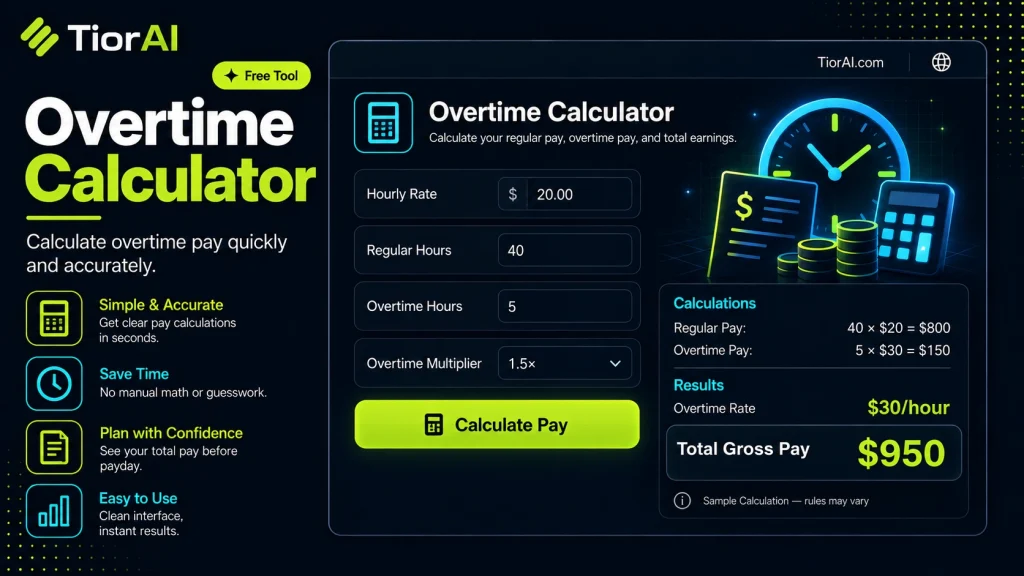
Overtime Calculator
Pay Breakdown
How to use it
- Enter Your Values Input your numbers or parameters into the Overtime Calculator. Fill in all required fields for an accurate calculation.
- Calculate Results Click the calculate button to process your inputs. The Overtime Calculator delivers instant, accurate results.
- Review and Use Review your calculated results, explore the breakdown, and copy or share the output for your needs.
Tip Try different input values with the Overtime Calculator to compare scenarios side by side before making decisions.
Understanding Overtime Pay Calculation
Overtime pay is the additional compensation employees receive for working beyond their standard work hours. The calculation is based on the employee’s regular hourly wage and the number of overtime hours worked. The most common formula used to calculate overtime pay is:
Overtime Pay = Overtime Hours × Overtime Rate
Here, Overtime Hours refers to the number of hours worked beyond the standard workweek (often 40 hours in many countries), and Overtime Rate is typically 1.5 times the regular hourly wage, known as “time and a half.” Some jobs or contracts may have different rates, such as double time.
This calculation is important because labor laws in many countries require employers to compensate employees fairly for extra hours worked. It ensures workers are paid appropriately for their time and helps employers comply with legal standards.
For example, if an employee earns $20 per hour and works 45 hours in a week, the 5 extra hours are overtime. The overtime pay would be calculated as 5 hours × ($20 × 1.5) = $150. This amount is added to the regular pay for the first 40 hours.
Understanding this formula helps both employees and employers verify correct payment and manage payroll accurately. It also assists in budgeting labor costs and planning work schedules.
How Overtime Pay Works
Overtime pay compensates employees for hours worked beyond their regular schedule, typically over 40 hours per week. The calculation involves multiplying the number of overtime hours by an overtime rate, which is usually 1.5 times the regular hourly wage. This ensures fair compensation for extra work and helps employers comply with labor regulations.
When to Use an Overtime Calculator
- When you need to calculate pay for hours worked beyond the standard workweek.
- To estimate additional labor costs for scheduling extra shifts.
- To verify payroll calculations for accuracy and legal compliance.
- When budgeting for projects requiring extended work hours.
- To determine fair pay for hourly contractors or freelancers.
Common Mistakes to Avoid
- Using the regular hourly rate instead of the correct overtime multiplier.
- Including all hours worked instead of only those exceeding standard hours in the overtime calculation.
- Overlooking special overtime rates for holidays or weekends.
Understanding how overtime pay is calculated helps both employees and employers ensure accurate and fair compensation. Using an overtime calculator simplifies this process by automating the math and reducing errors.
Common use cases
- Standard Overtime Calculation
- Double Time Overtime Scenario
- Partial Overtime with Different Standard Hours
Frequently asked questions
Reviews and questions
Whether this tool gave people the answer they needed, and what they asked about it.
Sign in to review this tool.
Sign In to ReviewNo reviews yet
Be the first to say whether this tool gave you what you needed.
Ask how to read the result, or what the tool does with an edge case — or answer someone else.
Sign In to AskNo questions yet
Not sure how to read a result? Be the first to ask.