

Md2 Generator
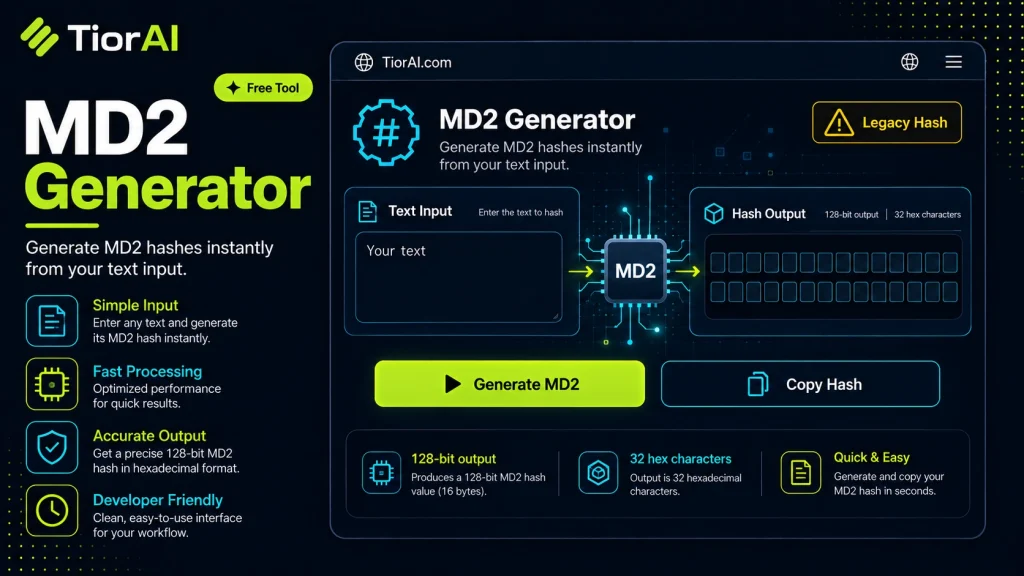
MD2 is a cryptographic hash function that generates a fixed 128-bit output from any input data. It was created in 1989 to work efficiently on 8-bit processors, which were prevalent at the time. The algorithm processes data in 16-byte blocks, padding the input and appending…
How to use it
- Configure Settings Set your preferences and parameters in the Md2 Generator. Customize the output to match your specific requirements.
- Generate Output Click generate to create your result. The tool processes your settings and produces output instantly.
- Copy or Download Review the generated output, then copy it to your clipboard or download it for immediate use.
Tip Regenerate multiple times with the Md2 Generator to compare variations and pick the best output for your needs.
Understanding MD2 Hashing Algorithm
MD2 is a cryptographic hash function designed by Ronald Rivest in 1989. It produces a fixed-size 128-bit (16-byte) hash value from an arbitrary-length input message. The primary purpose of MD2, like other hash functions, is to generate a unique fingerprint of data that can be used for integrity verification and digital signatures.
MD2 operates by processing the input in 16-byte blocks, padding the input if necessary, and applying a series of transformations based on a predefined substitution table. The algorithm was specifically optimized for 8-bit processors, which were common at the time of its creation.
Technical details and standards:
- MD2 is defined in
RFC 1319, which specifies the algorithm’s steps and output format. - The output is always a 128-bit hash, represented typically as a 32-character hexadecimal string.
- MD2 uses a checksum appended to the message before hashing to improve error detection.
Use cases for developers: MD2 was originally used in early security protocols and digital signature schemes, such as in some implementations of the X.509 certificate standard. Developers might encounter MD2 hashes when dealing with legacy systems or older cryptographic libraries.
However, MD2 is now considered cryptographically weak due to advances in cryptanalysis and increased computational power. It is vulnerable to collision attacks, where two different inputs produce the same hash, undermining its reliability for security-critical applications.
Despite this, understanding MD2 remains useful for developers maintaining legacy code or analyzing historical data. Modern applications typically use stronger hash functions like SHA-256 or SHA-3.
What is MD2 Hashing?
MD2 is a cryptographic hash function that generates a fixed 128-bit output from any input data. It was created in 1989 to work efficiently on 8-bit processors, which were prevalent at the time. The algorithm processes data in 16-byte blocks, padding the input and appending a checksum before applying a series of transformations. This produces a unique fingerprint of the input data, useful for verifying integrity and authenticity.
MD2 is defined in RFC 1319 and was once used in digital signatures and certificate verification. However, it has been superseded by more secure algorithms due to vulnerabilities discovered over time.
When to Use MD2 Generator
- Maintaining or interacting with legacy systems that require MD2 hashes for compatibility.
- Educational purposes to study the history and design of cryptographic hash functions.
- Verifying or analyzing data originally hashed with MD2.
- Situations where MD2 format is mandated but security is not critical.
Common Mistakes When Using MD2
- Using MD2 for new security applications despite its known weaknesses.
- Confusing MD2 with stronger hash functions like MD5 or SHA-2, leading to inappropriate security assumptions.
- Assuming MD2 hashes are collision-resistant and suitable for password storage or digital signatures.
Developers should be aware that MD2 is considered obsolete for security purposes. Modern cryptographic applications should use stronger hash functions such as SHA-256 or SHA-3. However, understanding MD2 remains important for legacy support and educational insight into cryptographic evolution.
Common use cases
- Generating MD2 hash for a simple string
- MD2 hash of an empty string
Frequently asked questions
Reviews and questions
Whether this tool gave people the answer they needed, and what they asked about it.
Sign in to review this tool.
Sign In to ReviewNo reviews yet
Be the first to say whether this tool gave you what you needed.
Ask how to read the result, or what the tool does with an edge case — or answer someone else.
Sign In to AskNo questions yet
Not sure how to read a result? Be the first to ask.