

Interest Rate Calculator
How Interest Rate Calculations Work Interest rate calculations are essential for understanding how money grows or costs over time. The two main types are simple and compound interest. Simple interest is calculated only on the original amount, while compound interest includes previously earned interest, leading…
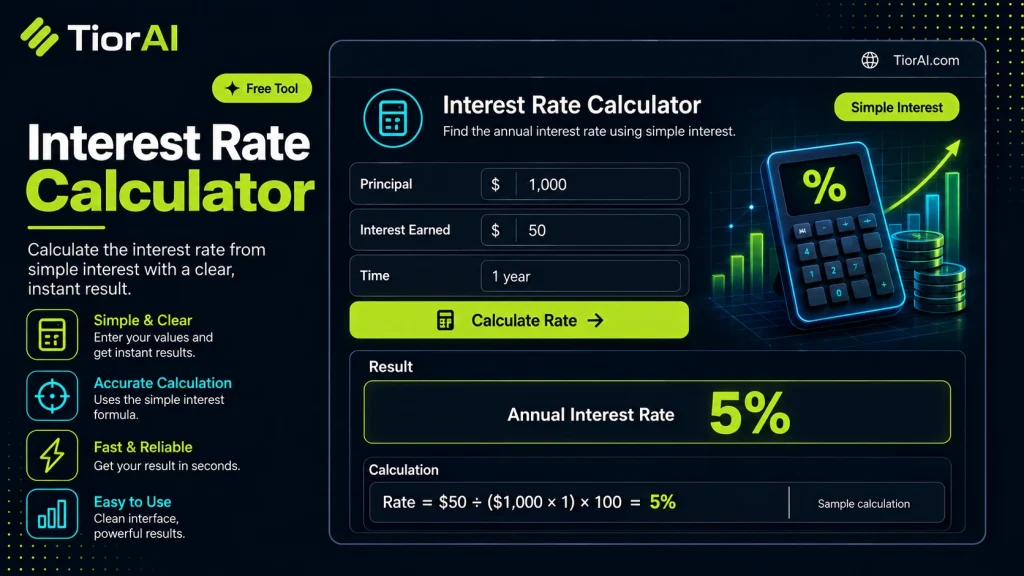
Annual Rate: -
Formula: r = (A/P - 1) / t
How to use it
- Enter Your Values Input your numbers or parameters into the Interest Rate Calculator. Fill in all required fields for an accurate calculation.
- Calculate Results Click the calculate button to process your inputs. The Interest Rate Calculator delivers instant, accurate results.
- Review and Use Review your calculated results, explore the breakdown, and copy or share the output for your needs.
Tip Run the Interest Rate Calculator multiple times with edge-case values to stress-test your assumptions before committing.
Understanding Interest Rate Calculations
Interest rate calculations are fundamental in finance for determining the cost of borrowing or the return on investment over time. The interest rate represents the percentage charged on the principal amount, either as a cost (loan) or gain (investment).
There are two primary types of interest calculations:
- Simple Interest: Calculated only on the original principal. The formula is
I = P × r × t, whereIis the interest earned or paid,Pis the principal amount,ris the annual interest rate (in decimal), andtis the time in years. - Compound Interest: Interest calculated on the principal plus any previously earned interest. The formula is
A = P × (1 + r/n)^(n×t), whereAis the amount accumulated,nis the number of compounding periods per year, and other variables are as above.
Understanding these formulas helps in evaluating loans, savings, mortgages, and investments. For example, compound interest can significantly increase returns over time due to interest-on-interest effects, which is why it is commonly used in savings accounts and investment products.
Calculating interest accurately is essential for budgeting, financial planning, and comparing different financial products. This calculation is commonly needed when determining monthly loan payments, estimating investment growth, or understanding credit card interest charges.
How Interest Rate Calculations Work
Interest rate calculations are essential for understanding how money grows or costs over time. The two main types are simple and compound interest. Simple interest is calculated only on the original amount, while compound interest includes previously earned interest, leading to exponential growth.
The formulas involve variables such as principal (the initial amount), interest rate (expressed as a decimal), time (usually in years), and compounding frequency (how often interest is added). These calculations help in evaluating loans, investments, and savings plans.
When to Use an Interest Rate Calculator
- To find out how much interest you will pay on a loan over a specific period.
- To estimate how much your investment will grow with compound interest.
- To compare different financial products with varying interest rates and compounding schedules.
- To plan savings goals by projecting future interest earnings.
Common Mistakes to Avoid
- Mixing up simple and compound interest formulas, which can lead to incorrect results.
- Entering interest rates as whole numbers instead of decimals, causing inflated calculations.
- Ignoring the compounding frequency, which significantly impacts the total interest accrued.
Understanding these concepts and using the calculator correctly ensures accurate financial planning and better decision-making.
Common use cases
- Calculating Simple Interest on a Personal Loan
- Estimating Compound Interest on a Savings Account
Frequently asked questions
Reviews and questions
Whether this tool gave people the answer they needed, and what they asked about it.
Sign in to review this tool.
Sign In to ReviewNo reviews yet
Be the first to say whether this tool gave you what you needed.
Ask how to read the result, or what the tool does with an edge case — or answer someone else.
Sign In to AskNo questions yet
Not sure how to read a result? Be the first to ask.