

IDN Decode
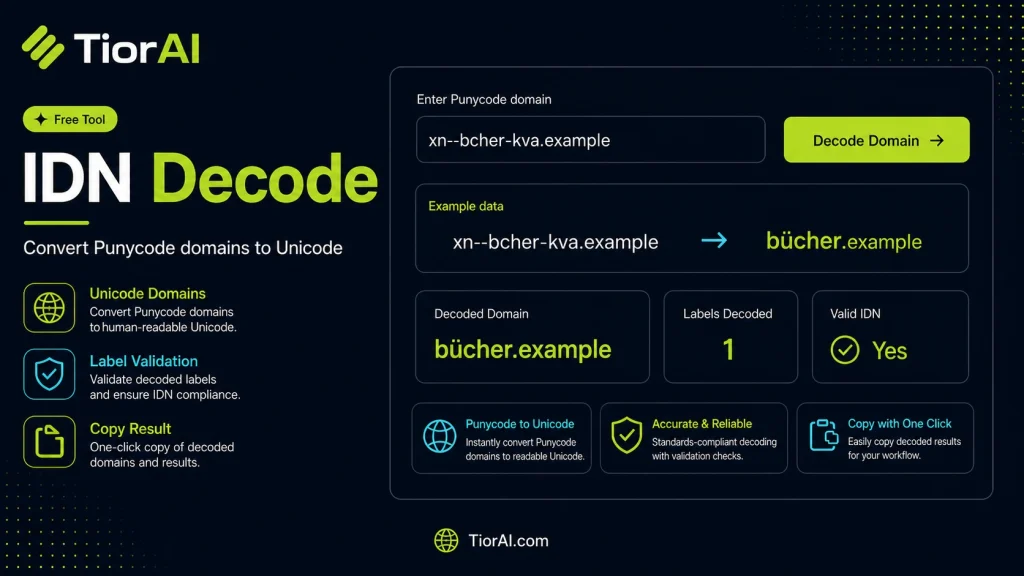
Process and transform your code with the free idn decode. Paste your input, hit the button, and get clean, formatted output — perfect for developers and engineers.
How to use it
- Paste Your Input Paste your code or data into the Idn Decode. The tool accepts standard input formats and validates your entry.
- Process and Transform Click the action button to process your input. Results are generated instantly with proper formatting.
- Export the Output Copy the processed output to your clipboard or download it for use in your development workflow.
Tip Use the Idn Decode during code reviews to quickly reformat or transform snippets for clearer comparisons.
Understanding Internationalized Domain Names (IDNs) and Decoding
Internationalized Domain Names (IDNs) allow domain names to include characters beyond the traditional ASCII set, such as accented letters, non-Latin scripts, and symbols from various languages. This capability enables users worldwide to access websites using domain names in their native languages.
However, the Domain Name System (DNS) infrastructure primarily supports ASCII characters. To bridge this gap, IDNs are encoded using a system called Punycode. Punycode converts Unicode characters into a limited ASCII character set that DNS can process. For example, the domain münich.com is encoded as xn--mnich-kva.com.
IDN decoding is the reverse process: it converts Punycode-encoded domain names back into their original Unicode representation. This is essential for displaying domain names in a human-readable format, especially in browsers, email clients, and other applications.
Common situations where IDN decoding is used include verifying domain names, troubleshooting domain-related issues, and ensuring correct display of internationalized URLs. It helps developers, network administrators, and users understand the actual domain names behind encoded strings.
What is IDN Decoding?
Internationalized Domain Names (IDNs) allow domain names to include characters from various languages and scripts beyond the standard ASCII set. Since the Domain Name System (DNS) only supports ASCII characters, these internationalized names are encoded using a system called Punycode. Punycode transforms Unicode characters into ASCII-compatible strings, typically starting with xn--.
IDN decoding is the process of converting these Punycode strings back into their original Unicode form. This makes domain names readable and meaningful to users in their native languages.
When to Use an IDN Decoder
- If you encounter a domain name beginning with
xn--and want to see the original Unicode characters. - When verifying the authenticity of an internationalized domain name to avoid phishing or spoofing.
- During troubleshooting of DNS or email issues involving IDNs to ensure the correct domain is referenced.
Common Mistakes to Avoid
- Mixing up Punycode encoding with URL encoding, which are different processes.
- Assuming all software or browsers display IDNs correctly without decoding, which can lead to confusion or security risks.
Understanding IDN decoding is essential for anyone working with internationalized web addresses, ensuring accurate interpretation and safe use of domain names worldwide.
Frequently asked questions
Reviews and questions
Whether this tool gave people the answer they needed, and what they asked about it.
Sign in to review this tool.
Sign In to ReviewNo reviews yet
Be the first to say whether this tool gave you what you needed.
Ask how to read the result, or what the tool does with an edge case — or answer someone else.
Sign In to AskNo questions yet
Not sure how to read a result? Be the first to ask.
AI tools related to this topic
Tools from the TiorAI directory that work on the same kind of job.
Course Decode
Course Decode is an analytics platform designed for online course creators to track student engagement, sales funnels, and marketing performance to optimize course success.

Decode Investing
Decode Investing is a web-based platform that provides retail investors with stock analysis, portfolio tracking, and investment research tools to make informed decisions.