

Depreciation Calculator
Build a year-by-year depreciation schedule for an asset using the straight-line, double declining balance, or sum-of-years-digits method.
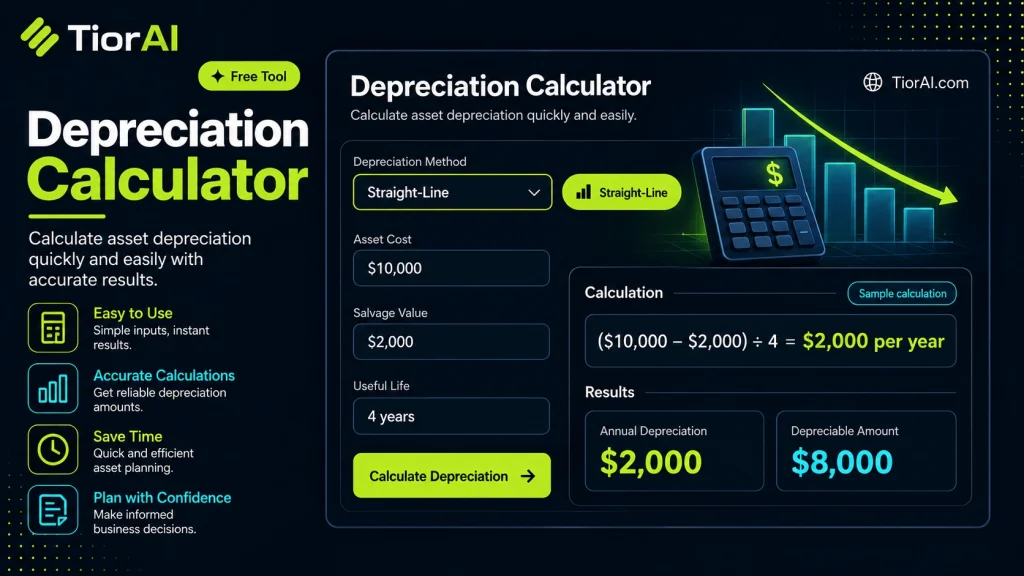
The full purchase price, including delivery and setup.
What the asset is worth at the end of its life. Enter 0 if it will be scrapped.
How many years the asset will be in service. Maximum 100.
Straight-line spreads the cost evenly. The other two front-load it, writing off more in the early years.
How Each Method Works
- Straight-Line
(cost − salvage) ÷ life— the same amount every year. Simplest, and the default for most reporting.- Double Declining Balance
book value × (2 ÷ life)— a fixed rate applied to the shrinking book value, so the write-off is largest in year one and tapers off. Capped so the book value never drops below salvage.- Sum-of-Years-Digits
(cost − salvage) × (years left ÷ sum of years)— accelerated like DDB but on a straight fraction, so it always lands exactly on the salvage value.
Accelerated methods suit assets that lose most of their value early or produce most of their output when new — vehicles, computers, machinery. This is a modelling tool, not tax advice; your jurisdiction may mandate a specific method and life for each asset class.
How to use it
- Enter Your Values Input your numbers or parameters into the Depreciation Calculator. Fill in all required fields for an accurate calculation.
- Calculate Results Click the calculate button to process your inputs. The Depreciation Calculator delivers instant, accurate results.
- Review and Use Review your calculated results, explore the breakdown, and copy or share the output for your needs.
Tip Use the Depreciation Calculator on mobile devices too — it's fully responsive and works perfectly on any screen size.
Understanding Depreciation and Its Calculation
Depreciation is the process of allocating the cost of a tangible asset over its useful life. It reflects how much of an asset’s value has been used up over time. This calculation is essential for businesses to accurately represent asset values on financial statements and to determine tax deductions.
The most common depreciation methods include:
- Straight-Line Depreciation: This method spreads the cost evenly over the asset’s useful life. The formula is
(Cost - Salvage Value) / Useful Life, where: Costis the initial purchase price of the asset.Salvage Valueis the estimated residual value at the end of its useful life.Useful Lifeis the expected duration the asset will be productive.- Declining Balance Method: This accelerates depreciation, applying a fixed rate to the asset’s book value each year.
- Units of Production Method: Depreciation is based on actual usage or output rather than time.
Calculating depreciation accurately matters because it affects profit reporting, tax liabilities, and asset management decisions. For example, a company buying machinery will depreciate it to match expenses with revenues generated by that machinery over time.
In real-world contexts, depreciation calculations are used in accounting, tax preparation, budgeting for asset replacement, and financial analysis.
What is Depreciation?
Depreciation is the accounting process of allocating the cost of a physical asset over its useful life. It helps businesses reflect the declining value of assets like machinery, vehicles, or equipment as they are used over time.
When to Use a Depreciation Calculator
A depreciation calculator is useful in several concrete scenarios:
- Preparing financial statements to show accurate asset values.
- Calculating tax deductions related to asset wear and tear.
- Budgeting for future asset replacement or maintenance costs.
- Evaluating the profitability and cost-effectiveness of fixed asset investments.
Common Mistakes to Avoid
When using a depreciation calculator, avoid these errors:
- Choosing an inappropriate depreciation method for the asset or business context, which can misstate expenses.
- Failing to subtract the salvage value from the asset cost before calculating depreciation, leading to overstated expenses.
Understanding the formulas and assumptions behind depreciation methods ensures accurate financial reporting and better decision-making.
Common use cases
- Straight-Line Depreciation for Office Equipment
- Declining Balance Depreciation for Vehicle
Frequently asked questions
Reviews and questions
Whether this tool gave people the answer they needed, and what they asked about it.
Sign in to review this tool.
Sign In to ReviewNo reviews yet
Be the first to say whether this tool gave you what you needed.
Ask how to read the result, or what the tool does with an edge case — or answer someone else.
Sign In to AskNo questions yet
Not sure how to read a result? Be the first to ask.