

Assemblyai vs Deepgram: Enterprise Features & Compliance
AssemblyAI vs Deepgram for enterprise — compare compliance, SSO, usage limits, API reliability, and custom voice options.
- Category
- Music & Audio
- Format
- Head-to-head
- Updated
- April 27, 2026


How they compare
| Feature |
AssemblyAI
|
Deepgram
|
|---|---|---|
| Made by | AssemblyAI, Inc. | Deepgram, Inc. |
| Category | AI Audio Editing AI Audio Enhancer AI Audio Splitter Music & Audio | AI Speech Recognition Tools AI Speech-to-Text AI Text-to-Speech Voice Generation & Conversion |
| Pricing model | Freemium Pay As You Go Subscription | Free Trial Pay As You Go Subscription |
| Platforms | API Web | API Web |
| Built with | JavaScript Machine Learning Python REST API | Docker Kubernetes Python TensorFlow |
| Languages | English | English French German Mandarin +2 more |
| Based in | United States | United States |
Greyed rows are the same for both tools.
What each one is
AssemblyAI
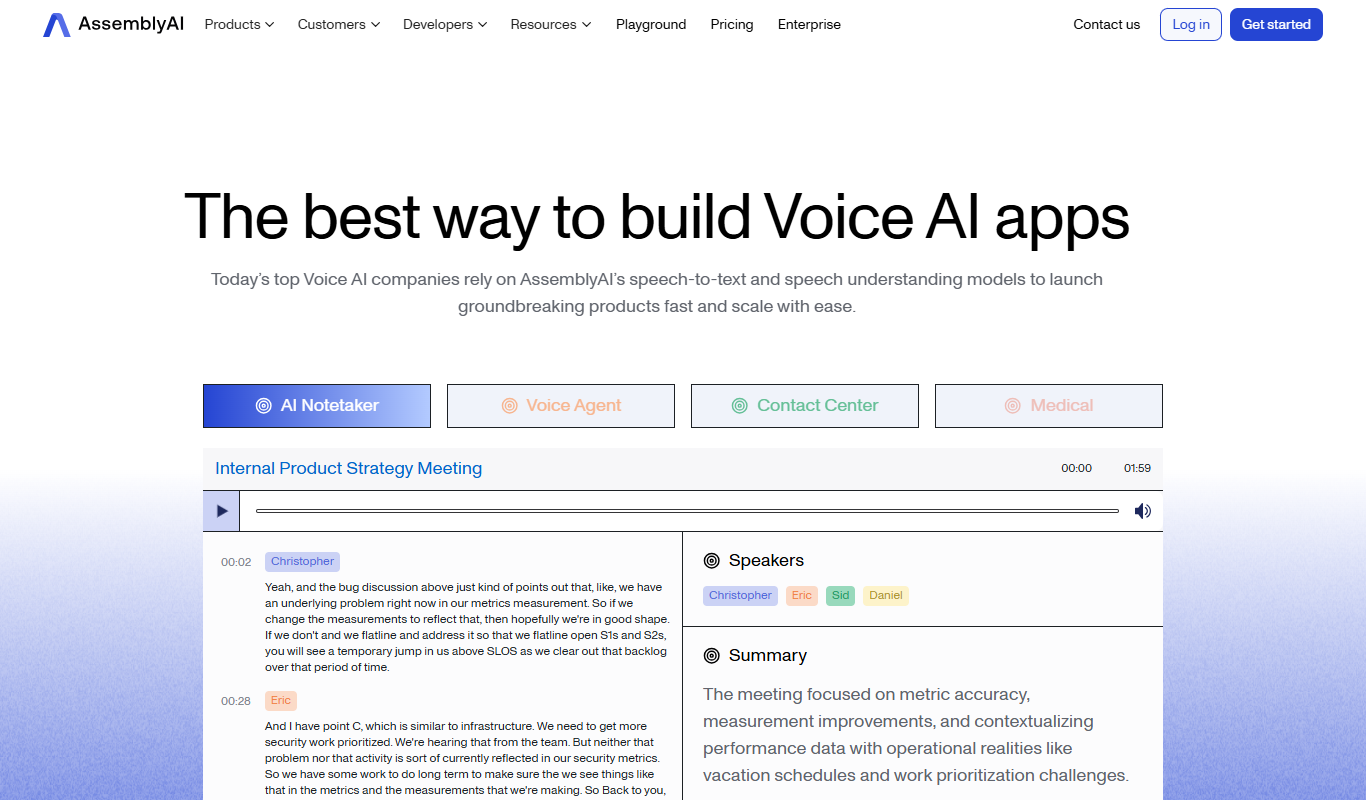
AssemblyAI is a developer-focused AI platform providing advanced speech-to-text transcription and audio intelligence APIs. It leverages deep learning models to convert spoken language into text with high accuracy and speed. Beyond transcription, AssemblyAI offers features like content moderation, topic detection, sentiment analysis, and entity recognition to extract meaningful insights from audio data.
Deepgram
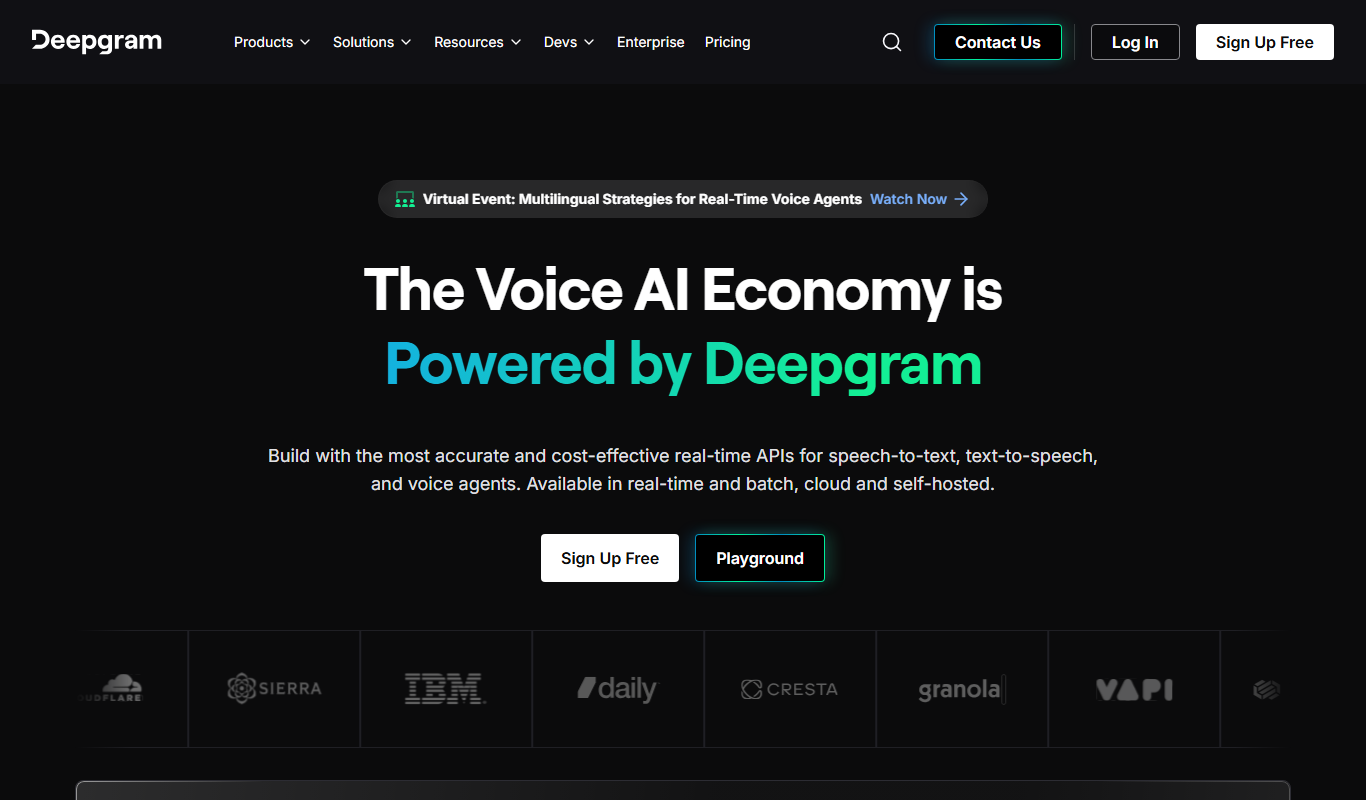
Deepgram is an AI-powered speech recognition platform that converts audio and video into highly accurate text transcriptions. Leveraging deep learning and neural networks, Deepgram offers scalable, customizable speech-to-text solutions designed for enterprises and developers. It supports real-time and batch transcription with advanced noise cancellation and language model adaptation to handle diverse audio environments.
Key features
AssemblyAI
-
High Accuracy Speech Recognition
Utilizes state-of-the-art deep learning models to deliver precise transcriptions even in challenging audio conditions.
-
Content Moderation and Safety
Automatically detects profanity, hate speech, and other sensitive content within audio.
-
Speaker Diarization
Identifies and separates different speakers in multi-person conversations.
-
Topic and Sentiment Detection
Extracts topics discussed and the sentiment expressed in the audio content.
-
Easy API Integration
Simple RESTful API design with comprehensive documentation and SDKs for multiple programming languages.
Deepgram
-
Real-Time and Batch Transcription
Supports live streaming transcription and processing of pre-recorded audio files.
-
Custom Model Training
Allows users to train models with custom vocabularies and acoustic profiles for improved accuracy.
-
Speaker Diarization
Automatically identifies and separates different speakers in multi-person conversations.
-
Noise Robustness
Advanced noise cancellation and filtering for transcription in challenging audio environments.
-
Multi-Language Support
Transcribes audio in multiple languages with high accuracy.
Pricing
Plans as published by each vendor. Check the vendor site before buying — pricing changes.
AssemblyAI
-
Free $0 ($50 free credit)
Includes 5 hours of free transcription per month with access to core features.
-
Pay-as-you-go From $0.65/hr
Flexible pricing based on usage beyond the free tier, suitable for scaling needs.
-
Enterprise Custom pricing
Tailored plans with dedicated support, SLAs, and advanced features for large organizations.
Deepgram
-
Free $0 (200 hrs/year)
Limited usage to test transcription capabilities with access to core features.
-
Growth Pay-as-you-go from $0.0043/min
Pay-as-you-go or subscription plans tailored for businesses with volume discounts.
-
Enterprise Custom pricing
Strengths and trade-offs
AssemblyAI
Strengths
- High transcription accuracy with advanced AI models
- Comprehensive audio analysis features beyond transcription
- Developer-friendly API with clear documentation
- Flexible pricing including a free tier
- Fast processing times suitable for real-time applications
Trade-offs
- Limited language support primarily to English
- No native desktop or mobile apps; API only
- Advanced features may require technical integration effort
Deepgram
Strengths
- High accuracy in noisy environments
- Flexible API with real-time and batch options
- Customizable models for industry-specific needs
- Supports multiple languages
- Scalable for enterprise use
Trade-offs
- Pricing details are not fully transparent without contacting sales
- Limited direct user interface; primarily API-driven
Who it is for
AssemblyAI
- Developers building voice-enabled applications
- Media companies needing automated captioning
- Customer service teams analyzing call center audio
- Content creators requiring transcription services
- Businesses implementing audio content moderation
Deepgram
- Call centers and customer support teams
- Media and content creators
- Enterprise businesses with large audio data
- Developers integrating speech-to-text
- Market researchers and analysts
What people use it for
AssemblyAI
-
Automated Transcription
Convert audio and video files into accurate text transcripts quickly using AI-powered speech recognition.
-
Audio Content Analysis
Extract insights such as sentiment, topics, and content moderation from audio using advanced AI models.
-
Voice Search and Commands
Integrate speech-to-text capabilities into applications for voice-enabled user interfaces and commands.
-
Media Captioning and Subtitling
Generate captions and subtitles for videos automatically to improve accessibility and engagement.
-
Call Center Analytics
Analyze customer service calls for quality assurance, sentiment analysis, and compliance monitoring.
Deepgram
-
Call Center Transcription
Automatically transcribe customer service calls to improve quality assurance and training.
-
Media Captioning
Generate accurate captions and subtitles for videos and podcasts to enhance accessibility.
-
Meeting Notes Automation
Convert meeting audio into searchable text notes for easier documentation and collaboration.
-
Voice Analytics
Analyze speech data for sentiment, keywords, and trends to gain business insights.
-
Real-Time Transcription
Provide live transcription for events, webinars, and broadcasts to engage audiences.
Getting started
AssemblyAI
-
Sign Up and Get API Key
Create an account on AssemblyAI's website and obtain your unique API key for authentication.
-
Upload Audio or Video
Send your audio or video files to AssemblyAI via the API for processing.
-
Request Transcription
Initiate a transcription job through the API, specifying any additional features like speaker labels or content moderation.
-
Receive and Use Results
Retrieve the transcription and analysis results from the API and integrate them into your application or workflow.
Deepgram
-
Sign Up
Create an account on Deepgram's platform to access the dashboard and API keys.
-
Upload Audio or Stream
Submit audio files or stream live audio through the API for transcription.
-
Customize Models
Optionally train custom models with your own vocabulary and acoustic data.
-
Receive Transcripts
Get accurate text transcriptions with timestamps, speaker labels, and confidence scores.
-
Integrate and Analyze
Use the transcriptions in your applications or analytics workflows via API.
Common questions
AssemblyAI supports common audio and video formats including MP3, WAV, MP4, M4A, and more.
Deepgram supports common audio formats including WAV, MP3, FLAC, and more.
Yes, it offers speaker diarization to identify and label different speakers in a conversation.
Yes, Deepgram offers real-time streaming transcription via its API.
There is no strict limit, but very long files may require chunking or batch processing.
Yes, users can train custom models with specific vocabularies and acoustic data.
Currently, AssemblyAI primarily supports English transcription.
Deepgram supports transcription in several languages including English, Spanish, French, German, Mandarin, and Portuguese.
More comparisons with these tools
-

Resemble AI vs Deepgram: Voice Cloning, API Access & Pricing
Compare Resemble AI and Deepgram on voice cloning quality, API features, response latency, pricing tiers, and enterprise support.
- Resemble AI: $29/month Starts at Deepgram: Pay-as-you-go from $0.0043/min
- Resemble AI: 2 Platforms Deepgram: 2
-
Assemblyai Free vs Paid: Free vs Paid Compared
Compare the free and paid tiers of AssemblyAI Free and Paid — features, usage limits, and which plan is worth paying for.
-

Assemblyai vs otter.ai: Best for Content Creators & Developers?
AssemblyAI or Otter.ai? Compare voice quality, API access, cloning speed, and pricing for creators and developers.
- AssemblyAI: From $0.65/hr Starts at Otter.ai: $16.99/month
- AssemblyAI: 2 Platforms Otter.ai: 3
-
Assemblyai vs Aws Transcribe: Pricing, Languages & Studio Features
AssemblyAI vs Aws Transcribe — compare pricing plans, supported languages, studio editing tools, and which fits your workflow.
-
Assemblyai vs Google Stt: Which Sounds More Human?
We tested AssemblyAI and Google Stt on voice realism, emotional range, cloning accuracy, and pricing — here's which sounds more natural.
-
Assemblyai vs Whisper AI: Voice Quality, Cloning & Pricing Compared
AssemblyAI vs Whisper AI — compare voice naturalness, cloning speed, language support, and pricing to find the best AI voice tool.
- AssemblyAI: From $0.65/hr Starts at Whisper AI: $0.006/minute
- AssemblyAI: 2 Platforms Whisper AI: 3