

Scout AI Agents Around Your Rules and Systems
Scout builds AI agents that encode your rules, connect to your systems and run the process accurately every time, with a full audit trail.
- Best for
- Operational review
- Key capability
- Rule-based agents
Save Scout, follow its updates and vote on it — everything stays in your account.
Sign in or create a free account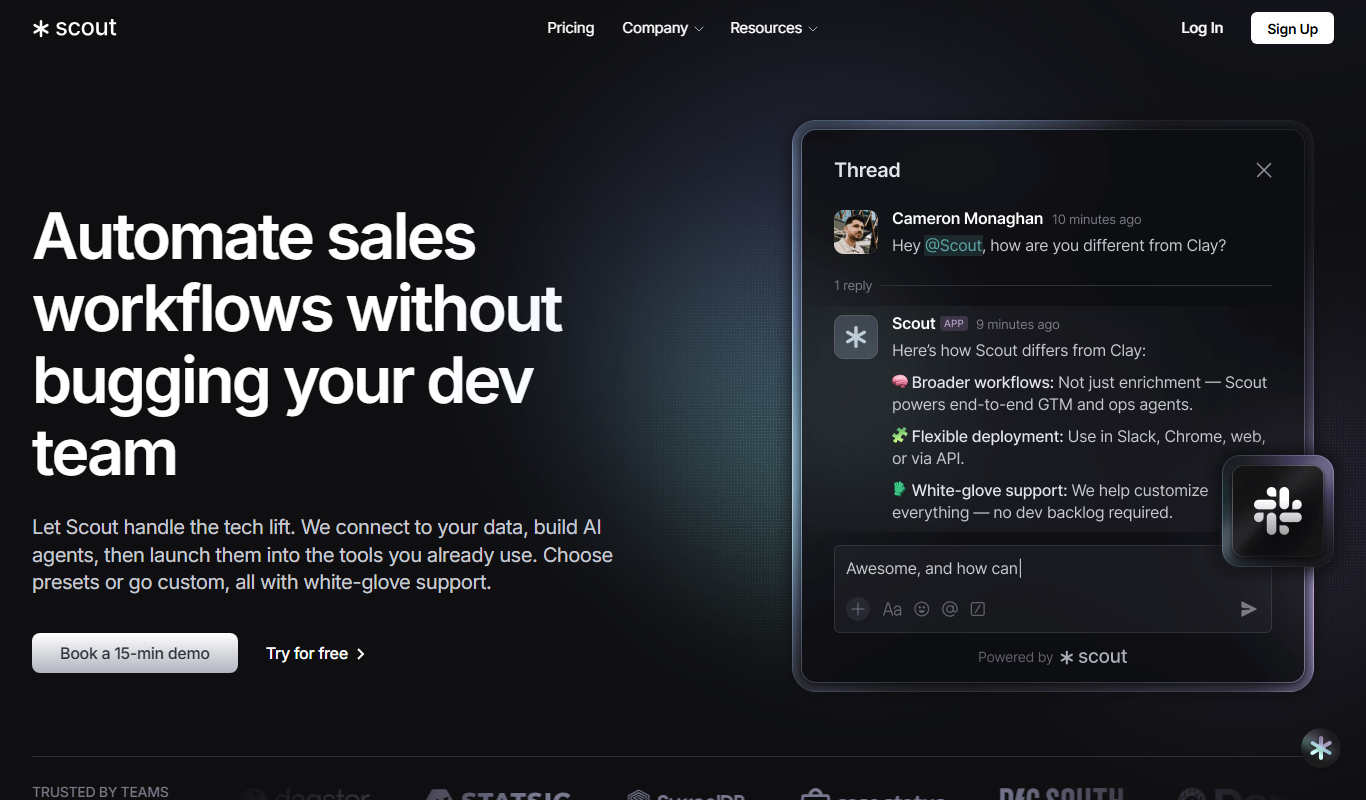
What is Scout?
Scout is a platform for building AI agents that encode a company’s rules, connect to its systems and run a process the same way every time, with a full audit trail. Teams start from a pre-built template or describe the process, and Scout builds the agent around their rules.
Key features of Scout
Scout builds agents from templates or plain descriptions, connects them to systems of record, runs them with user permissions, human approval and a full audit log, and deploys them in Slack, a CRM, a website embed or via API.
Rule-based agents
Agents encode your rules and run the process accurately every time.
Integrations with systems of record
Connect document repositories, databases, CRM, SharePoint and more, with data staying in your environment.
Permissions and human approval
Agents act with each user's own permissions and can start with human approval on every decision.
Full audit trail
The History tab shows every conversation, decision and tool used.
Choice of models
Choose models from OpenAI, Anthropic or Google, or let Dynamic Mode select one for each task.
Pros and cons of Scout
Pros
- Agents follow your specific rules with a full audit trail
- Data stays in your environment
- Human approval and user-level permissions
- Hands-on help to scope, connect and maintain agents
Cons
- Plans are customized and start with a demo
- The Starter plan has tight usage limits
Key use cases for Scout
Operational review
Apply verification rules to every item and flag exceptions for human review.
Compliance and audit prep
Check every record against your compliance requirements.
RFPs and security questionnaires
Complete vendor questionnaires and RFPs from your existing documentation.
Document and data processing
Classify, extract, route and flag high-volume document intake.
How Scout works
- 1
Describe the process
Choose a pre-built template or describe what you need.
- 2
Connect your systems
Integrate the systems of record the agent needs.
- 3
Test in a sandbox
Chat with your agent in sandbox mode before going live.
- 4
Deploy with controls
Start with human approval on every decision; agents earn autonomy once accuracy is validated.
Who is using Scout
Scout pricing
Starter
Book a demo
1 seat, 200 agent messages, 3 active workflows, 50 workflow runs, 1GB of storage and 2 integrations, with community support.
Scale
Custom pricing
Unlimited seats, custom limits and dedicated support with SLA; Solutions Engineers can build custom agents and workflows.
Plans and prices are as published by the vendor and can change. Check the official site before you buy. Open the pricing page (opens in a new tab)
Frequently asked questions about Scout
A platform that builds AI agents that encode your rules, connect to your systems and run the process accurately every time.
In Slack via @mentions, embedded in your CRM, through a website embed or via API.
Agents act with each user’s own permissions, can start with human approval on every decision and keep a full audit log.
Models from OpenAI, Anthropic or Google, or Dynamic Mode, which selects a model for each task.
Plans are customized for every workspace: Starter is set up through a demo, and Scale has custom limits and pricing.
Conclusion
Teams bring Scout a process whose rules are already written down, and it builds an agent that applies those rules inside their own systems with a full audit trail. Agents connect to systems of record such as document repositories, databases, CRM and SharePoint, and the data stays in the customer’s environment. Typical jobs include review against verification rules, compliance checks on every record, RFP and security questionnaires, and rule-based document intake.
Each agent acts with the user’s own permissions, can start with human approval on every decision and keeps a full audit log. Agents run in Slack, inside a CRM, through a website embed or via API, using models from OpenAI, Anthropic or Google. Plans are customized per workspace and start with a demo, from a Starter tier with usage limits to a Scale tier with custom limits and dedicated support.
Sources
Sign in to review this tool.
Sign In to ReviewNo reviews yet
Be the first to share how this tool worked for you.
Ask about pricing, limits, or how it compares — or answer someone else.
Sign In to AskNo questions yet
Have a question about using or paying for this tool? Be the first to ask.
Featured on TiorAI



Alternative Tools
Explore similar AI tools that might fit your needs

Terraform
Terraform is an infrastructure as code tool from HashiCorp that automates provisioning and managing cloud infrastructure using declarative configuration files.

Pulumi
Pulumi is an infrastructure as code platform that allows developers to define and manage cloud infrastructure using general-purpose programming languages, supporting multi-cloud environments and integrating with DevOps workflows.

Ansible
Ansible is an open-source IT automation tool that uses simple YAML playbooks to automate configuration management, application deployment, and orchestration without requiring agents on managed nodes.