

From my experience with ScaleArc, I found it excels at providing seamless database load balancing and failover without requiring any changes to existing applications. Its proxy-based architecture simplifies scaling and improves availability for enterprise databases. After spending time with the platform, I can say it’s particularly well-suited for database administrators and DevOps teams managing mission-critical relational databases in hybrid or cloud environments. However, the lack of publicly available pricing and the deployment complexity may require careful planning. Overall, if you need to enhance database performance and uptime transparently, ScaleArc delivers solid, enterprise-grade capabilities.
ScaleArc Database Load Balancer for High Availability and Performance
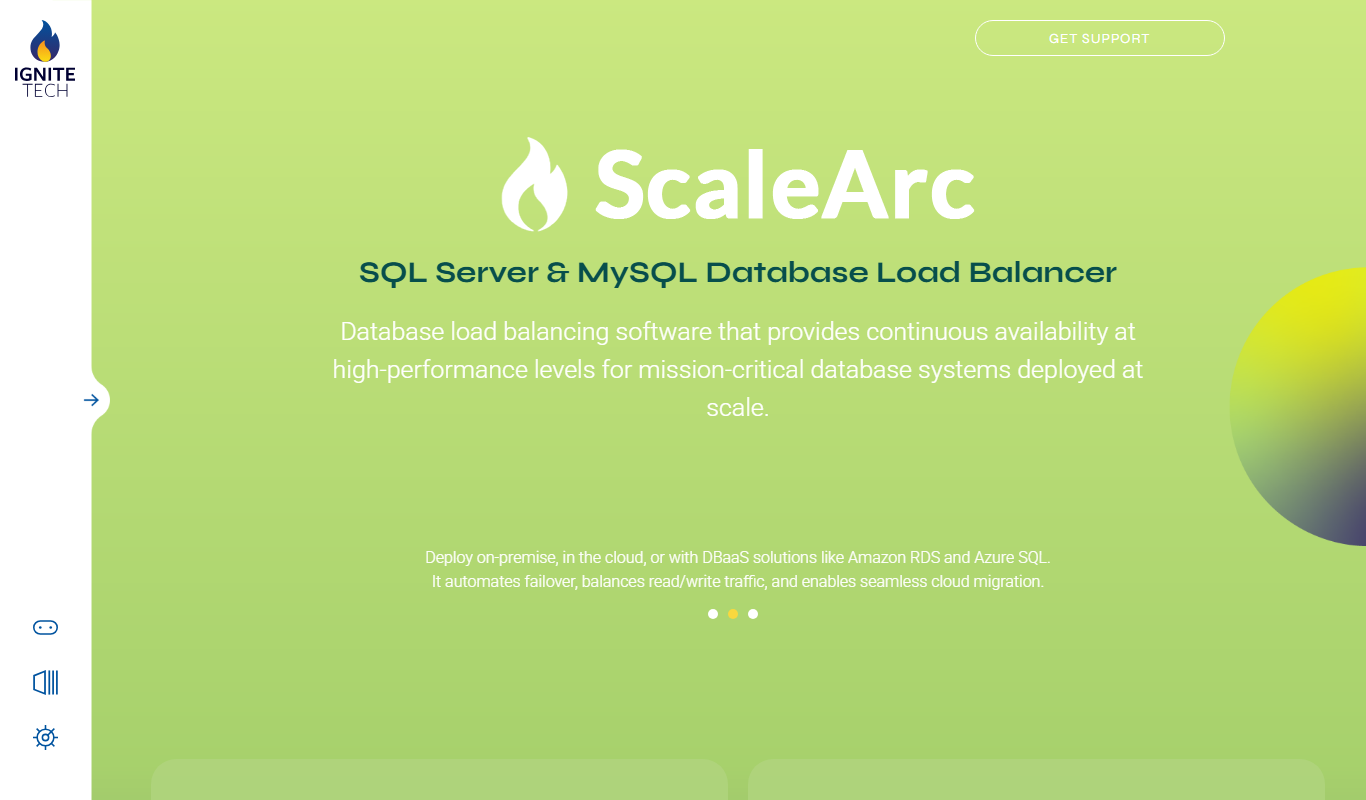
ScaleArc is a database load balancing and caching solution that enhances database performance, scalability, and availability by intelligently routing SQL queries and providing automatic failover.
- Best for
- Database Load Balancing
- Key capability
- Real-Time Load Balancing
Do you recommend this tool?
What is ScaleArc?
ScaleArc is an intelligent database load balancing and caching platform designed to improve database performance, scalability, and availability. It acts as a proxy layer between applications and databases, distributing queries efficiently across multiple database instances while providing failover capabilities and query optimization. ScaleArc supports various relational databases and helps enterprises manage database traffic without modifying application code.
Key features of ScaleArc
ScaleArc offers real-time database load balancing, automatic failover, query caching, SQL query rewriting, and analytics to monitor database performance. It supports multi-cloud and hybrid environments, enabling seamless scaling and high availability for mission-critical applications.
Real-Time Load Balancing
Distributes SQL queries dynamically to balance load and maximize resource utilization.
Automatic Failover
Detects database failures and reroutes traffic to healthy nodes without downtime.
Query Caching
Caches frequent query results to reduce database load and improve response times.
SQL Query Rewriting
Optimizes and rewrites queries on the fly to enhance performance.
Comprehensive Analytics
Provides detailed insights into query patterns, latency, and database health.
Pros and cons of ScaleArc
Pros
- Improves database performance without application changes
- Supports multiple database platforms
- Enhances high availability with automatic failover
- Provides real-time analytics and monitoring
- Enables horizontal scaling of databases
Cons
- Pricing details are not publicly available
- Requires deployment and configuration effort
- Primarily focused on relational databases
Key use cases for ScaleArc
Database Load Balancing
Distributes database queries across multiple database servers to improve performance and availability.
High Availability
Ensures continuous database uptime by automatically redirecting traffic during server failures.
Database Scalability
Enables horizontal scaling of databases without application changes.
SQL Query Optimization
Analyzes and optimizes SQL queries to reduce latency and improve throughput.
Database Security
Provides features like query filtering and masking to enhance database security.
How ScaleArc works
- 1
Deploy Proxy Layer
Install ScaleArc as a proxy between your application and database servers.
- 2
Configure Database Instances
Add your database servers to ScaleArc for load balancing and failover.
- 3
Route Queries
ScaleArc intercepts and intelligently routes SQL queries to the optimal database instance.
- 4
Monitor and Optimize
Use ScaleArc’s analytics dashboard to monitor traffic and optimize query performance.
Who is using ScaleArc
Database administrators
DevOps teams
Enterprise IT departments
Software architects
Cloud infrastructure teams
ScaleArc pricing
Custom
Contact Sales
Tailored pricing based on deployment size and requirements.
Plans and prices are as published by the vendor and can change. Check the official site before you buy. Open the pricing page (opens in a new tab)
Frequently asked questions about ScaleArc
ScaleArc supports major relational databases including MySQL, Microsoft SQL Server, and Oracle.
No, ScaleArc operates transparently as a proxy, requiring no changes to existing applications.
Yes, ScaleArc supports on-premises, cloud, and hybrid deployments.
By automatically detecting failures and rerouting traffic to healthy database nodes, ScaleArc ensures continuous availability.
This tool is designed to help users accomplish its core tasks more efficiently. It is typically used by individuals or teams looking to improve productivity and workflow.
Yes, it can help with that use case depending on how you configure it and what features are available. You’ll get the best results with clear inputs and a defined goal.
Data handling and security practices vary by provider. Review the official privacy policy to understand how your data is stored and used.
Sign in to review this tool.
Sign In to ReviewNo reviews yet
Be the first to share how this tool worked for you.
Ask about pricing, limits, or how it compares — or answer someone else.
Sign In to AskNo questions yet
Have a question about using or paying for this tool? Be the first to ask.
Featured on TiorAI



More AI DevOps Assistant tools
Other tools in the same category, for when this one is not quite the fit.

Enterprise
CockroachDB
CockroachDB is a distributed SQL database designed for cloud-native applications that require strong consistency, high availability, and horizontal scalability across multiple regions.

Free Trial
Acronis Cyber Backup
Acronis Cyber Backup is a data protection platform offering automated backups, AI-based ransomware protection, and disaster recovery for physical, virtual, and cloud environments.

Pay As You Go
CloudWatch
AWS CloudWatch is a monitoring and observability service that collects metrics and logs from AWS resources and applications, enabling real-time monitoring, alerting, and operational insights.

Free
Octopus Deploy
Octopus Deploy is a DevOps automation tool that simplifies continuous delivery by automating application deployments, managing releases, and integrating with CI/CD pipelines.

Free
ServerPilot
ServerPilot is a cloud server management platform that automates the setup and management of web servers for PHP applications, simplifying deployment and security for developers and businesses.

Enterprise
ScriptRunner
ScriptRunner is an automation platform that centralizes management, security, and execution of PowerShell scripts to streamline IT workflows and enable self-service automation.

Free
Dependabot
Dependabot is a GitHub-integrated tool that automates dependency updates and security vulnerability detection by creating pull requests to keep projects secure and current.

Free
Heroku
Heroku is a cloud platform as a service (PaaS) that enables developers to deploy, manage, and scale applications easily without managing infrastructure.