

From my experience with md.ai, I found it excels at providing specialized annotation tools tailored for medical imaging, which is crucial for creating high-quality datasets for AI training. The platform’s collaborative features make it easy for multidisciplinary teams to work together remotely, improving annotation accuracy and efficiency. However, the platform is primarily web-based and currently supports only English, which might limit accessibility for some users. Overall, if you are involved in healthcare AI research or medical image labeling, md.ai offers a robust and user-friendly solution to accelerate your projects.
md.ai Medical Image Annotation Platform for AI Training and Research
md.ai is a cloud platform designed for annotating medical images to create labeled datasets that improve AI model training in healthcare.
- Best for
- Medical Image Annotation
- Key capability
- Multi-Modality Support

Do you recommend this tool?
What is md.ai?
md.ai is a cloud-based medical image annotation platform designed to streamline the creation of labeled datasets for artificial intelligence applications in healthcare. It supports a wide range of medical imaging modalities and provides tools for precise annotation, collaboration, and quality control, helping researchers and clinicians accelerate AI model development.
Key features of md.ai
md.ai offers advanced annotation tools tailored for medical images, collaborative project management, multi-user workflows with role-based permissions, integration with AI training pipelines, and support for exporting datasets in multiple formats. Its interface is optimized for radiology and other medical imaging specialties.
Multi-Modality Support
Supports annotation of X-rays, CT, MRI, ultrasound, and other medical imaging types.
Collaborative Annotation
Enables multiple users to work together with role-based access and review workflows.
Advanced Annotation Tools
Includes polygon, bounding box, point, and freehand drawing tools optimized for medical images.
Integration with AI Pipelines
Exports data in formats ready for machine learning frameworks like TensorFlow and PyTorch.
Cloud-Based Platform
Accessible from anywhere with secure data storage and compliance with healthcare data standards.
Pros and cons of md.ai
Pros
- Specialized tools for medical image annotation
- Supports collaboration among multidisciplinary teams
- Cloud-based with easy access and data management
- Flexible export options for AI training
- Free tier available for individual users
Cons
- Limited language support (English only)
- Pricing details for enterprise plans require direct contact
- Primarily web-based, no dedicated mobile apps
Key use cases for md.ai
Medical Image Annotation
Annotate medical images such as X-rays, CT scans, and MRIs to create high-quality labeled datasets for AI model training.
AI Model Training Support
Provide accurate and standardized annotations to improve the performance of machine learning models in medical imaging.
Collaborative Research
Enable teams of radiologists, data scientists, and researchers to collaborate on image labeling projects remotely.
Quality Control and Review
Facilitate multi-level review workflows to ensure annotation accuracy and consistency across datasets.
Dataset Management
Organize, manage, and export annotated datasets in various formats compatible with AI frameworks.
How md.ai works
- 1
Create an Account
Sign up on the md.ai platform to start managing annotation projects.
- 2
Upload Medical Images
Import medical imaging data such as DICOM files into the platform.
- 3
Annotate Images
Use specialized tools to label regions of interest, segment structures, and add metadata.
- 4
Collaborate and Review
Invite team members to review annotations, provide feedback, and ensure quality.
- 5
Export Labeled Data
Download annotated datasets in formats compatible with AI frameworks for model training.
Who is using md.ai
Radiologists and medical imaging specialists
Healthcare AI researchers and data scientists
Medical institutions and hospitals
AI startups focused on healthcare
Academic research groups in medical imaging
md.ai pricing
Free
$0/month
Basic access with limited projects and annotation tools for individual users.
Enterprise
Custom pricing
Advanced features, unlimited projects, dedicated support, and compliance options for organizations.
Plans and prices are as published by the vendor and can change. Check the official site before you buy. Open the pricing page (opens in a new tab)
Frequently asked questions about md.ai
md.ai supports a variety of medical imaging modalities including X-rays, CT scans, MRIs, ultrasound, and more.
Yes, md.ai allows collaborative annotation with role-based permissions and review workflows.
md.ai provides secure data handling and offers enterprise options that comply with healthcare regulations.
Annotated data can be exported in multiple formats compatible with popular AI frameworks for seamless integration.
Yes, it can help with that use case depending on how you configure it and what features are available. You’ll get the best results with clear inputs and a defined goal.
This tool is designed to help users accomplish its core tasks more efficiently. It is typically used by individuals or teams looking to improve productivity and workflow.
It depends on your specific needs and how you plan to use the tool. The official website and documentation are the best sources for the latest details.
Sign in to review this tool.
Sign In to ReviewNo reviews yet
Be the first to share how this tool worked for you.
Ask about pricing, limits, or how it compares — or answer someone else.
Sign In to AskNo questions yet
Have a question about using or paying for this tool? Be the first to ask.
Featured on TiorAI



Alternative Tools
Explore similar AI tools that might fit your needs

Freemium
V7 Darwin
V7 Darwin is an AI platform that automates video annotation and labeling to accelerate computer vision model training with integrated collaboration and API access.
More AI Artificial Intelligence Tools tools
Other tools in the same category, for when this one is not quite the fit.
Freemium
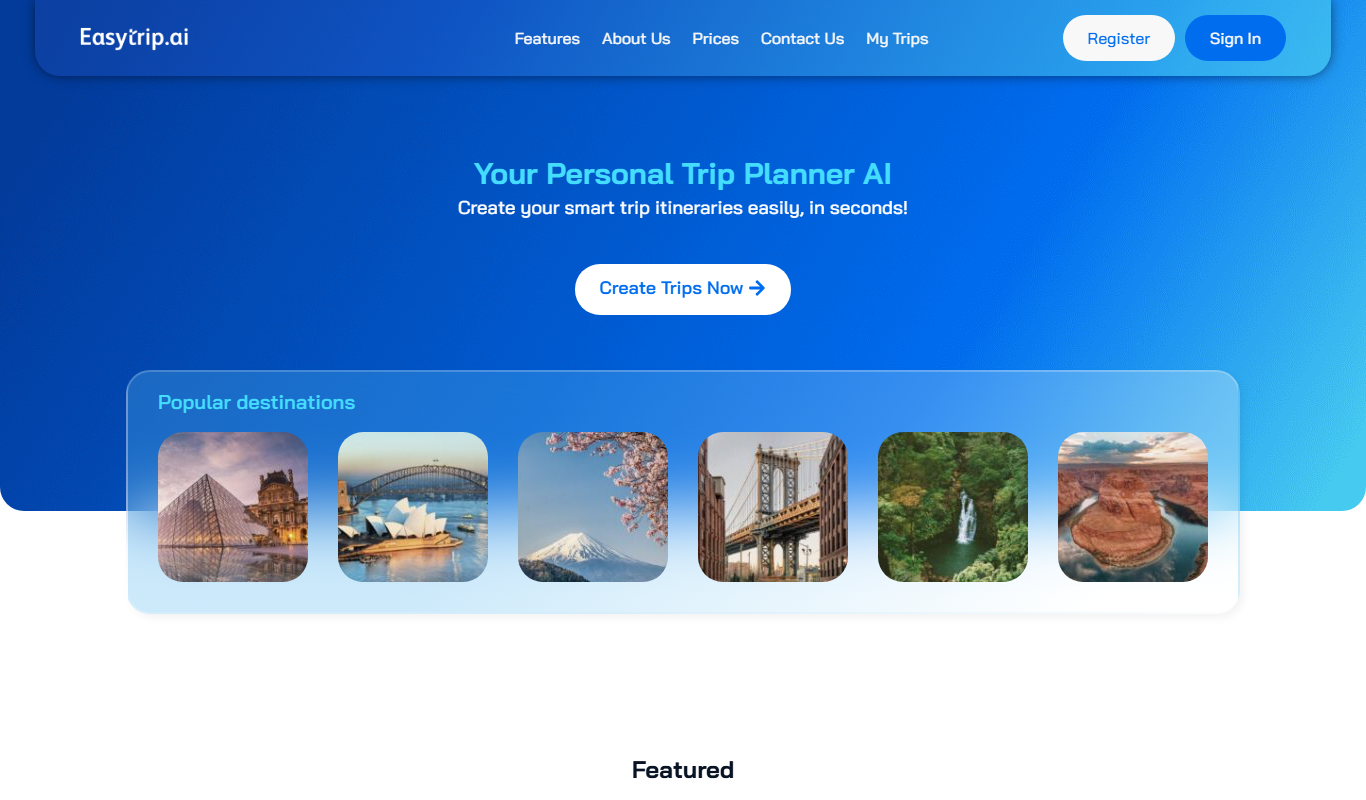
EasyTrip AI
EasyTrip AI is an AI-driven travel planner that generates customized trip itineraries based on your travel dates, destinations, and preferences, helping you organize your trip efficiently.

Freemium
Travel Itinerary AI
Travel Itinerary AI is an AI-powered web tool that creates personalized travel itineraries based on your preferences, helping you plan and manage trips efficiently.

Free
NilgAI Travel
NilgAI Travel is an AI-driven travel planning tool that creates personalized itineraries based on your preferences, travel dates, and budget, helping you efficiently plan trips worldwide.

Custom Pricing
sentiance.com
Sentiance is an AI-powered platform that transforms sensor and contextual data into actionable behavioral insights, enabling businesses to understand user behavior and deliver personalized experiences in real-time.

Contact for pricing
ODESIS
ODESIS is an AI-driven analytics platform that helps businesses transform data into actionable insights through machine learning, visualization, and predictive analytics.

Contact for pricing
QUINETICS
Quinetics is an AI platform that provides businesses with advanced data analytics, workflow automation, and custom machine learning model development to optimize operations and decision-making.

Free
aigclist
AIGCList is a free online directory that aggregates and categorizes AI tools, providing detailed information, user reviews, and AI industry news to help users discover and compare AI solutions.

Free
AI Tool Center
AI Tool Center is a free online directory that helps users discover, compare, and review AI tools across various categories and industries.