

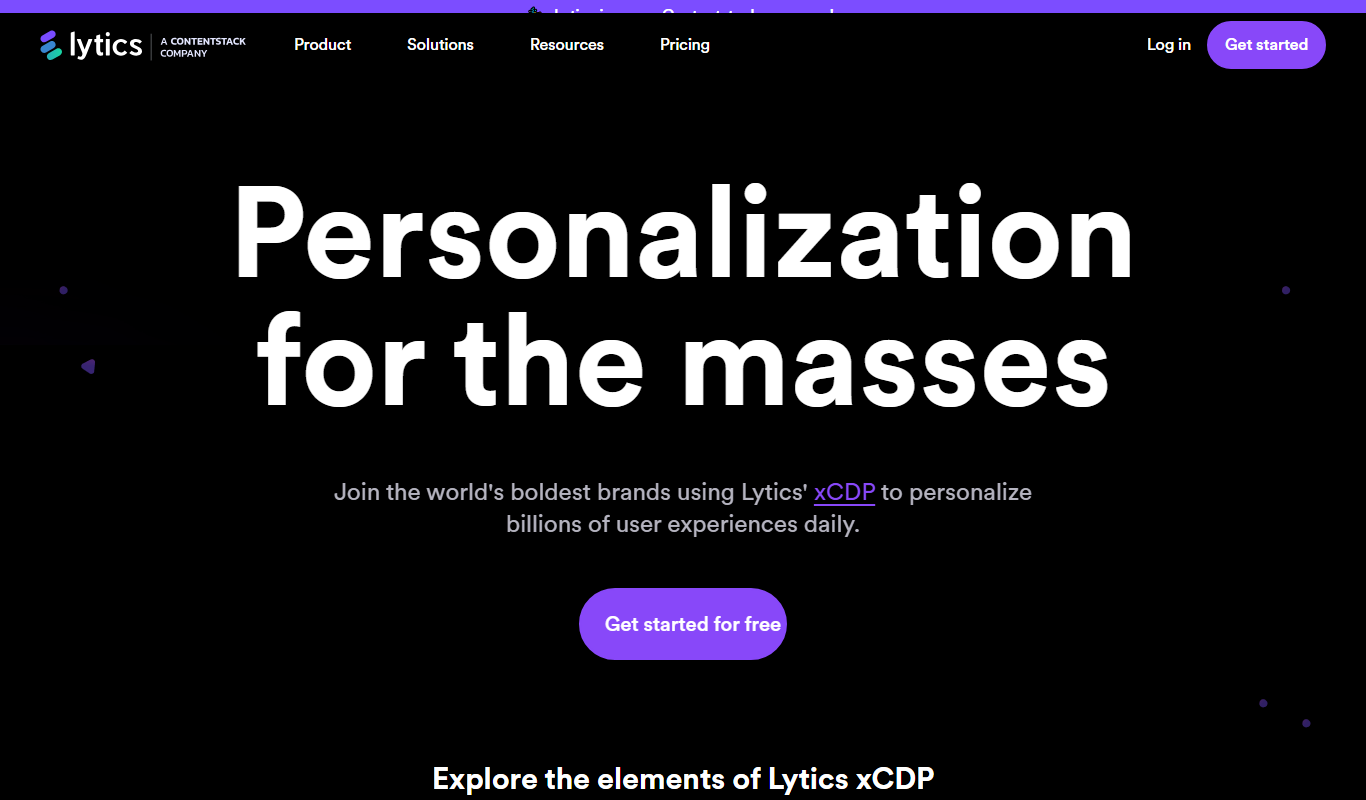
From my experience with Lytics Customer Data Platform, I found it excels at unifying diverse customer data sources into actionable profiles, which is crucial for precise audience segmentation and personalized marketing. The platform’s predictive analytics capabilities provide valuable foresight into customer behavior, helping optimize campaigns effectively. However, the custom pricing and complexity might be a barrier for smaller businesses or less technical users. Overall, if your organization requires advanced data unification and machine learning-driven marketing insights, Lytics delivers a robust and scalable solution.
Lytics Customer Data Platform for Advanced Audience Segmentation & Analytics
Lytics Customer Data Platform unifies customer data from multiple sources to create detailed profiles, enabling marketers to segment audiences precisely, deliver personalized campaigns, and leverage predictive analytics for improved marketing outcomes.
- Best for
- Audience Segmentation
- Key capability
- Unified Customer Profiles
Do you recommend this tool?
What is Lytics Customer Data Platform (CDP)?
Lytics Customer Data Platform (CDP) is a cloud-based solution designed to unify customer data from various sources, enabling marketers to build comprehensive customer profiles. It empowers businesses to segment audiences precisely, personalize marketing efforts, and orchestrate customer journeys with data-driven insights. Lytics integrates behavioral, transactional, and demographic data to provide a single source of truth for customer intelligence.
Key features of Lytics Customer Data Platform (CDP)
Lytics offers advanced audience segmentation, real-time data unification, predictive analytics powered by machine learning, and seamless integrations with marketing channels. Its platform enables marketers to automate personalized campaigns and optimize customer engagement through actionable insights.
Unified Customer Profiles
Combine data from multiple sources to create comprehensive, real-time customer profiles.
Behavioral Segmentation
Segment customers based on actions, preferences, and engagement patterns.
Predictive Modeling
Apply machine learning to forecast customer lifetime value, churn risk, and conversion likelihood.
Omnichannel Activation
Integrate with email, advertising, social media, and other platforms to deliver personalized experiences.
Real-Time Data Processing
Process and update customer data instantly to enable timely marketing interventions.
Pros and cons of Lytics Customer Data Platform (CDP)
Pros
- Robust data unification from multiple sources
- Advanced machine learning for predictive insights
- Strong omnichannel marketing integrations
- Real-time data processing capabilities
Cons
- Pricing is custom and may be expensive for small businesses
- Steeper learning curve for non-technical users
- Limited language support beyond English
Key use cases for Lytics Customer Data Platform (CDP)
Audience Segmentation
Create detailed customer segments based on behavior, demographics, and engagement data to target marketing campaigns effectively.
Personalized Marketing
Deliver personalized content and offers across channels by leveraging unified customer profiles.
Customer Journey Orchestration
Map and automate customer journeys to optimize engagement and conversion rates.
Data Unification
Aggregate customer data from multiple sources into a single, actionable profile.
Predictive Analytics
Use machine learning models to predict customer behavior and improve marketing ROI.
How Lytics Customer Data Platform (CDP) works
- 1
Data Integration
Connect and ingest customer data from multiple sources such as websites, CRM, email platforms, and mobile apps.
- 2
Profile Unification
Aggregate and unify disparate data points into a single customer profile for a holistic view.
- 3
Audience Segmentation
Use behavioral and demographic data to create dynamic customer segments tailored to marketing goals.
- 4
Activation
Push segmented audiences to marketing channels for personalized campaign delivery.
- 5
Analytics & Optimization
Leverage machine learning insights to predict customer behavior and refine marketing strategies.
Who is using Lytics Customer Data Platform (CDP)
Marketing teams in mid-market and enterprise companies
Data analysts focused on customer insights
Customer experience managers
Digital marketing agencies
E-commerce businesses
Lytics Customer Data Platform (CDP) pricing
Custom Enterprise
Contact Sales
Tailored pricing based on data volume, integrations, and feature requirements.
Plans and prices are as published by the vendor and can change. Check the official site before you buy. Open the pricing page (opens in a new tab)
Frequently asked questions about Lytics Customer Data Platform (CDP)
Lytics can integrate data from websites, mobile apps, CRM systems, email platforms, advertising networks, and more.
Yes, Lytics processes data in real-time to keep customer profiles and segments up to date.
Lytics primarily targets mid-market to enterprise organizations due to its advanced features and custom pricing.
Yes, by enabling precise audience targeting and predictive analytics, Lytics helps optimize marketing spend and results.
This tool is designed to help users accomplish its core tasks more efficiently. It is typically used by individuals or teams looking to improve productivity and workflow.
Data handling and security practices vary by provider. Review the official privacy policy to understand how your data is stored and used.
Integration support depends on the tool and its available connectors or API. Check the official documentation or integrations page to confirm what is supported.
Pricing depends on the plan and included features. For the most accurate and up-to-date details, check the official pricing page.
Sign in to review this tool.
Sign In to ReviewNo reviews yet
Be the first to share how this tool worked for you.
Ask about pricing, limits, or how it compares — or answer someone else.
Sign In to AskNo questions yet
Have a question about using or paying for this tool? Be the first to ask.
Featured on TiorAI



More AI Automation & Workflow Tools tools
Other tools in the same category, for when this one is not quite the fit.
Free Trial
Journeai
Journeai is an AI-powered software that automatically maps customer journeys across multiple marketing channels, providing real-time analytics and insights to optimize marketing strategies.
Freemium
Meoweler
Meoweler is an AI chatbot platform that helps businesses automate customer support and engagement through no-code chatbot creation and natural language processing.

Free
Momo
Momo is an AI-powered assistant that automates workflows, manages tasks, and enhances team collaboration by integrating with popular productivity tools.

Contact for pricing
QUINETICS
Quinetics is an AI platform that provides businesses with advanced data analytics, workflow automation, and custom machine learning model development to optimize operations and decision-making.
Free Trial
RobotaLife
RobotaLife is an AI chatbot platform that enables businesses to automate customer interactions, generate leads, and improve support efficiency through customizable conversational agents.
Freemium
Ai & Stuff
Ai & Stuff is a web platform providing multiple AI-powered tools for generating text and images, automating content tasks, and assisting creative workflows.

Freemium
Saleswise | AI Tools for Real Estate Agents
Saleswise is an AI-driven sales assistant platform designed for real estate agents to automate lead qualification, follow-ups, and pipeline management, improving sales efficiency.

Free
ChatGBT
ChatGBT is an AI chatbot platform that helps businesses automate customer support and engagement through customizable chatbots integrated on websites.