

From my experience with Luigi, I found it excels at managing complex batch workflows with clear task dependencies using Python. Its open-source nature and web UI make it accessible for developers who want to automate ETL and data pipelines without heavy overhead. However, it requires familiarity with Python programming and is not designed for real-time streaming data scenarios, which can be a limitation for some use cases. Overall, if you need a reliable, extensible tool for orchestrating batch jobs and visualizing workflows, Luigi delivers solid results.
Luigi Workflow Manager for Python: Open-Source Data Pipeline Automation Tool
Luigi is an open-source Python package developed by Spotify that automates complex batch workflows by managing task dependencies, scheduling, and monitoring through a web interface.
- Best for
- Data Pipeline Orchestration
- Key capability
- Task Dependency Management

Do you recommend this tool?
What is Luigi?
Luigi is an open-source Python package developed by Spotify for building complex pipelines of batch jobs. It handles dependency resolution, workflow management, and visualization, enabling developers to automate and monitor long-running data pipelines efficiently.
Key features of Luigi
Luigi provides a Python framework to define tasks and their dependencies, a scheduler to manage execution order, and a web interface to visualize pipeline status. It supports retry mechanisms, failure notifications, and extensibility for custom workflows.
Task Dependency Management
Automatically resolves and schedules tasks based on defined dependencies.
Centralized Scheduler
Coordinates task execution and retries failed tasks to ensure pipeline reliability.
Web Interface
Provides visualization of task graphs and real-time monitoring of pipeline status.
Extensible Task Definitions
Allows custom Python code for defining complex workflows and integrations.
Failure Handling
Supports retry policies and notifications for failed tasks.
Pros and cons of Luigi
Pros
- Open-source and free with active community
- Flexible Python-based task definitions
- Robust dependency and failure management
- Web UI for easy monitoring and visualization
- Scalable for complex batch workflows
Cons
- Requires Python programming skills
- Not designed for real-time streaming workflows
- Limited built-in integrations compared to some commercial tools
Key use cases for Luigi
Data Pipeline Orchestration
Design and manage complex data workflows with dependencies and scheduling.
Batch Processing Automation
Automate batch jobs and ensure reliable execution with retry and failure handling.
ETL Workflow Management
Coordinate Extract, Transform, Load processes across multiple systems and data sources.
Task Dependency Tracking
Track task completion status and manage dependencies between tasks in workflows.
Pipeline Visualization
Visualize workflow graphs and monitor progress through a web-based UI.
How Luigi works
- 1
Define Tasks
Write Python classes representing individual tasks with input, output, and run logic.
- 2
Set Dependencies
Specify task dependencies so Luigi knows the order of execution.
- 3
Run Scheduler
Start Luigi’s central scheduler to manage task execution and monitor progress.
- 4
Monitor Pipelines
Use the web UI to track running tasks, visualize dependencies, and check logs.
Who is using Luigi
Data engineers
Python developers
Data scientists managing batch workflows
DevOps teams automating ETL pipelines
Organizations needing reliable workflow orchestration
Luigi pricing
Free
$0
Open-source and free to use with community support.
Plans and prices are as published by the vendor and can change. Check the official site before you buy. Open the pricing page (opens in a new tab)
Frequently asked questions about Luigi
Yes, Luigi is an open-source project released under the Apache License 2.0.
Luigi is built using Python and requires Python knowledge to define workflows.
Yes, Luigi supports retrying failed tasks and can notify users of failures.
Yes, it includes a web UI to visualize workflows and monitor task status.
This tool is designed to help users accomplish its core tasks more efficiently. It is typically used by individuals or teams looking to improve productivity and workflow.
It depends on your specific needs and how you plan to use the tool. The official website and documentation are the best sources for the latest details.
Data handling and security practices vary by provider. Review the official privacy policy to understand how your data is stored and used.
It depends on your specific needs and how you plan to use the tool. The official website and documentation are the best sources for the latest details.
Sign in to review this tool.
Sign In to ReviewNo reviews yet
Be the first to share how this tool worked for you.
Ask about pricing, limits, or how it compares — or answer someone else.
Sign In to AskNo questions yet
Have a question about using or paying for this tool? Be the first to ask.
Featured on TiorAI



Alternative Tools
Explore similar AI tools that might fit your needs

Enterprise
Prefect
Prefect is a Python-native workflow orchestration tool that helps data teams automate, monitor, and manage complex data pipelines with hybrid execution and robust error handling.
Enterprise
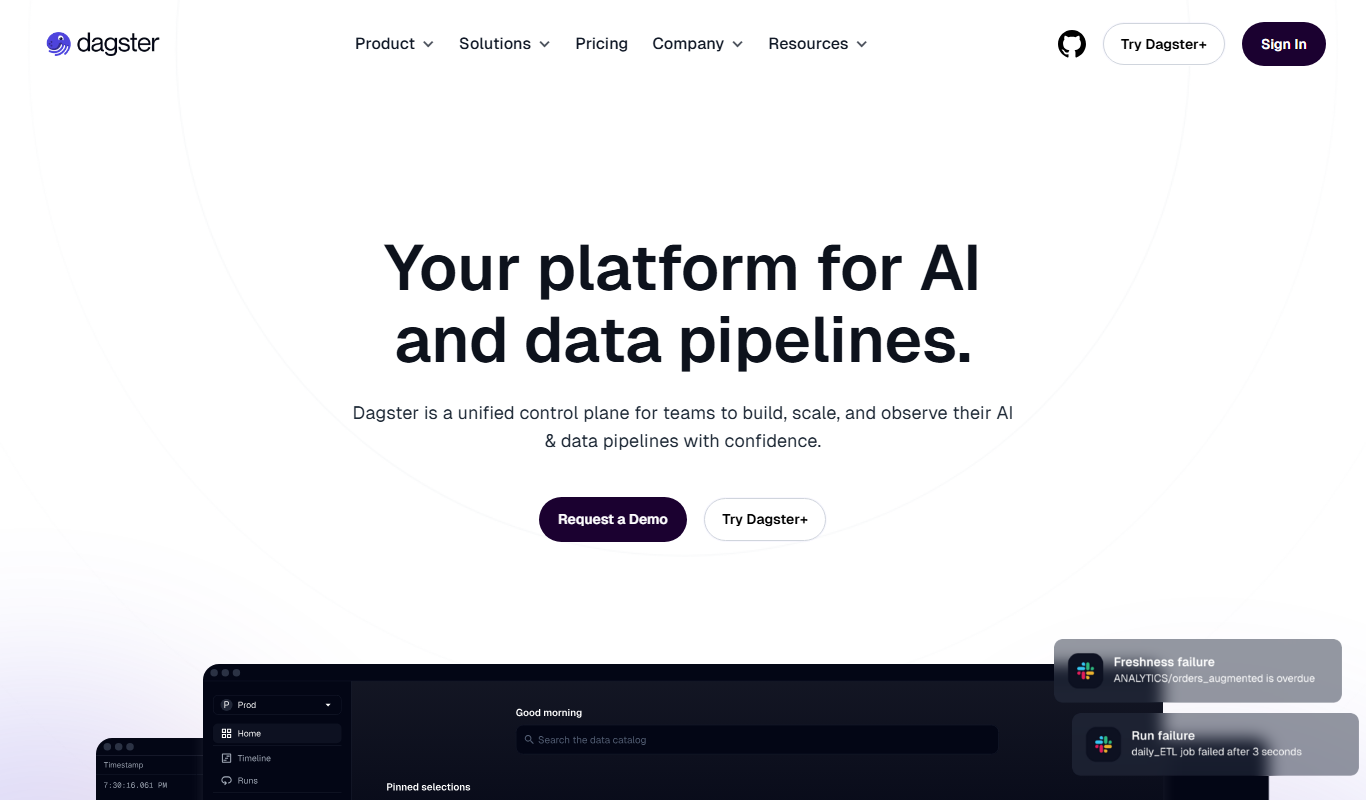
Dagster
Dagster is an open-source data orchestration platform that enables developers to build, schedule, and monitor reliable data pipelines with strong typing, observability, and extensibility.
More AI DevOps Assistant tools
Other tools in the same category, for when this one is not quite the fit.

Enterprise
CockroachDB
CockroachDB is a distributed SQL database designed for cloud-native applications that require strong consistency, high availability, and horizontal scalability across multiple regions.

Free Trial
Acronis Cyber Backup
Acronis Cyber Backup is a data protection platform offering automated backups, AI-based ransomware protection, and disaster recovery for physical, virtual, and cloud environments.

Pay As You Go
CloudWatch
AWS CloudWatch is a monitoring and observability service that collects metrics and logs from AWS resources and applications, enabling real-time monitoring, alerting, and operational insights.

Free
Octopus Deploy
Octopus Deploy is a DevOps automation tool that simplifies continuous delivery by automating application deployments, managing releases, and integrating with CI/CD pipelines.

Free
ServerPilot
ServerPilot is a cloud server management platform that automates the setup and management of web servers for PHP applications, simplifying deployment and security for developers and businesses.

Enterprise
ScriptRunner
ScriptRunner is an automation platform that centralizes management, security, and execution of PowerShell scripts to streamline IT workflows and enable self-service automation.

Free
Dependabot
Dependabot is a GitHub-integrated tool that automates dependency updates and security vulnerability detection by creating pull requests to keep projects secure and current.

Free
Heroku
Heroku is a cloud platform as a service (PaaS) that enables developers to deploy, manage, and scale applications easily without managing infrastructure.