

Liquid Network Bitcoin Sidechain for Faster, Confidential Blockchain Transactions
Liquid Network is a Bitcoin sidechain developed by Blockstream that enables faster, confidential Bitcoin transactions and digital asset issuance through a federated network.
- Best for
- Faster Bitcoin Transactions
- Key capability
- Confidential Transactions
Save Liquid Network, follow its updates and vote on it — everything stays in your account.
Sign in or create a free account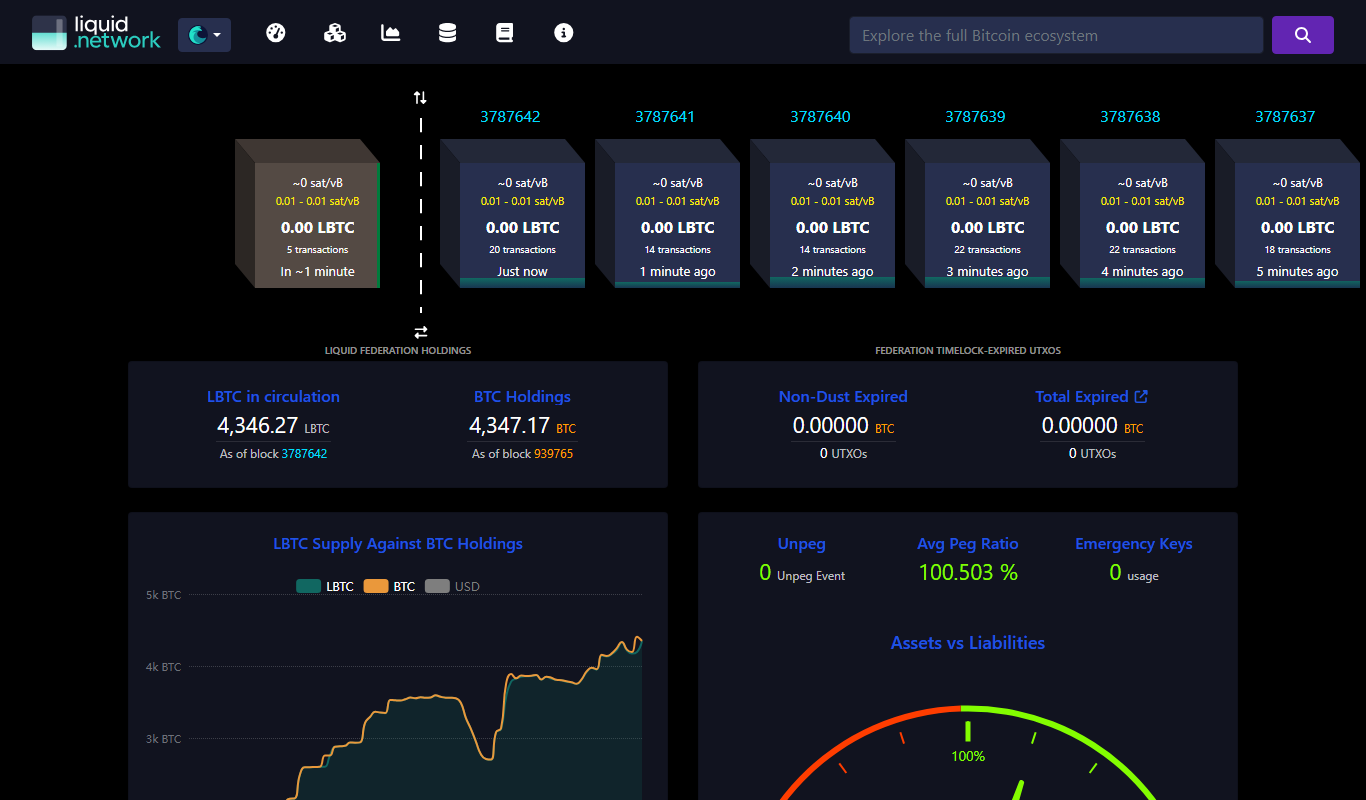
What is Liquid Network?
Liquid Network is a Bitcoin sidechain developed by Blockstream that enables faster, more private transactions and the issuance of digital assets. It operates as a federated sidechain, allowing users to transfer Bitcoin and other assets with enhanced speed and confidentiality compared to the Bitcoin mainchain. Liquid is designed primarily for exchanges, traders, and financial institutions seeking efficient settlement and privacy features.
Key features of Liquid Network
Liquid Network offers confidential transactions, fast settlement times, asset issuance capabilities, atomic swaps, and interoperability with Bitcoin. It enhances privacy by hiding transaction amounts and asset types, while maintaining security through a federation of trusted functionaries.
Confidential Transactions
Hides transaction amounts and asset types to enhance user privacy.
Fast Settlement
Transactions settle in approximately 2 minutes, much faster than Bitcoin mainnet confirmations.
Asset Issuance
Allows creation and transfer of digital assets like stablecoins and tokens.
Atomic Swaps
Enables trustless exchange between Bitcoin and Liquid assets.
Federated Security Model
Operates under a federation of trusted functionaries to secure the network.
Pros and cons of Liquid Network
Pros
- Significantly faster Bitcoin transactions
- Enhanced privacy with confidential transactions
- Supports issuance of various digital assets
- Enables atomic swaps for cross-chain trading
- Backed by Blockstream, a reputable blockchain company
Cons
- Federated model relies on trusted functionaries
- Not fully decentralized like Bitcoin mainnet
- Requires locking Bitcoin to use Liquid assets
Key use cases for Liquid Network
Faster Bitcoin Transactions
Liquid Network enables quicker settlement times compared to the Bitcoin mainchain, making it suitable for traders and exchanges.
Confidential Asset Transfers
It provides confidential transactions that hide amounts and asset types, enhancing privacy for users.
Issuance of Digital Assets
Users can issue digital assets such as stablecoins and tokenized securities on the Liquid sidechain.
Atomic Swaps
Supports atomic swaps between Bitcoin and Liquid assets, facilitating trustless cross-chain exchanges.
Improved Liquidity for Exchanges
Exchanges use Liquid to move funds off-chain quickly, reducing congestion and improving liquidity management.
How Liquid Network works
- 1
Deposit Bitcoin to Liquid
Users lock Bitcoin on the main Bitcoin blockchain to receive an equivalent amount of Liquid Bitcoin (L-BTC) on the Liquid sidechain.
- 2
Transact on Liquid Sidechain
Users perform fast, confidential transactions using L-BTC or other issued assets within the Liquid Network.
- 3
Withdraw to Bitcoin Mainchain
Users can redeem their L-BTC back to Bitcoin on the mainchain by unlocking the locked Bitcoin.
Who is using Liquid Network
Liquid Network pricing
Transaction fees
Fee per transaction in L-BTC, minimum 0.1 sat/vB
Every transaction on Liquid carries a fee paid in L-BTC, starting at 0.1 sat/vB.
Plans and prices are as published by the vendor and can change. Check the official site before you buy. Open the pricing page (opens in a new tab)
Frequently asked questions about Liquid Network
Liquid Network is a Bitcoin sidechain that enables faster and confidential transactions, as well as digital asset issuance.
It offers faster settlement times and privacy features by processing transactions off the main Bitcoin blockchain.
Primarily exchanges, traders, and financial institutions, but anyone can use it to transfer Bitcoin and assets.
Yes, it uses a federated model with trusted functionaries and cryptographic proofs to maintain security.
This tool is designed to help users accomplish its core tasks more efficiently. It is typically used by individuals or teams looking to improve productivity and workflow.
It depends on your specific needs and how you plan to use the tool. The official website and documentation are the best sources for the latest details.
Conclusion
Bitcoin is locked on the main blockchain to receive an equivalent amount of Liquid Bitcoin (L-BTC) on the sidechain, and L-BTC can later be redeemed back to Bitcoin on the mainchain. Transactions inside the network hide amounts and asset types and settle much faster than Bitcoin mainnet confirmations. Digital assets such as stablecoins and tokenized securities can be issued on the sidechain, and atomic swaps enable trustless exchange between Bitcoin and Liquid assets.
It is designed primarily for exchanges, traders and financial institutions, although anyone can use it to transfer Bitcoin and assets. Security rests on a federation of trusted functionaries, and the network is not fully decentralized like Bitcoin mainnet.
Using it is not free either: every transaction on Liquid carries a fee paid in L-BTC, starting at 0.1 sat/vB.
Sources
Sign in to review this tool.
Sign In to ReviewNo reviews yet
Be the first to share how this tool worked for you.
Ask about pricing, limits, or how it compares — or answer someone else.
Sign In to AskNo questions yet
Have a question about using or paying for this tool? Be the first to ask.
Featured on TiorAI



Alternative Tools
Explore similar AI tools that might fit your needs

Rootstock (RSK)
RSK is a smart contract platform secured by Bitcoin's network through merge-mining, enabling faster transactions and Ethereum-compatible decentralized applications on a Bitcoin sidechain.

Stacks
Stacks is an open-source Bitcoin L2 for smart contracts and decentralized apps, with Clarity contracts, the sBTC asset and self-custodial Bitcoin staking.
More Business Management tools
Other tools in the same category, for when this one is not quite the fit.
AI PDF redaction tool App
AI PDF Redaction Tool App is a web-based solution that uses AI to identify and permanently remove sensitive data from PDF documents, ensuring privacy and compliance.

LightPDF
LightPDF is a web-based PDF editor and converter that allows users to edit, convert, compress, merge, split, and secure PDF documents easily without installing software.

Tandem GPT
Tandem GPT is an AI language partner for rehearsing real-life conversations in a foreign language, with ready-made or custom scenarios, text or voice practice and corrections.

Talentpair
Talentpair is an AI hiring platform where companies post jobs, receive candidates matched by AI and pre-screened, and pay a placement fee only if they make a hire.

BudgetSEO
BudgetSEO is an AI SEO article generator that goes from keywords to published blog content, with GPT-4 articles, generated images, WordPress posting and free blog tools.

Innovatiana
Innovatiana provides expert data labeling services for AI: image, video, text, audio and LLM annotation by trained, in-house annotators, delivered as production-grade training datasets.

Exitfund
Exitfund is an angel investor network that invests in pre-seed, seed and Series A startups and helps founders raise additional funding.
MakerJournal
MakerJournal uses AI to turn your progress logs and GitHub commits into summaries that indie makers and solo developers can post to their social accounts.