

From my experience with KubeSphere, I found it excels at simplifying complex Kubernetes operations through its intuitive web console and integrated DevOps tools. Spending time with the platform, I can say it’s particularly well-suited for DevOps teams and enterprises managing multiple Kubernetes clusters who want to streamline application deployment and monitoring. However, there is a trade-off: users should have some Kubernetes knowledge to fully leverage its capabilities, as the learning curve can be steep for beginners. Overall, if you need a comprehensive open-source Kubernetes management platform with multi-cluster and CI/CD support, KubeSphere delivers solid results.
KubeSphere Kubernetes Platform for Enterprise DevOps and Cloud Native Management
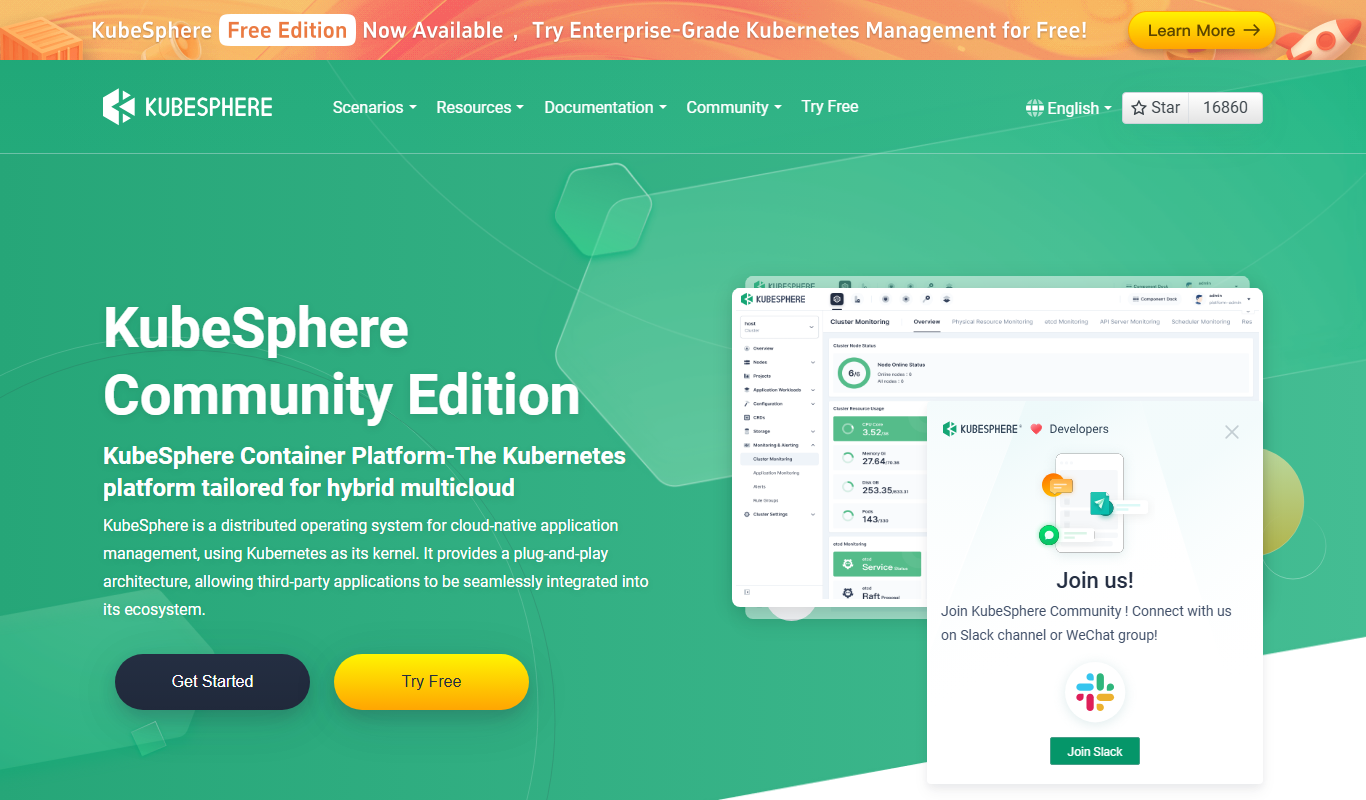
KubeSphere is an open-source Kubernetes platform that simplifies multi-cluster management, DevOps automation, and cloud native application lifecycle management through an intuitive web console and integrated tools.
- Best for
- Kubernetes Cluster Management
- Key capability
- Multi-Cluster Management
Do you recommend this tool?
What is KubeSphere?
KubeSphere is an open-source container platform built on Kubernetes that provides a user-friendly web console and a suite of enterprise-grade features for managing cloud native applications and DevOps workflows. It simplifies Kubernetes cluster operations, supports multi-cluster and multi-tenant management, and integrates CI/CD, monitoring, and application lifecycle tools to accelerate cloud native development.
Key features of KubeSphere
KubeSphere offers a comprehensive Kubernetes management platform with features including multi-cluster management, DevOps automation, application lifecycle management, multi-tenancy, observability, and an integrated application marketplace. It is designed to improve productivity and operational efficiency for enterprises adopting Kubernetes.
Multi-Cluster Management
Manage multiple Kubernetes clusters from a single pane of glass with centralized control.
DevOps Pipeline Integration
Built-in CI/CD pipelines support automated build, test, and deployment workflows.
Multi-Tenancy and RBAC
Provide secure resource isolation and fine-grained access control for different teams and projects.
Application Store
Deploy applications quickly using a curated marketplace of Helm charts and templates.
Observability Tools
Integrated monitoring, logging, and alerting tools help detect and resolve issues proactively.
Pros and cons of KubeSphere
Pros
- Comprehensive Kubernetes management with multi-cluster support
- Integrated DevOps and CI/CD tools streamline workflows
- Open source with active community and enterprise features
- User-friendly web console simplifies complex Kubernetes operations
- Supports multi-tenancy with fine-grained access control
Cons
- Requires existing Kubernetes knowledge for optimal use
- Documentation can be complex for beginners
- Primarily focused on Kubernetes; not a standalone container solution
Key use cases for KubeSphere
Kubernetes Cluster Management
Manage multiple Kubernetes clusters with a unified web console that simplifies deployment, monitoring, and maintenance.
DevOps Automation
Automate CI/CD pipelines and application lifecycle management with integrated tools and workflows.
Multi-Tenant Cloud Native Platform
Provide multi-tenant isolation and resource management for enterprises running cloud native applications.
Application Store and Marketplace
Deploy and manage applications easily using a built-in app store with Helm charts and templates.
Observability and Monitoring
Gain insights into cluster health and application performance through integrated monitoring, logging, and alerting.
How KubeSphere works
- 1
Install KubeSphere
Deploy KubeSphere on top of existing Kubernetes clusters or install it as a standalone platform.
- 2
Access Web Console
Use the intuitive web interface to manage clusters, projects, and applications.
- 3
Configure Multi-Tenancy
Set up tenants, projects, and role-based access control to isolate resources and users.
- 4
Deploy Applications
Use the application store or custom Helm charts to deploy and manage cloud native apps.
- 5
Automate CI/CD
Create and manage CI/CD pipelines integrated with Git repositories and container registries.
- 6
Monitor and Troubleshoot
Leverage built-in monitoring, logging, and alerting to maintain cluster and application health.
Who is using KubeSphere
DevOps teams
Cloud native application developers
Enterprise IT administrators
SREs managing Kubernetes clusters
Organizations adopting multi-cloud or hybrid cloud strategies
KubeSphere pricing
Open Source
$0
Free to use with full access to all features under Apache 2.0 license.
Plans and prices are as published by the vendor and can change. Check the official site before you buy. Open the pricing page (opens in a new tab)
Frequently asked questions about KubeSphere
Yes, KubeSphere is an open-source platform available under the Apache 2.0 license.
Yes, it supports centralized management of multiple Kubernetes clusters.
Yes, it includes integrated DevOps tools for building and managing CI/CD workflows.
KubeSphere runs on Kubernetes clusters and provides a web-based console accessible via browsers.
This tool is designed to help users accomplish its core tasks more efficiently. It is typically used by individuals or teams looking to improve productivity and workflow.
Some tools offer a free plan or trial with limited features. Availability can vary, so confirm on the official website.
It depends on your specific needs and how you plan to use the tool. The official website and documentation are the best sources for the latest details.
Yes, it can help with that use case depending on how you configure it and what features are available. You’ll get the best results with clear inputs and a defined goal.
Sign in to review this tool.
Sign In to ReviewNo reviews yet
Be the first to share how this tool worked for you.
Ask about pricing, limits, or how it compares — or answer someone else.
Sign In to AskNo questions yet
Have a question about using or paying for this tool? Be the first to ask.
Featured on TiorAI



Alternative Tools
Explore similar AI tools that might fit your needs

Free
Rancher
Rancher is an open-source platform that enables centralized management, security, and deployment of Kubernetes clusters across hybrid and multi-cloud environments.
More AI DevOps Assistant tools
Other tools in the same category, for when this one is not quite the fit.

Enterprise
CockroachDB
CockroachDB is a distributed SQL database designed for cloud-native applications that require strong consistency, high availability, and horizontal scalability across multiple regions.

Free Trial
Acronis Cyber Backup
Acronis Cyber Backup is a data protection platform offering automated backups, AI-based ransomware protection, and disaster recovery for physical, virtual, and cloud environments.

Pay As You Go
CloudWatch
AWS CloudWatch is a monitoring and observability service that collects metrics and logs from AWS resources and applications, enabling real-time monitoring, alerting, and operational insights.

Free
Octopus Deploy
Octopus Deploy is a DevOps automation tool that simplifies continuous delivery by automating application deployments, managing releases, and integrating with CI/CD pipelines.

Free
ServerPilot
ServerPilot is a cloud server management platform that automates the setup and management of web servers for PHP applications, simplifying deployment and security for developers and businesses.

Enterprise
ScriptRunner
ScriptRunner is an automation platform that centralizes management, security, and execution of PowerShell scripts to streamline IT workflows and enable self-service automation.

Free
Dependabot
Dependabot is a GitHub-integrated tool that automates dependency updates and security vulnerability detection by creating pull requests to keep projects secure and current.

Free
Heroku
Heroku is a cloud platform as a service (PaaS) that enables developers to deploy, manage, and scale applications easily without managing infrastructure.