

From my experience with Faraday.dev, I found it excels at automating the complex and time-consuming aspects of machine learning workflows, especially feature engineering and model deployment. The platform’s user-friendly interface and API support make it accessible for data scientists and engineers aiming to accelerate AI projects without deep coding. However, the lack of publicly available pricing and limited details on supported algorithms may require direct consultation for enterprise adoption. Overall, if you need to streamline your machine learning lifecycle and improve collaboration within your data team, Faraday.dev offers a robust and practical solution.
Faraday.dev AI Platform for Data Science and Machine Learning Automation
Faraday.dev is an AI platform that automates the machine learning lifecycle, enabling users to build, train, deploy, and monitor models efficiently with minimal coding.
- Best for
- Automated Machine Learning
- Key capability
- Automated Feature Engineering
Your actions


Do you recommend this tool?
What is Faraday.dev?
Faraday.dev is an AI-driven platform designed to automate and simplify the end-to-end machine learning lifecycle. It empowers data scientists and developers to build, train, and deploy machine learning models faster by automating complex tasks such as feature engineering, model selection, and deployment. The platform provides a user-friendly interface and APIs to integrate AI capabilities into business workflows, reducing the need for extensive coding and manual intervention.
Key features of Faraday.dev
Faraday.dev offers automated feature engineering, model training and evaluation, seamless deployment options, and real-time monitoring. It supports collaboration among data teams and integrates with existing data sources and tools to accelerate AI adoption.
Automated Feature Engineering
Automatically transforms raw data into meaningful features to improve model performance.
End-to-End ML Pipeline Automation
Streamlines the entire machine learning workflow from data ingestion to deployment.
Model Deployment APIs
Provides APIs for easy integration of trained models into applications and services.
Collaboration Tools
Facilitates teamwork among data scientists and engineers with shared projects and version control.
Performance Monitoring
Tracks model accuracy and alerts users to data drift or performance degradation.
Pros and cons of Faraday.dev
Pros
- Automates complex machine learning workflows
- Reduces time to deploy AI models
- Supports collaboration among data teams
- Includes real-time model monitoring
- Integrates with various data sources
Cons
- Pricing details not publicly available
- Limited information on supported algorithms
- Primarily English language support
Key use cases for Faraday.dev
Automated Machine Learning
Build, train, and deploy machine learning models automatically without extensive coding.
Feature Engineering
Automatically generate and select relevant features from raw data to improve model accuracy.
Data Science Workflow Automation
Streamline data preparation, model training, validation, and deployment processes.
Model Deployment and Monitoring
Deploy models into production environments and monitor their performance continuously.
Collaboration for Data Teams
Enable data scientists and engineers to collaborate efficiently on projects within a unified platform.
How Faraday.dev works
- 1
Connect Data Sources
Integrate your datasets from various sources into the Faraday.dev platform.
- 2
Automate Feature Engineering
Leverage the platform’s AI to automatically generate and select impactful features.
- 3
Train and Evaluate Models
Use automated machine learning to build and validate models optimized for your data.
- 4
Deploy Models
Deploy models to production environments via API or other supported methods.
- 5
Monitor and Iterate
Continuously monitor model performance and retrain as needed to maintain accuracy.
Who is using Faraday.dev
Data scientists
Machine learning engineers
AI developers
Enterprise businesses
Data science teams
Faraday.dev pricing
Starter
Contact for pricing
Basic access with limited features suitable for small projects.
Enterprise
Custom pricing
Full feature set with dedicated support and scalability for large organizations.
Plans and prices are as published by the vendor and can change. Check the official site before you buy. Open the pricing page (opens in a new tab)
Frequently asked questions about Faraday.dev
Faraday.dev supports a variety of supervised learning models including classification and regression algorithms.
Yes, the platform supports integration with multiple data sources and formats via APIs.
While some familiarity with data science helps, the platform automates many tasks to reduce the need for extensive coding.
Yes, it includes tools to monitor model performance and detect data drift in real time.
It depends on your specific needs and how you plan to use the tool. The official website and documentation are the best sources for the latest details.
It depends on your specific needs and how you plan to use the tool. The official website and documentation are the best sources for the latest details.
It depends on your specific needs and how you plan to use the tool. The official website and documentation are the best sources for the latest details.
Yes, it can help with that use case depending on how you configure it and what features are available. You’ll get the best results with clear inputs and a defined goal.
Sign in to review this tool.
Sign In to ReviewNo reviews yet
Be the first to share how this tool worked for you.
Ask about pricing, limits, or how it compares — or answer someone else.
Sign In to AskNo questions yet
Have a question about using or paying for this tool? Be the first to ask.
Featured on TiorAI



More AI Ai Tools tools
Other tools in the same category, for when this one is not quite the fit.

Free
Pogo Travel
Pogo Travel is an AI-driven platform that generates personalized travel itineraries based on your preferences, travel dates, and interests, offering collaborative planning and offline access.

Freemium
PlaninGo
PlaninGo is an AI travel planning tool that generates personalized trip itineraries and guides based on your preferences, helping you plan efficient and enjoyable trips.

Free
Travelwiz
Travelwiz is an AI-powered travel planning tool that creates personalized trip itineraries and offers tailored travel recommendations based on user preferences.

Free
Momo
Momo is an AI-powered assistant that automates workflows, manages tasks, and enhances team collaboration by integrating with popular productivity tools.

Free
Nextrip
Nextrip AI is an online travel planning tool that uses artificial intelligence to generate personalized trip itineraries based on your preferences, travel dates, and destinations.

Freemium
TravelBot AI Travel Assistant
TravelBot AI Travel Assistant is a web-based platform that uses artificial intelligence to help users create personalized travel itineraries, book flights and hotels, and receive tailored travel recommendations based on preferences and budget.
Freemium
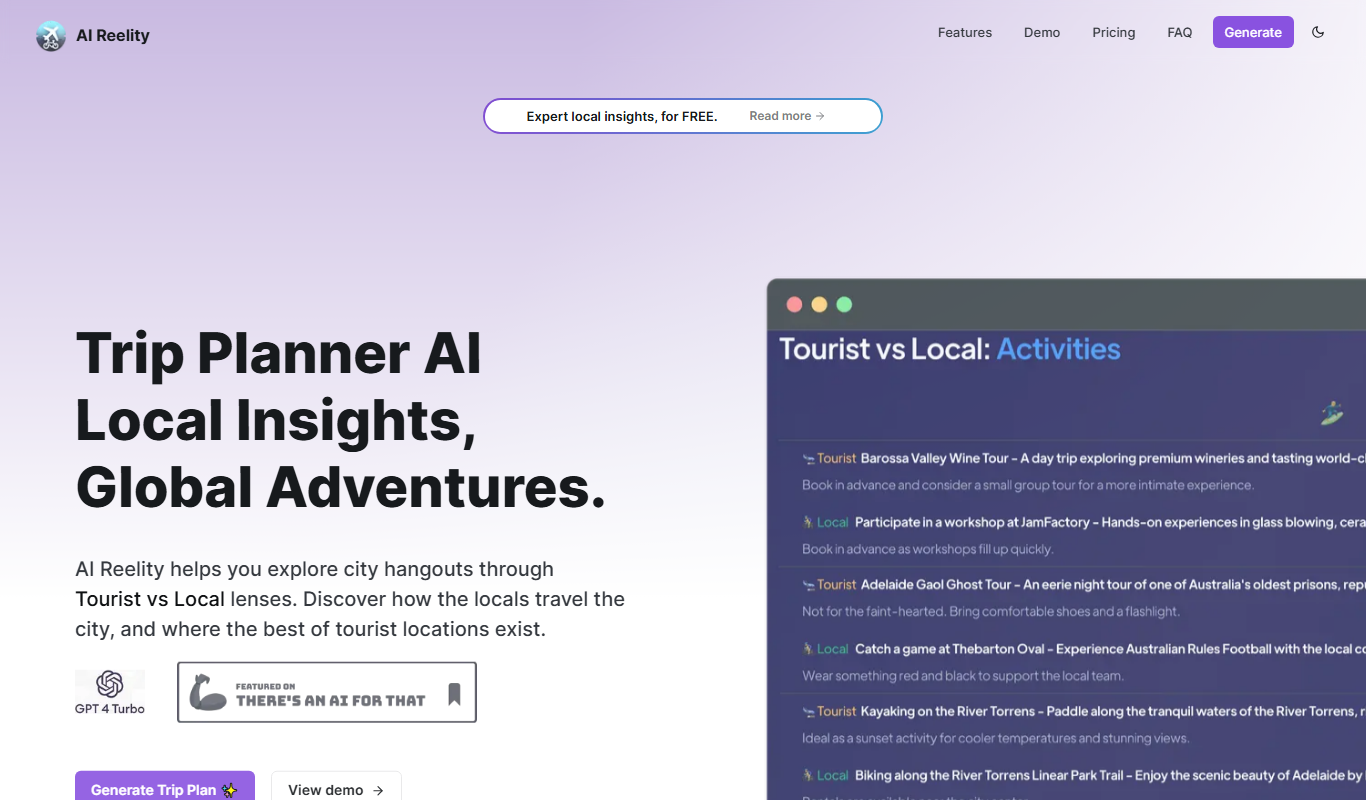
AIreelity
AIreelity is an AI-driven video creation platform that transforms text scripts into engaging marketing videos with customizable templates and AI voiceovers.

Free
AIJOURNEY
AIJOURNEY is an AI-driven career development tool that provides personalized career path recommendations, identifies skill gaps, and offers curated learning resources to help users advance professionally.