

Falkonry AI Platform for Industrial IoT and Predictive Analytics Solutions
Falkonry is an AI platform that analyzes industrial IoT time series data to provide predictive maintenance, anomaly detection, and operational insights.
- Best for
- Industrial Operations Optimization
- Key capability
- Continuous Event Detection
Save Falkonry, follow its updates and vote on it — everything stays in your account.
Sign in or create a free account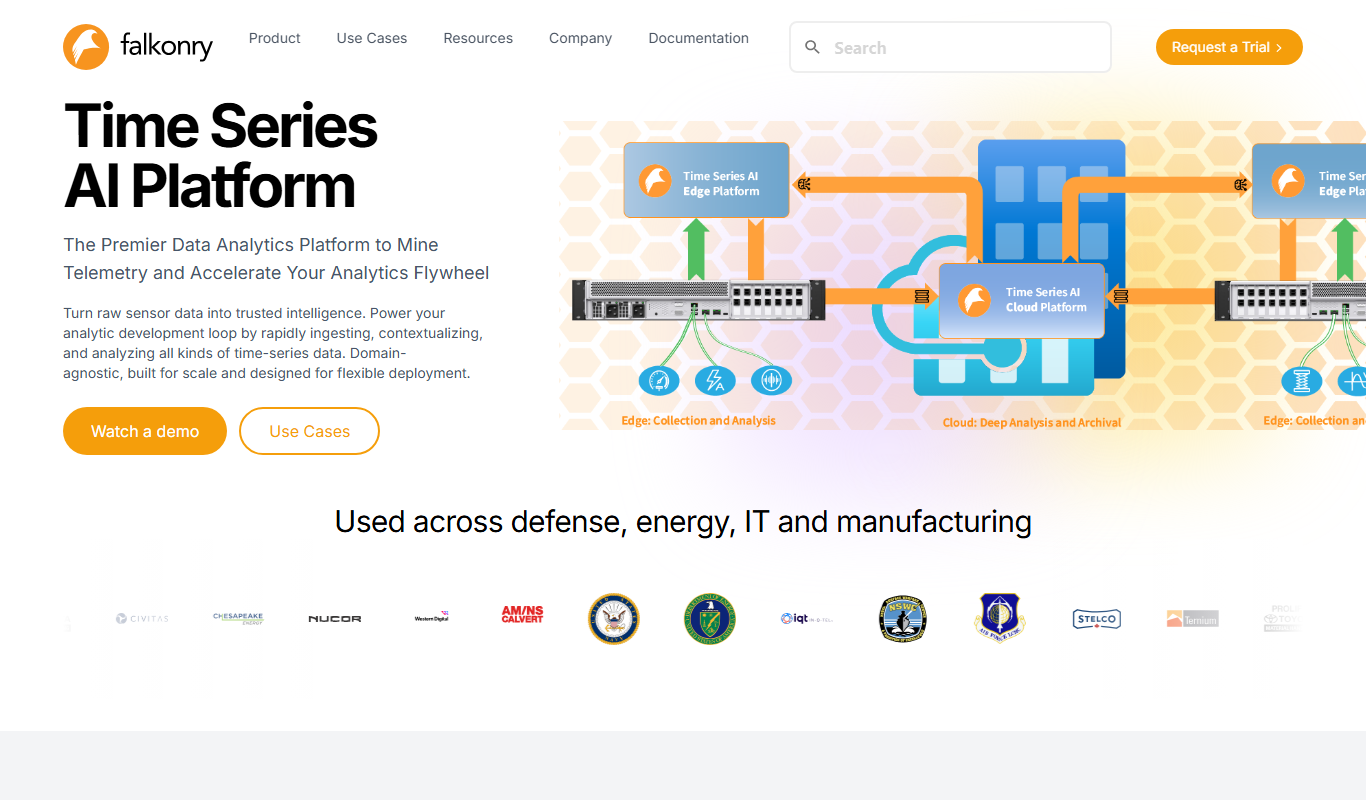
What is Falkonry?
Falkonry is an AI-powered platform designed for industrial organizations to analyze time series data from IoT devices and operational systems. It provides predictive analytics and event detection capabilities that help businesses optimize processes, improve asset reliability, and automate workflows. Falkonry’s technology enables real-time insights by applying machine learning models to complex sensor data without requiring extensive data science expertise.
Key features of Falkonry
The platform offers continuous event detection, anomaly detection, predictive maintenance forecasting, and root cause analysis. It supports integration with various industrial data sources and provides APIs for embedding AI insights into existing systems. Falkonry emphasizes ease of use with visual tools for model building and monitoring.
Continuous Event Detection
Automatically identifies operational events and anomalies in streaming time series data.
Predictive Maintenance
Forecasts equipment failures to enable proactive maintenance scheduling.
Root Cause Analysis
Pinpoints causes of operational issues using AI pattern recognition.
Visual Model Builder
User-friendly interface to create and adjust event detection models without coding.
API Integration
Allows embedding AI insights into existing enterprise systems and workflows.
Pros and cons of Falkonry
Pros
- Specialized in industrial time series and IoT data analytics
- User-friendly visual model building interface
- Strong predictive maintenance and anomaly detection capabilities
- Flexible API for integration with existing systems
Cons
- Pricing is custom and may be expensive for smaller organizations
- Primarily focused on industrial sectors, less suited for general analytics
- Requires some operational domain knowledge to configure models effectively
Key use cases for Falkonry
Industrial Operations Optimization
Use Falkonry to analyze sensor and operational data in real-time to detect anomalies and optimize manufacturing processes.
Predictive Maintenance
Leverage Falkonry’s AI to predict equipment failures before they occur, reducing downtime and maintenance costs.
IoT Data Analysis
Aggregate and interpret complex IoT time series data streams to gain actionable insights across industrial assets.
Process Automation
Automate decision-making workflows by integrating Falkonry’s AI insights into operational control systems.
Root Cause Analysis
Identify the underlying causes of operational issues quickly through Falkonry’s pattern recognition and event detection.
How Falkonry works
- 1
Connect Data Sources
Integrate IoT sensors, SCADA systems, and other operational data streams into Falkonry.
- 2
Configure Event Models
Use Falkonry’s visual interface to define patterns and events relevant to your operations.
- 3
Run Continuous Analytics
The platform continuously analyzes incoming data to detect anomalies and predict failures.
- 4
Receive Insights
Get real-time alerts, dashboards, and reports to inform operational decisions.
- 5
Integrate with Workflows
Embed AI-driven insights into control systems or maintenance workflows for automation.
Who is using Falkonry
Falkonry pricing
Custom Enterprise Plan
Contact for pricing
Tailored solutions based on organizational needs, data volume, and integration complexity.
Plans and prices are as published by the vendor and can change. Check the official site before you buy. Open the pricing page (opens in a new tab)
Frequently asked questions about Falkonry
Falkonry primarily serves manufacturing, energy, utilities, and other industrial sectors requiring operational analytics.
No, Falkonry provides visual tools and automated AI to simplify model creation without requiring deep data science skills.
Yes, Falkonry supports integration with various IoT data sources and enterprise systems via APIs.
Falkonry is designed for enterprise-level industrial operations and may not be cost-effective for small businesses.
This tool is designed to help users accomplish its core tasks more efficiently. It is typically used by individuals or teams looking to improve productivity and workflow.
Some tools offer a free plan or trial with limited features. Availability can vary, so confirm on the official website.
It depends on your specific needs and how you plan to use the tool. The official website and documentation are the best sources for the latest details.
It depends on your specific needs and how you plan to use the tool. The official website and documentation are the best sources for the latest details.
Conclusion
Data from IoT sensors, SCADA systems and other operational streams is connected to Falkonry first. A visual interface is then used to define the patterns and events relevant to operations, and the platform continuously analyzes incoming data to detect anomalies and predict failures. Alerts, dashboards and reports deliver the findings in real time, and AI insights can be embedded into control systems or maintenance workflows. Root cause analysis uses AI pattern recognition to pinpoint the causes of operational issues. Predictive maintenance forecasts equipment failures so maintenance can be scheduled proactively, which is meant to reduce downtime and maintenance costs.
Integration with various IoT data sources and enterprise systems runs via APIs. Building models does not require deep data science skills, because visual tools and automated AI simplify model creation. Some operational domain knowledge is still required to configure models effectively. The platform primarily serves manufacturing, energy and utilities operators, and within them it addresses operations managers, maintenance teams and industrial IoT solution architects. It is designed for enterprise-level industrial operations and is less suited for general analytics, with custom pricing based on data volume and integration complexity.
Sources
Sign in to review this tool.
Sign In to ReviewNo reviews yet
Be the first to share how this tool worked for you.
Ask about pricing, limits, or how it compares — or answer someone else.
Sign In to AskNo questions yet
Have a question about using or paying for this tool? Be the first to ask.
Featured on TiorAI



More AI Analytics Assistant tools
Other tools in the same category, for when this one is not quite the fit.

Supascout
Supascout analyzes App Store reviews to give actionable insights, helping you understand user needs and frustrations so you can address them with confidence.

spiralup.co
Spiral is an AI agent for customer reviews, live chats and calls: it reads your feedback so you can simply ask about complaints, feature requests and sentiment trends.
腾讯问卷
Tencent Wenjuan is an online survey platform by Tencent that allows users to create, distribute, and analyze surveys with multiple question types and real-time data analytics, primarily serving Chinese-speaking users.
EstimateOne
EstimateOne (E1) is an Australian construction tender platform that helps subcontractors, builders and suppliers find tenders and win more work.
Octolens AI
Octolens is an AI social listening tool that tracks brand mentions across Reddit, X, LinkedIn and 10+ platforms, with API, MCP and webhooks on every plan.

Insight7
Insight7 analyzes customer calls, scores every conversation, coaches reps and deploys AI voice and chat agents for customer teams.

neuronsinc.com
Neurons is a neuromarketing AI that predicts attention, engagement and memorability of ad creatives before they go live, with heatmaps and behavioral scores.
LangWatch
LangWatch is an AI agent testing and evaluation platform with simulations, evals, observability and prompt management, available in the cloud or self-hosted.