

From my experience with Drools, it stands out as a robust and flexible business rules management system that excels in separating business logic from application code. Its open-source nature and strong community support make it an attractive choice for enterprises looking to automate complex decision-making processes. However, the learning curve can be steep for newcomers, especially those unfamiliar with Java or rule-based systems. For organizations needing scalable, maintainable, and transparent rule automation integrated with BPM workflows, Drools delivers a comprehensive solution.
Drools Business Rules Management System for Automated Decision Making
Drools is an open-source business rules management system that enables organizations to automate decision-making by defining and executing complex business rules within Java applications.
- Best for
- Automated Business Decision Making
- Key capability
- Powerful Rule Engine
Do you recommend this tool?
What is Drools?
Drools is an open-source Business Rules Management System (BRMS) that provides a core Business Rules Engine (BRE), a web authoring and rules management application, and an Eclipse IDE plugin for core development. It enables organizations to define, deploy, monitor, and maintain business rules and decision logic separately from application code, facilitating agile and flexible decision automation.
Key features of Drools
Drools offers a powerful rule engine supporting forward and backward chaining, complex event processing, decision tables, domain-specific languages, and integration with BPMN workflows. It supports declarative programming to externalize business logic, making it easier to manage and update rules without redeploying applications.
Powerful Rule Engine
Supports forward and backward chaining with efficient pattern matching algorithms.
Complex Event Processing
Detect and respond to event patterns in real-time for dynamic decision making.
Decision Tables and DSL
Simplify rule authoring with spreadsheet-like decision tables and domain-specific languages.
Integration with BPMN
Seamlessly integrate rules with business process workflows for end-to-end automation.
Open Source and Extensible
Community-driven with extensible architecture allowing customization and integration.
Pros and cons of Drools
Pros
- Open-source with a strong community
- Highly flexible and extensible rule engine
- Supports complex event processing and BPM integration
- Enables separation of business logic from application code
- Provides tools for both developers and business users
Cons
- Steep learning curve for beginners
- Primarily Java-centric, limiting use in other environments
- Enterprise features require paid Red Hat subscription
Key use cases for Drools
Automated Business Decision Making
Implement complex business rules to automate decisions in enterprise applications.
Workflow and Process Automation
Integrate with BPM tools to automate workflows based on defined rules and conditions.
Compliance and Policy Enforcement
Ensure business processes comply with regulations by encoding policies as executable rules.
Event Processing and Monitoring
React to real-time events by applying rules to trigger actions or alerts.
Risk Management and Fraud Detection
Use rule-based logic to identify and mitigate risks or fraudulent activities.
How Drools works
- 1
Define Business Rules
Write rules using Drools Rule Language (DRL), decision tables, or guided editors.
- 2
Deploy Rules to Engine
Load rules into the Drools engine embedded in your application or accessed via API.
- 3
Execute Rules
The engine evaluates facts against rules to infer conclusions or trigger actions.
- 4
Manage and Update Rules
Use Drools Workbench or Eclipse plugin to modify rules dynamically without code changes.
Who is using Drools
Enterprise software developers
Business analysts and rule authors
Organizations needing automated decision systems
Companies implementing BPM and workflow automation
Risk management and compliance teams
Drools pricing
Community Edition
$0
Free open-source version with full core features.
Red Hat Decision Manager
Contact for pricing
Enterprise-grade supported version with additional tools and SLAs.
Plans and prices are as published by the vendor and can change. Check the official site before you buy. Open the pricing page (opens in a new tab)
Frequently asked questions about Drools
Drools primarily supports Java and is designed to be embedded within Java applications.
Yes, Drools includes complex event processing capabilities to handle real-time data streams.
Drools Workbench provides a user-friendly interface for business users to author and manage rules.
The core Drools engine is open-source and free; enterprise support is available through Red Hat.
This tool is designed to help users accomplish its core tasks more efficiently. It is typically used by individuals or teams looking to improve productivity and workflow.
Some tools offer a free plan or trial with limited features. Availability can vary, so confirm on the official website.
Integration support depends on the tool and its available connectors or API. Check the official documentation or integrations page to confirm what is supported.
Yes, it can help with that use case depending on how you configure it and what features are available. You’ll get the best results with clear inputs and a defined goal.
Sign in to review this tool.
Sign In to ReviewNo reviews yet
Be the first to share how this tool worked for you.
Ask about pricing, limits, or how it compares — or answer someone else.
Sign In to AskNo questions yet
Have a question about using or paying for this tool? Be the first to ask.
Featured on TiorAI



Alternative Tools
Explore similar AI tools that might fit your needs
Enterprise
Camunda BPM
Camunda BPM is an open-source platform that automates business workflows and decisions using BPMN and DMN standards, providing tools for modeling, executing, and monitoring processes.
More AI Workflow tools
Other tools in the same category, for when this one is not quite the fit.

Free
Furkot
Furkot is a web-based trip planner that helps users create multi-stop routes, optimize travel paths, schedule accommodations and activities, and share itineraries for efficient road trip planning.

Free
EcoCart
EcoCart is a plugin that integrates with e-commerce platforms to calculate and offset the carbon footprint of online purchases, allowing customers to contribute to verified climate projects during checkout.

Contact for pricing
Trials.ai
Trials.ai is an AI-driven platform that helps medical researchers design optimized clinical trial protocols, improve patient recruitment, and ensure regulatory compliance to accelerate trial success.

Free
ZipBooks
ZipBooks is a cloud-based accounting software designed for small businesses and freelancers to manage invoicing, expenses, payments, and financial reporting with ease.

Free Trial
Lookeen
Lookeen is a Windows desktop search software that enables fast and comprehensive searching of emails, files, and documents, integrating deeply with Microsoft Outlook and supporting network drives.
Custom Pricing
Ataccama
Ataccama is an AI-driven data management platform that integrates data governance, master data management, and data quality automation to help enterprises manage and improve their data assets efficiently.
Enterprise
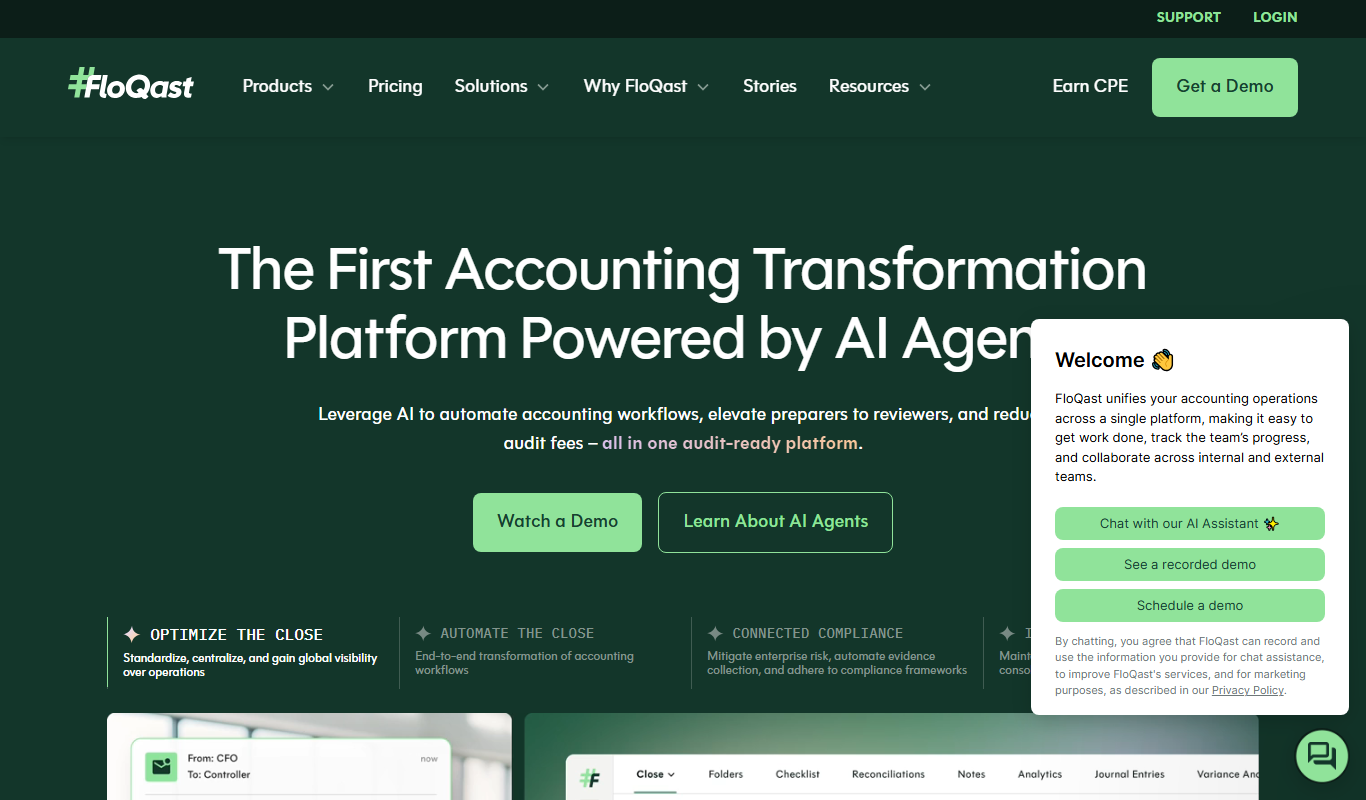
FloQast
FloQast is a cloud software designed to streamline and automate the accounting month-end close process, improving accuracy and collaboration for finance teams.

Custom Pricing
Talentsoft
Talentsoft is a cloud-based talent management software that integrates recruitment, learning, performance management, and succession planning to help organizations manage their workforce effectively.