

From my experience with Cradle, I found it excels at leveraging AI to streamline the early stages of drug discovery, particularly in generating novel molecules and predicting their properties. The platform’s strength lies in its ability to explore vast chemical spaces efficiently, which is invaluable for researchers aiming to accelerate pharmaceutical R&D. However, the lack of publicly available pricing and the need for some technical expertise may pose challenges for smaller teams or newcomers. Overall, if you are involved in drug candidate design and want to integrate AI into your workflow, Cradle offers a robust and specialized solution.
Cradle AI Platform for Drug Discovery and Molecular Design Solutions
Cradle is an AI-driven platform that assists researchers in designing novel drug candidates by generating molecules and predicting their properties to accelerate pharmaceutical research.
- Best for
- Drug Candidate Design
- Key capability
- AI-Driven Molecular Design


Do you recommend this tool?
What is Cradle?
Cradle is an AI-powered drug discovery platform developed by Cradle Co., Ltd. It leverages advanced machine learning and computational chemistry techniques to assist researchers in designing novel molecules with desired biological and chemical properties. The platform aims to accelerate pharmaceutical research by enabling efficient exploration of chemical space and prediction of molecular characteristics, thereby reducing time and cost in early drug development stages.
Key features of Cradle
Cradle offers features such as AI-driven molecular generation, property prediction models, lead optimization workflows, and chemical space visualization tools. These capabilities help researchers design and evaluate drug candidates more effectively, integrating seamlessly into existing drug discovery pipelines.
AI-Driven Molecular Design
Generates novel molecules tailored to specific drug discovery goals using deep learning.
Comprehensive Property Prediction
Predicts multiple molecular properties including bioactivity, toxicity, and solubility.
Chemical Space Visualization
Interactive tools to explore and understand chemical diversity and relationships.
Lead Optimization Workflow
Supports iterative improvement of candidate molecules to enhance drug-like properties.
Integration with Research Pipelines
Designed to complement existing pharmaceutical R&D workflows for seamless adoption.
Pros and cons of Cradle
Pros
- Advanced AI models tailored for drug discovery
- Comprehensive molecular property predictions
- Interactive chemical space exploration tools
Cons
- Pricing details not publicly available
- Primarily web-based platform with no mobile apps
- Technical expertise may be required to maximize benefits
Key use cases for Cradle
Drug Candidate Design
Use AI-driven molecular design to generate novel drug candidates with optimized properties.
Molecular Property Prediction
Predict chemical and biological properties of molecules to prioritize compounds for synthesis.
Lead Optimization
Refine lead compounds by exploring chemical space efficiently using AI algorithms.
Chemical Space Exploration
Explore vast chemical spaces to identify promising molecules beyond traditional methods.
Pharmaceutical Research Acceleration
Accelerate early-stage drug discovery workflows by integrating AI-powered tools.
How Cradle works
- 1
Data Input
Users input molecular structures or target profiles to initiate the design process.
- 2
AI Molecular Generation
The platform uses machine learning models to generate novel molecules with optimized properties.
- 3
Property Prediction
Predictive models evaluate chemical and biological properties to assess molecule viability.
- 4
Lead Optimization
Iterative refinement of molecules based on predicted properties and user feedback.
- 5
Result Analysis
Visualize and analyze generated molecules to select promising candidates for synthesis.
Who is using Cradle
Pharmaceutical companies
Biotech startups
Academic researchers in drug discovery
Computational chemists
Medicinal chemists
Cradle pricing
Contact for Pricing
Custom pricing
Pricing available upon request based on user needs and scale.
Plans and prices are as published by the vendor and can change. Check the official site before you buy. Open the pricing page (opens in a new tab)
Frequently asked questions about Cradle
Cradle can design a wide range of small molecules tailored for drug discovery applications.
Yes, Cradle supports both industrial and academic researchers in molecular design.
Cradle is designed to integrate with existing drug discovery workflows, though specific integrations depend on user requirements.
It depends on your specific needs and how you plan to use the tool. The official website and documentation are the best sources for the latest details.
It depends on your specific needs and how you plan to use the tool. The official website and documentation are the best sources for the latest details.
It depends on your specific needs and how you plan to use the tool. The official website and documentation are the best sources for the latest details.
Sign in to review this tool.
Sign In to ReviewNo reviews yet
Be the first to share how this tool worked for you.
Ask about pricing, limits, or how it compares — or answer someone else.
Sign In to AskNo questions yet
Have a question about using or paying for this tool? Be the first to ask.
Featured on TiorAI



Alternative Tools
Explore similar AI tools that might fit your needs

Custom Pricing
Insilico Medicine
Insilico Medicine is an AI biotechnology platform that accelerates drug discovery and biomarker development using deep learning and generative chemistry.
Custom Pricing
Atomwise
Atomwise is an AI-powered drug discovery platform that uses deep learning to analyze molecular structures, predict binding affinities, and accelerate pharmaceutical research.
Custom Pricing
Schrödinger
Schrödinger is a molecular modeling software suite that supports drug discovery and materials science through advanced simulations and AI integration.
More AI Artificial Intelligence Tools tools
Other tools in the same category, for when this one is not quite the fit.
Freemium
EasyTrip AI
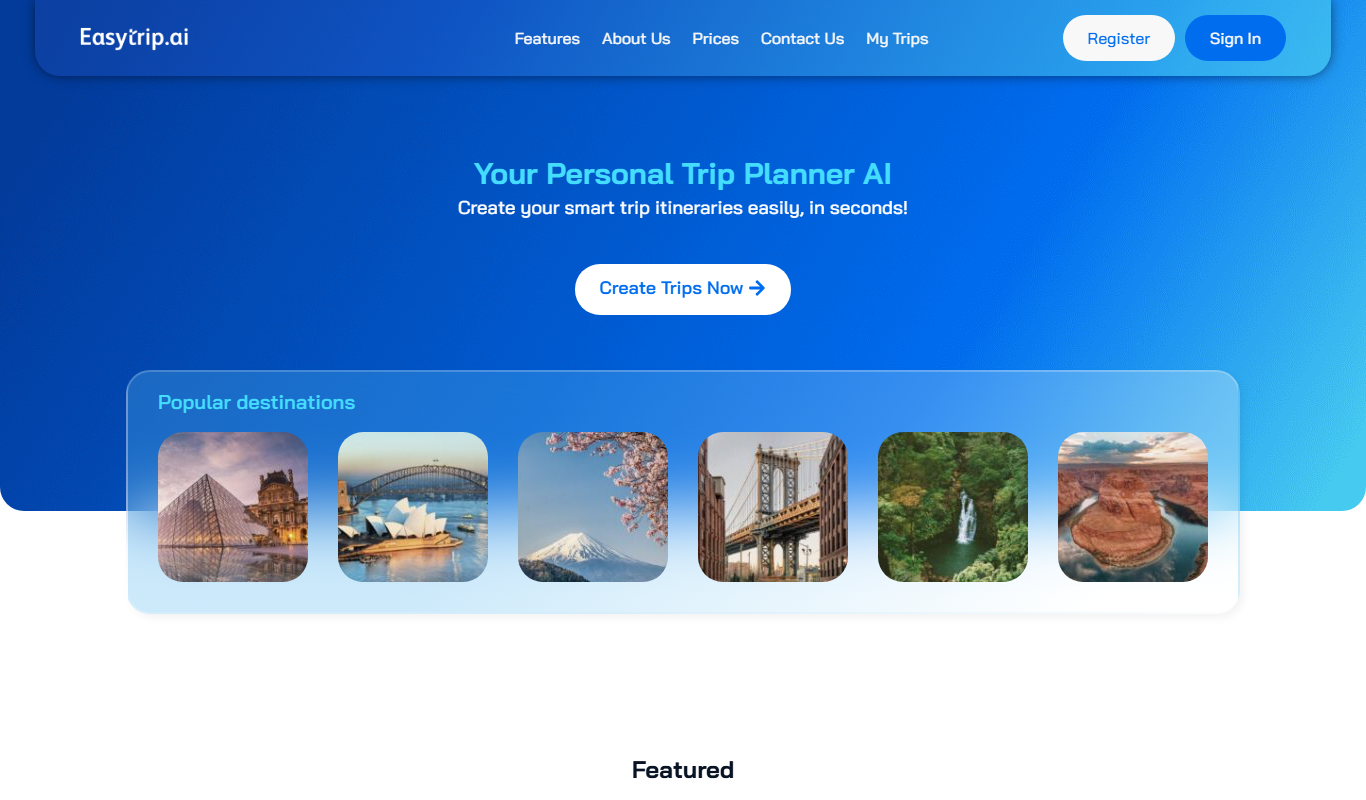
EasyTrip AI is an AI-driven travel planner that generates customized trip itineraries based on your travel dates, destinations, and preferences, helping you organize your trip efficiently.

Freemium
Travel Itinerary AI
Travel Itinerary AI is an AI-powered web tool that creates personalized travel itineraries based on your preferences, helping you plan and manage trips efficiently.

Free
NilgAI Travel
NilgAI Travel is an AI-driven travel planning tool that creates personalized itineraries based on your preferences, travel dates, and budget, helping you efficiently plan trips worldwide.

Custom Pricing
sentiance.com
Sentiance is an AI-powered platform that transforms sensor and contextual data into actionable behavioral insights, enabling businesses to understand user behavior and deliver personalized experiences in real-time.

Contact for pricing
ODESIS
ODESIS is an AI-driven analytics platform that helps businesses transform data into actionable insights through machine learning, visualization, and predictive analytics.

Contact for pricing
QUINETICS
Quinetics is an AI platform that provides businesses with advanced data analytics, workflow automation, and custom machine learning model development to optimize operations and decision-making.

Free
aigclist
AIGCList is a free online directory that aggregates and categorizes AI tools, providing detailed information, user reviews, and AI industry news to help users discover and compare AI solutions.

Free
AI Tool Center
AI Tool Center is a free online directory that helps users discover, compare, and review AI tools across various categories and industries.