

From my experience with Coqui, I found it excels at providing open-source, high-quality speech synthesis and recognition tools that empower developers to build custom voice applications. The platform’s flexibility in training personalized voice models and its active community support make it particularly well-suited for startups, researchers, and accessibility-focused projects. However, leveraging its full potential requires some technical expertise, especially for custom model training. Overall, if you need an open, customizable speech AI solution without vendor lock-in, Coqui delivers robust capabilities with transparency.

Coqui AI Text-to-Speech and Speech Recognition Platform for Developers
Coqui is an open-source AI platform providing high-quality text-to-speech and speech recognition technologies, enabling developers to build custom voice applications with flexible model training and API access.
- Best for
- Voice Synthesis for Applications
- Key capability
- Open-Source Framework
Do you recommend this tool?
What is Coqui?
Coqui is an open-source AI platform specializing in text-to-speech (TTS) and speech recognition technologies. It provides developers and organizations with tools to build, customize, and deploy high-quality speech synthesis and automatic speech recognition (ASR) models. Originating from Mozilla’s TTS and DeepSpeech projects, Coqui focuses on community-driven development, enabling flexible voice AI solutions for various applications.
Key features of Coqui
Coqui offers state-of-the-art text-to-speech synthesis with natural voice quality, robust speech-to-text recognition, and tools for training custom models. Its open-source nature allows full control over voice data and models, supporting multiple languages and accents. The platform includes APIs, pre-trained models, and easy integration options for developers.
Open-Source Framework
Full access to source code for transparency, customization, and community contributions.
High-Quality Text-to-Speech
Natural and expressive voice synthesis supporting multiple languages and accents.
Accurate Speech Recognition
Robust ASR models capable of transcribing speech with high accuracy in diverse environments.
Custom Model Training
Tools to create personalized voice models tailored to specific voices or languages.
API and SDK Access
Developer-friendly interfaces for easy integration into various platforms and applications.
Pros and cons of Coqui
Pros
- Open-source with active community support
- High-quality, natural-sounding voices
- Flexible custom model training
- Supports multiple languages and accents
- Developer-friendly APIs and SDKs
Cons
- Hosted services require subscription
- May require technical expertise to train custom models
- Limited out-of-the-box voices compared to some commercial providers
Key use cases for Coqui
Voice Synthesis for Applications
Generate natural-sounding speech for apps, games, and accessibility tools using Coqui's text-to-speech models.
Speech Recognition and Transcription
Convert spoken language into text for transcription services, voice commands, and real-time communication.
Custom Voice Model Training
Train custom voice models tailored to specific accents, languages, or brand voices using open-source tools.
Accessibility Enhancements
Improve accessibility by integrating high-quality speech synthesis and recognition into software for users with disabilities.
Research and Development
Use Coqui’s open-source frameworks for experimenting and advancing speech AI technologies.
How Coqui works
- 1
Download or Access Models
Get pre-trained TTS and ASR models from Coqui’s repository or use their API for immediate integration.
- 2
Customize or Train Models
Use provided tools to train custom voice models with your own datasets to fit specific needs.
- 3
Integrate via API or SDK
Embed speech synthesis or recognition capabilities into your applications using Coqui’s API or SDK.
- 4
Deploy and Scale
Deploy models on-premises or in the cloud, scaling as needed for your user base.
Who is using Coqui
Developers building voice-enabled applications
Startups and enterprises needing custom TTS/ASR
Accessibility technology providers
Researchers in speech AI
Content creators requiring voice synthesis
Coqui pricing
Free
$0/month
Access to open-source models and community support.
Subscription
Contact for pricing
Premium support, hosted API access, and enterprise features.
Plans and prices are as published by the vendor and can change. Check the official site before you buy. Open the pricing page (opens in a new tab)
Frequently asked questions about Coqui
Yes, Coqui’s core TTS and ASR technologies are open source, allowing anyone to use and modify them.
Yes, Coqui provides tools and documentation to train custom voice models using your own datasets.
Coqui supports multiple languages including English, Spanish, French, German, Italian, and Portuguese, with ongoing community contributions for more.
Coqui offers subscription plans that include hosted API services for easier deployment and scaling.
This tool is designed to help users accomplish its core tasks more efficiently. It is typically used by individuals or teams looking to improve productivity and workflow.
Some tools offer a free plan or trial with limited features. Availability can vary, so confirm on the official website.
Yes, it can help with that use case depending on how you configure it and what features are available. You’ll get the best results with clear inputs and a defined goal.
Sign in to review this tool.
Sign In to ReviewNo reviews yet
Be the first to share how this tool worked for you.
Ask about pricing, limits, or how it compares — or answer someone else.
Sign In to AskNo questions yet
Have a question about using or paying for this tool? Be the first to ask.
Featured on TiorAI



More AI Ai Tools tools
Other tools in the same category, for when this one is not quite the fit.

Free
Pogo Travel
Pogo Travel is an AI-driven platform that generates personalized travel itineraries based on your preferences, travel dates, and interests, offering collaborative planning and offline access.

Freemium
PlaninGo
PlaninGo is an AI travel planning tool that generates personalized trip itineraries and guides based on your preferences, helping you plan efficient and enjoyable trips.

Free
Travelwiz
Travelwiz is an AI-powered travel planning tool that creates personalized trip itineraries and offers tailored travel recommendations based on user preferences.

Free
Momo
Momo is an AI-powered assistant that automates workflows, manages tasks, and enhances team collaboration by integrating with popular productivity tools.

Free
Nextrip
Nextrip AI is an online travel planning tool that uses artificial intelligence to generate personalized trip itineraries based on your preferences, travel dates, and destinations.

Freemium
TravelBot AI Travel Assistant
TravelBot AI Travel Assistant is a web-based platform that uses artificial intelligence to help users create personalized travel itineraries, book flights and hotels, and receive tailored travel recommendations based on preferences and budget.
Freemium
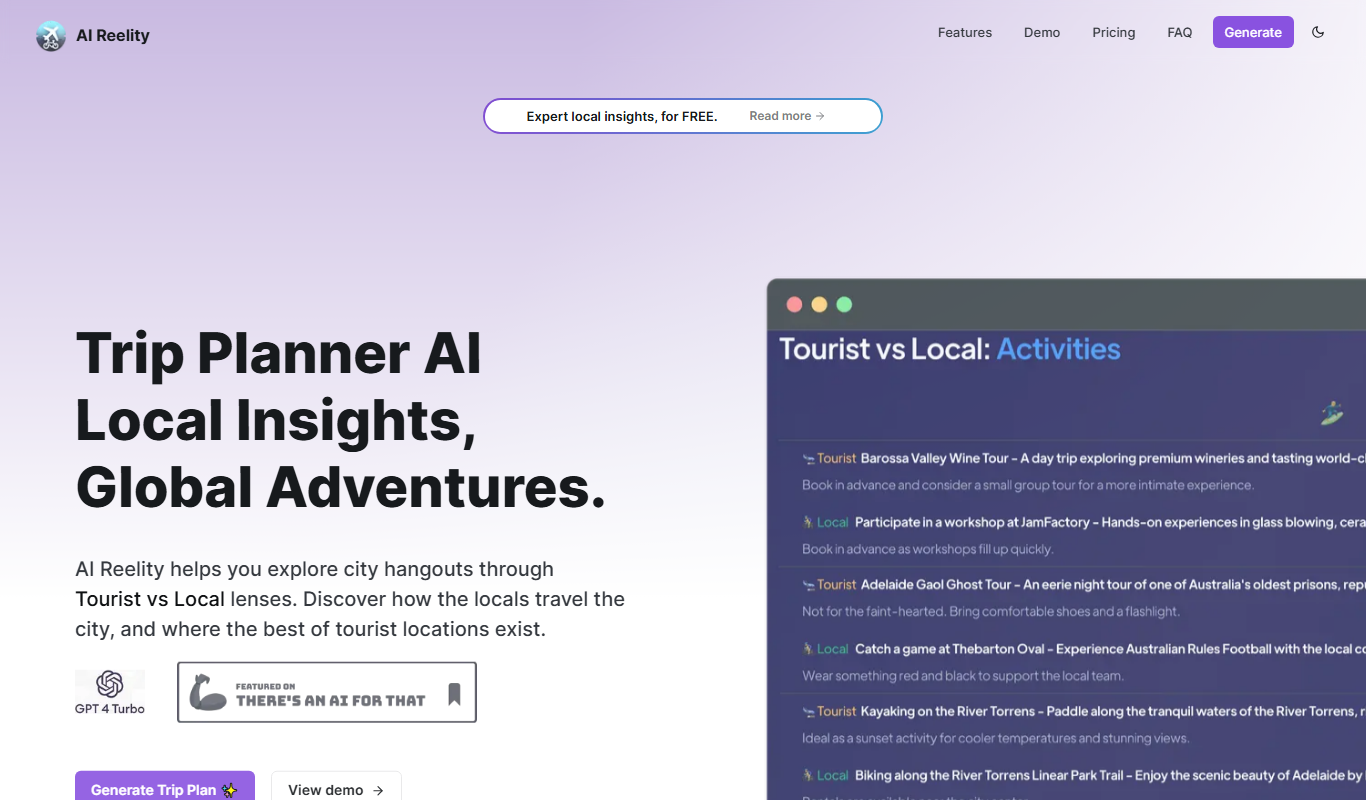
AIreelity
AIreelity is an AI-driven video creation platform that transforms text scripts into engaging marketing videos with customizable templates and AI voiceovers.

Free
AIJOURNEY
AIJOURNEY is an AI-driven career development tool that provides personalized career path recommendations, identifies skill gaps, and offers curated learning resources to help users advance professionally.