
From my experience with Chainlink, I found it excels at securely bridging blockchain smart contracts with real-world data, which is critical for reliable decentralized applications. After spending time exploring its developer tools and documentation, I can say it’s particularly well-suited for blockchain developers and DeFi projects that require trustworthy external data feeds. However, there is a trade-off: the cost and complexity can increase with high usage and custom oracle setups. Overall, if you need dependable oracle services to power smart contracts, Chainlink delivers robust and decentralized solutions.
Chainlink Oracle Network for Secure Blockchain Data Integration and Smart Contracts
Chainlink is a decentralized oracle network that securely connects smart contracts to external data sources, APIs, and payment systems, enabling reliable blockchain applications.
Tech Stack:
Go
JavaScript
Rust
Solidity
What is Chainlink?
Chainlink is a decentralized oracle network that enables smart contracts on any blockchain to securely connect to external data sources, APIs, and traditional bank payments. It solves the problem of blockchains being isolated from real-world data by providing tamper-resistant inputs and outputs through a network of independent oracle nodes.

Key Features of Chainlink
Decentralized Oracle Network
Multiple independent nodes provide data to prevent single points of failure and manipulation.
Secure Data Feeds
Reliable, tamper-proof price feeds and external data for DeFi and other blockchain applications.
Verifiable Random Function (VRF)
Provably fair and verifiable randomness for gaming, lotteries, and unpredictable smart contract outcomes.
Cross-Chain Compatibility
Supports multiple blockchain platforms enabling interoperability and data sharing.
Customizable Oracle Solutions
Developers can create tailored oracle networks for specific data requirements and security needs.
Pros and Cons of Chainlink
Pros
- Highly secure decentralized oracle network
- Supports multiple blockchain platforms
- Enables real-world data integration for smart contracts
- Provides verifiable randomness for fair outcomes
- Strong developer community and extensive documentation
Cons
- Costs can vary and increase with high usage
- Complexity in setting up custom oracle networks
- Dependent on external data providers’ reliability
Key Use Cases for Chainlink
Smart Contract Data Feeds
Provide reliable, tamper-proof external data to smart contracts for DeFi, insurance, gaming, and more.
Cross-Chain Interoperability
Enable communication and data transfer between different blockchain networks securely.
Decentralized Finance (DeFi)
Power DeFi applications with accurate price feeds, random number generation, and external API access.
Enterprise Blockchain Integration
Connect enterprise systems and legacy data sources to blockchain applications using secure oracles.
Verifiable Randomness
Generate provably fair and tamper-proof random numbers for gaming and lottery smart contracts.
How Chainlink Works
-
1
Deploy Smart Contract
Develop and deploy a smart contract that requires external data or off-chain computation.
-
2
Request Data via Chainlink
The smart contract sends a request to the Chainlink oracle network for specific data or computation.
-
3
Oracle Nodes Fetch Data
Multiple independent Chainlink nodes retrieve data from external APIs or data providers.
-
4
Data Aggregation and Validation
Chainlink aggregates responses from multiple nodes to ensure accuracy and prevent manipulation.
-
5
Deliver Data to Smart Contract
Validated data is sent back to the smart contract, triggering contract execution based on real-world inputs.
Who's Using Chainlink
Blockchain developers
DeFi platforms
Enterprise blockchain integrators
Gaming and lottery smart contract creators
Crypto startups requiring reliable data feeds
Chainlink Pricing
Free
$0
Access to Chainlink documentation, developer tools, and testnet usage.
Usage-based
Varies
Pay per oracle request or data feed usage depending on network demand and node operators.
Frequently Asked Questions About Chainlink
Chainlink is used to connect smart contracts with real-world data, APIs, and payment systems securely and reliably.
By using multiple independent oracle nodes and aggregating their responses, Chainlink prevents data manipulation and single points of failure.
Chainlink supports Ethereum, Binance Smart Chain, Polygon, Avalanche, and many other blockchain platforms.
Developers can access Chainlink tools and testnets for free, but production use involves paying node operators based on usage.
It depends on your specific needs and how you plan to use the tool. The official website and documentation are the best sources for the latest details.
It depends on your specific needs and how you plan to use the tool. The official website and documentation are the best sources for the latest details.
It depends on your specific needs and how you plan to use the tool. The official website and documentation are the best sources for the latest details.
It depends on your specific needs and how you plan to use the tool. The official website and documentation are the best sources for the latest details.
Share your review
Reviews are limited to one per logged-in user and are published after moderation.
You need an account to review this tool.
0.0
★
★
★
★
★
0 reviews
5 star
0
4 star
0
3 star
0
2 star
0
1 star
0
No reviews yet
Be the first to share how this tool worked for you.
Questions from the community
Read questions and answers about this tool, or ask your own.
No questions yet
Start the conversation by asking the first question about this tool.
Is this tool helpful?
Alternative Tools
Explore similar AI tools that might fit your needs

Free
The Graph
The Graph is a decentralized protocol that indexes and queries blockchain data using GraphQL, enabling developers to build fast and reliable decentralized applications.

Enterprise
Awan LLM
Awan LLM is a cloud platform that enables deployment, management, and scaling of custom large language models with API integration and enterprise-grade security.

Free
Islam & AI
Islam & AI is a web platform that integrates artificial intelligence with Islamic texts to provide enhanced learning, research, and community engagement tools in English and Arabic.

Free
RandomUser.me
RandomUser.me is a free API service that generates realistic fake user profiles including names, emails, addresses, and pictures for developers to use in testing and development.

Enterprise
Clarifai
Clarifai is an AI platform specializing in image and video recognition, offering pre-trained and custom models for visual data analysis, content moderation, and visual search via API integration.
Enterprise
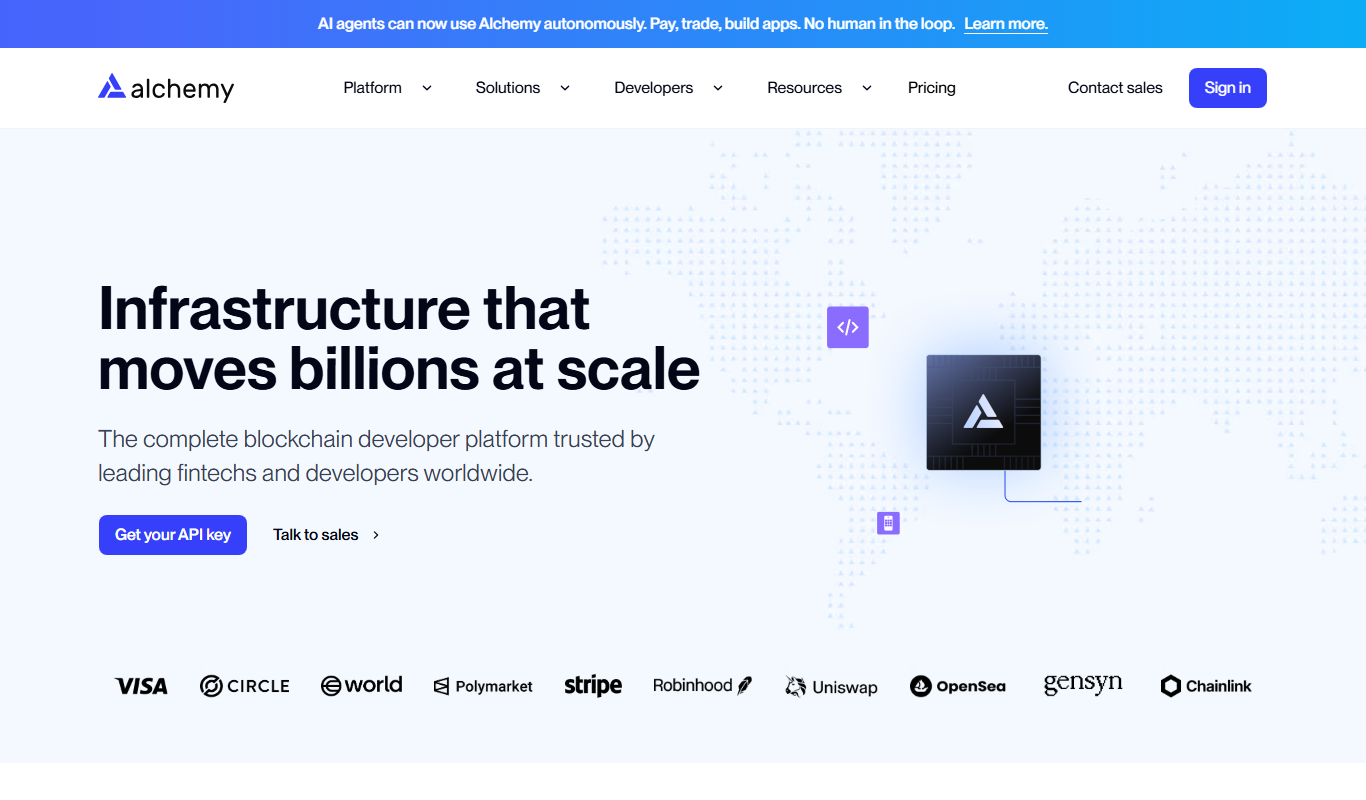
Alchemy
Alchemy is a blockchain developer platform providing APIs and scalable node infrastructure to build, monitor, and scale decentralized applications on Ethereum and other blockchains.
Freemium
RapidAPI
RapidAPI is a platform that allows developers to find, test, and connect to thousands of APIs from a single interface, offering unified SDKs, API analytics, and monetization options.

Free Trial
BasicAI Cloud
BasicAI Cloud is a cloud-based AI platform that enables users to train, deploy, and manage custom AI models without coding, using scalable cloud resources and integrated data annotation tools.

Freemium
Mono API
Mono API is a financial data aggregation platform that enables developers to access real-time banking data and initiate payments securely via a single API, primarily serving African markets.