

UUID Generator
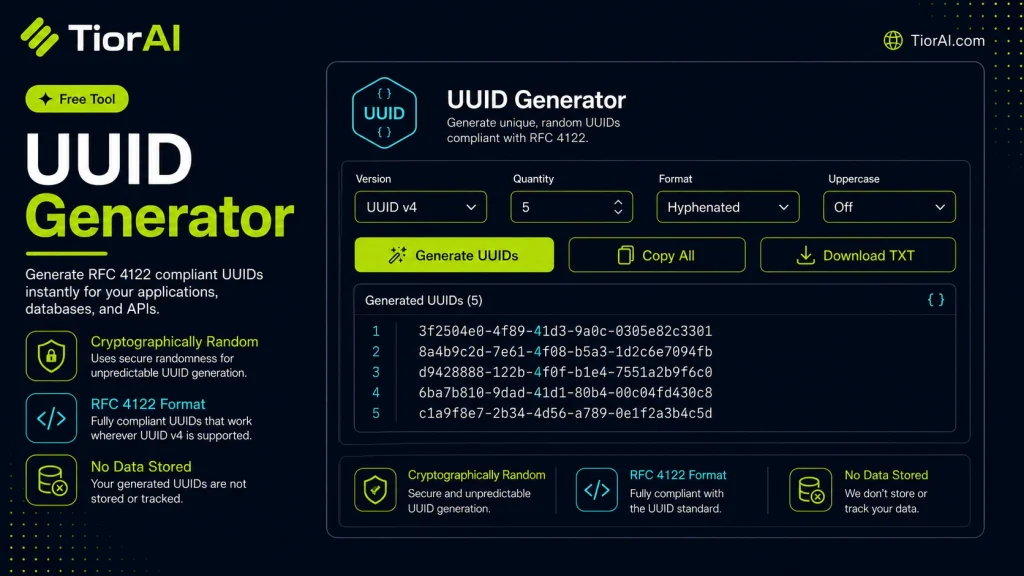
Generate universally unique identifiers (UUID/GUID) with our free generator. Create v1, v4, or bulk UUIDs for databases, APIs, and distributed systems – copy to clipboard with one click.
How to use it
- Configure Settings Set your preferences and parameters in the Uuid Generator. Customize the output to match your specific requirements.
- Generate Output Click generate to create your result. The tool processes your settings and produces output instantly.
- Copy or Download Review the generated output, then copy it to your clipboard or download it for immediate use.
Tip Customize all available settings in the Uuid Generator before generating — small tweaks can make a big difference.
What is a UUID?
A UUID (Universally Unique Identifier) is a 128-bit number used to uniquely identify information in computer systems. It is designed to be globally unique without requiring a central registration authority. UUIDs are commonly represented as 32 hexadecimal digits, displayed in five groups separated by hyphens, for example: 123e4567-e89b-12d3-a456-426614174000.
UUIDs are essential in distributed systems, databases, and software development where unique identifiers are needed to avoid collisions. Unlike incremental IDs, UUIDs can be generated independently on different machines without coordination, making them ideal for decentralized environments.
Why are UUIDs needed?
- Uniqueness: Ensures that identifiers do not clash across systems or databases.
- Decentralization: Allows multiple systems to generate IDs without a central authority.
- Security: UUIDs are hard to guess, which can help in some security contexts.
Common UUID Versions
There are several versions of UUIDs, each generated differently:
- Version 1: Based on timestamp and MAC address.
- Version 3 and 5: Name-based using MD5 or SHA-1 hashing.
- Version 4: Randomly generated, most commonly used.
Each version serves different use cases depending on the need for predictability, security, or uniqueness.
Understanding UUIDs
A UUID (Universally Unique Identifier) is a standardized 128-bit number used to uniquely identify objects or information in computer systems. Unlike simple incremental IDs, UUIDs are designed to be unique across different systems without requiring a central authority or coordination. This makes them ideal for distributed environments, databases, and applications where uniqueness is critical.
UUIDs are typically displayed as 32 hexadecimal characters separated by hyphens into five groups. There are several versions of UUIDs, with version 4 being the most common, which generates identifiers randomly. Other versions use timestamps, MAC addresses, or hashing of names.
When to Use a UUID Generator
- When you need unique identifiers across multiple systems or services without conflicts.
- Assigning IDs in distributed databases or microservices architectures.
- Generating session tokens or transaction IDs in web applications.
- Creating unique keys for objects in software development to avoid collisions.
Common Mistakes to Avoid
- Assuming all UUIDs are equally secure or random without understanding the version used.
- Using UUIDs as primary keys in databases without considering their size and potential impact on indexing and performance.
- Confusing UUID versions and applying the wrong type for your use case, which can affect uniqueness or predictability.
Understanding how UUIDs work and when to use them helps ensure your applications generate truly unique identifiers efficiently and reliably.
Frequently asked questions
Reviews and questions
Whether this tool gave people the answer they needed, and what they asked about it.
Sign in to review this tool.
Sign In to ReviewNo reviews yet
Be the first to say whether this tool gave you what you needed.
Ask how to read the result, or what the tool does with an edge case — or answer someone else.
Sign In to AskNo questions yet
Not sure how to read a result? Be the first to ask.
AI tools related to this topic
Tools from the TiorAI directory that work on the same kind of job.

Random Movie Generator
Random Movie Generator is a free web tool that instantly suggests random movies to help users decide what to watch without browsing extensive lists.

This Person Does Not Exist – Random Face Generator
This Person Does Not Exist is a free AI tool that instantly generates photorealistic human faces using GANs, creating unique images of people who do not exist.

Unique Datasets for AI training
Unique Datasets for AI Training is a web-based marketplace by FileMarket AI offering diverse, high-quality datasets for AI and machine learning model development, enabling secure purchase and immediate access to data.