

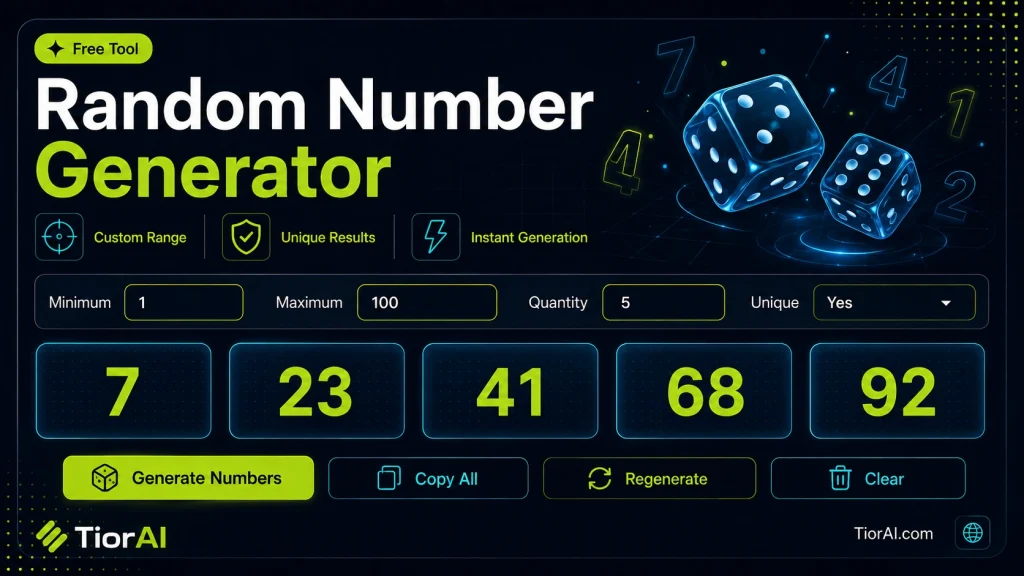
How to use it
- Configure Settings Set your preferences and parameters in the Random Number Generator. Customize the output to match your specific requirements.
- Generate Output Click generate to create your result. The tool processes your settings and produces output instantly.
- Copy or Download Review the generated output, then copy it to your clipboard or download it for immediate use.
Tip Bookmark the Random Number Generator for repeat use — generators are even more powerful when used as part of your regular workflow.
Understanding Random Number Generation
A random number generator (RNG) is a system or algorithm designed to produce a sequence of numbers that lack any predictable pattern. These numbers appear random and are used in various fields such as statistics, cryptography, gaming, and simulations.
There are two main types of RNGs: True Random Number Generators (TRNGs) and Pseudorandom Number Generators (PRNGs). TRNGs rely on physical phenomena like electronic noise or radioactive decay to generate randomness, while PRNGs use deterministic algorithms that produce sequences based on an initial value called a seed.
Random numbers are essential when unbiased, unpredictable outcomes are needed. For example, in simulations, random sampling helps model real-world uncertainty. In gaming, RNGs determine outcomes like dice rolls or card shuffles to ensure fairness. Cryptography uses RNGs to create secure keys that are hard to guess.
Because computers are deterministic machines, true randomness is hard to achieve purely through software. Most online tools use PRNGs, which are sufficient for general purposes but not for high-security applications.
What is a Random Number Generator?
A random number generator (RNG) is a tool that produces numbers without any predictable pattern. These numbers are used in many applications where unpredictability or fairness is important, such as games, simulations, and statistical sampling.
When to Use a Random Number Generator
- Picking winners in contests or giveaways
- Generating test data for software or research
- Creating randomized sequences for games or learning activities
- Assigning random identifiers when uniqueness is not critical
Common Mistakes to Avoid
- Believing that all RNGs produce truly unpredictable numbers—most online tools use algorithms that are deterministic.
- Expecting random numbers to never repeat duplicates without using additional logic to prevent repeats.
Technical Context
Random number generators typically use pseudorandom algorithms that start from a seed value. While these sequences appear random for everyday use, they are not suitable for cryptographic or security-sensitive applications. True randomness requires physical processes, which are not commonly available in online tools.
Frequently asked questions
Reviews and questions
Whether this tool gave people the answer they needed, and what they asked about it.
Sign in to review this tool.
Sign In to ReviewNo reviews yet
Be the first to say whether this tool gave you what you needed.
Ask how to read the result, or what the tool does with an edge case — or answer someone else.
Sign In to AskNo questions yet
Not sure how to read a result? Be the first to ask.
AI tools related to this topic
Tools from the TiorAI directory that work on the same kind of job.

Adola: Voice & Phone Number for your AI
Adola is an AI communication platform providing virtual phone numbers and realistic AI voice calls to automate business phone interactions such as customer support and marketing.

Random Movie Generator
Random Movie Generator is a free web tool that instantly suggests random movies to help users decide what to watch without browsing extensive lists.

This Person Does Not Exist – Random Face Generator
This Person Does Not Exist is a free AI tool that instantly generates photorealistic human faces using GANs, creating unique images of people who do not exist.