

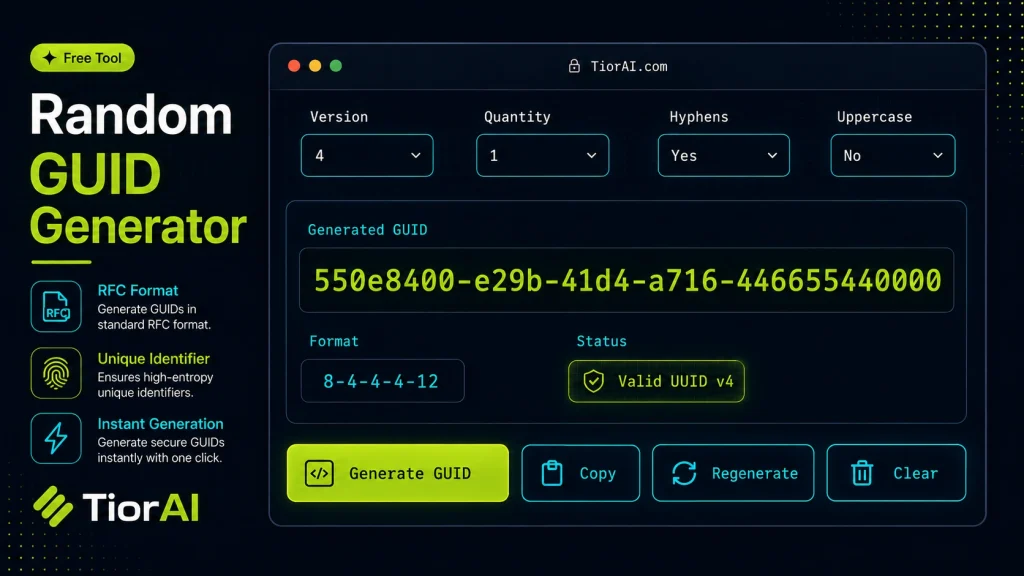
How to use it
- Configure Settings Set your preferences and parameters in the Random Guid Generator. Customize the output to match your specific requirements.
- Generate Output Click generate to create your result. The tool processes your settings and produces output instantly.
- Copy or Download Review the generated output, then copy it to your clipboard or download it for immediate use.
Tip The Random Guid Generator creates production-ready output — no manual cleanup needed before using the results.
Understanding GUIDs and Their Purpose
A GUID (Globally Unique Identifier) is a 128-bit value used to uniquely identify information in computer systems. It is typically represented as a 32-character hexadecimal string, often displayed in groups separated by hyphens, such as 3F2504E0-4F89-11D3-9A0C-0305E82C3301. GUIDs are designed to be unique across space and time, meaning the probability of two GUIDs being the same is extremely low.
GUIDs are essential in distributed systems, databases, and software development where unique identifiers are required without central coordination. For example, they are used to assign unique keys to database records, identify components in software, or tag sessions and transactions.
Generating a GUID involves algorithms that combine elements like timestamps, hardware identifiers (such as MAC addresses), and random or pseudo-random numbers. This ensures that each generated GUID is statistically unique.
Common uses of GUIDs include:
- Database primary keys to avoid collisions in distributed environments
- Identifying software components or interfaces uniquely
- Tracking sessions or transactions in web applications
- Tagging files or resources in cloud storage systems
What is a GUID?
A GUID (Globally Unique Identifier) is a 128-bit value used to uniquely identify objects or data across different systems. It is usually represented as a long hexadecimal string divided into sections by hyphens. GUIDs are essential in software development and database management where unique identifiers are required without a central authority.
When to Use a Random GUID Generator
Use a random GUID generator when you need to create unique identifiers that must not collide, especially in distributed systems or databases. Examples include assigning keys to records in a distributed database, tagging sessions in web applications, or generating unique filenames.
Common Mistakes to Avoid
- Believing GUIDs are absolutely guaranteed unique; while collisions are extremely rare, they are theoretically possible.
- Using GUIDs as user-facing identifiers, which can confuse users due to their length and complexity.
- Generating GUIDs without proper algorithms, which can lead to duplicates or predictable values.
Technical Context
GUIDs are generated using algorithms that combine timestamps, hardware identifiers, and random numbers to ensure uniqueness. They are widely supported across programming languages and platforms, making them a reliable choice for unique identification in many applications.
Frequently asked questions
Reviews and questions
Whether this tool gave people the answer they needed, and what they asked about it.
Sign in to review this tool.
Sign In to ReviewNo reviews yet
Be the first to say whether this tool gave you what you needed.
Ask how to read the result, or what the tool does with an edge case — or answer someone else.
Sign In to AskNo questions yet
Not sure how to read a result? Be the first to ask.
AI tools related to this topic
Tools from the TiorAI directory that work on the same kind of job.

Random Movie Generator
Random Movie Generator is a free web tool that instantly suggests random movies to help users decide what to watch without browsing extensive lists.

This Person Does Not Exist – Random Face Generator
This Person Does Not Exist is a free AI tool that instantly generates photorealistic human faces using GANs, creating unique images of people who do not exist.