

Random Address Generator
Generate realistic sample addresses for testing forms, imports, and mock data.
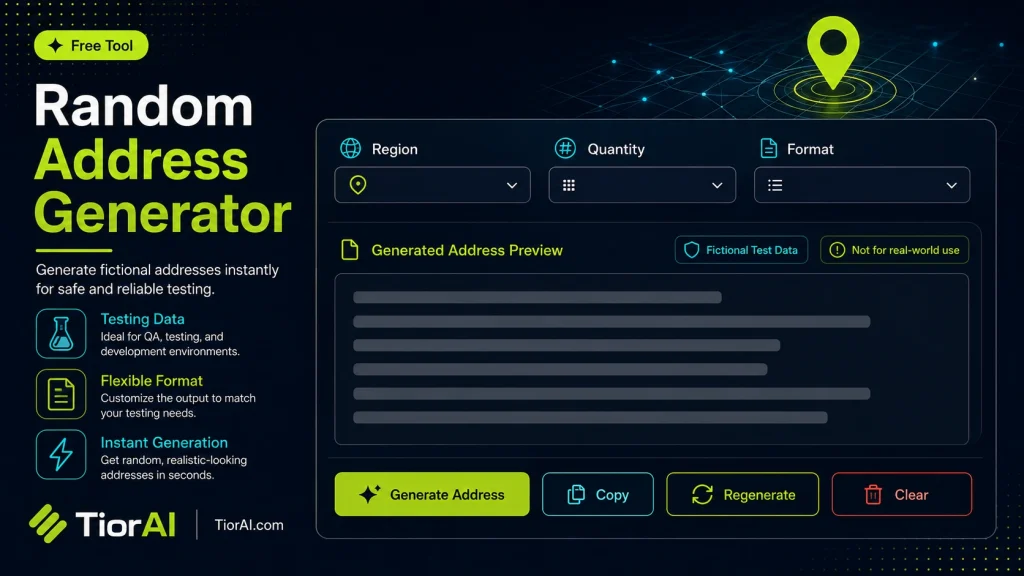
| # | Street | City | Region | Postal Code |
|---|
How to use it
- Configure Settings Set your preferences and parameters in the Random Address Generator. Customize the output to match your specific requirements.
- Generate Output Click generate to create your result. The tool processes your settings and produces output instantly.
- Copy or Download Review the generated output, then copy it to your clipboard or download it for immediate use.
Tip Use the Random Address Generator to quickly prototype ideas before investing time in manual creation.
Understanding Random Address Generation
A random address generator is a tool that creates fictitious or realistic-looking addresses by combining various address components such as street names, city names, postal codes, and countries. This process involves selecting elements from predefined datasets or databases and assembling them into a coherent address format that mimics real-world addresses.
These generated addresses are not tied to actual locations, which makes them useful for scenarios where real addresses cannot be used due to privacy, security, or testing constraints. The generation process often uses algorithms to ensure that the addresses follow valid formatting rules for the target country or region.
Common situations where random address generation is needed include software testing, where developers require large volumes of address data to simulate user inputs; data anonymization, where real addresses must be replaced with fake ones to protect privacy; and content creation, such as populating sample data in demos or mockups.
By automating the creation of addresses, these tools save time and reduce errors compared to manual entry, especially when large datasets are required.
What is a Random Address Generator?
A random address generator is a utility that creates fake but plausible addresses by combining elements like street names, cities, postal codes, and countries. These addresses are generated algorithmically to follow the formatting rules of specific regions, making them look realistic without corresponding to real-world locations.
When to Use a Random Address Generator
- When you need large volumes of address data for software testing without exposing real user information.
- For populating sample data in demos, mockups, or training materials where realistic addresses improve the experience.
- To anonymize datasets by replacing real addresses with fake ones, protecting privacy during analysis or sharing.
Common Mistakes to Avoid
- Using generated addresses as if they were real, which can cause problems in shipping, billing, or legal contexts.
- Failing to ensure the generated address format matches the target country’s postal standards, resulting in invalid or unusable data.
Random address generators are practical tools that automate the creation of address data, saving time and reducing errors compared to manual entry. They are especially useful in development and testing environments where privacy and data integrity are important.
Frequently asked questions
Reviews and questions
Whether this tool gave people the answer they needed, and what they asked about it.
Sign in to review this tool.
Sign In to ReviewNo reviews yet
Be the first to say whether this tool gave you what you needed.
Ask how to read the result, or what the tool does with an edge case — or answer someone else.
Sign In to AskNo questions yet
Not sure how to read a result? Be the first to ask.
AI tools related to this topic
Tools from the TiorAI directory that work on the same kind of job.

Random Movie Generator
Random Movie Generator is a free web tool that instantly suggests random movies to help users decide what to watch without browsing extensive lists.

This Person Does Not Exist – Random Face Generator
This Person Does Not Exist is a free AI tool that instantly generates photorealistic human faces using GANs, creating unique images of people who do not exist.