

ULID Generator
Understanding ULIDs ULIDs (Universally Unique Lexicographically Sortable Identifiers) are unique identifiers designed to be both unique and sortable by creation time. They combine a millisecond-precision timestamp with a random component, encoded in a case-insensitive Base32 format. This makes ULIDs ideal for systems that require unique…
How to use it
- Configure Settings Set your preferences and parameters in the Ulid Generator. Customize the output to match your specific requirements.
- Generate Output Click generate to create your result. The tool processes your settings and produces output instantly.
- Copy or Download Review the generated output, then copy it to your clipboard or download it for immediate use.
Tip Regenerate multiple times with the Ulid Generator to compare variations and pick the best output for your needs.
What is a ULID?
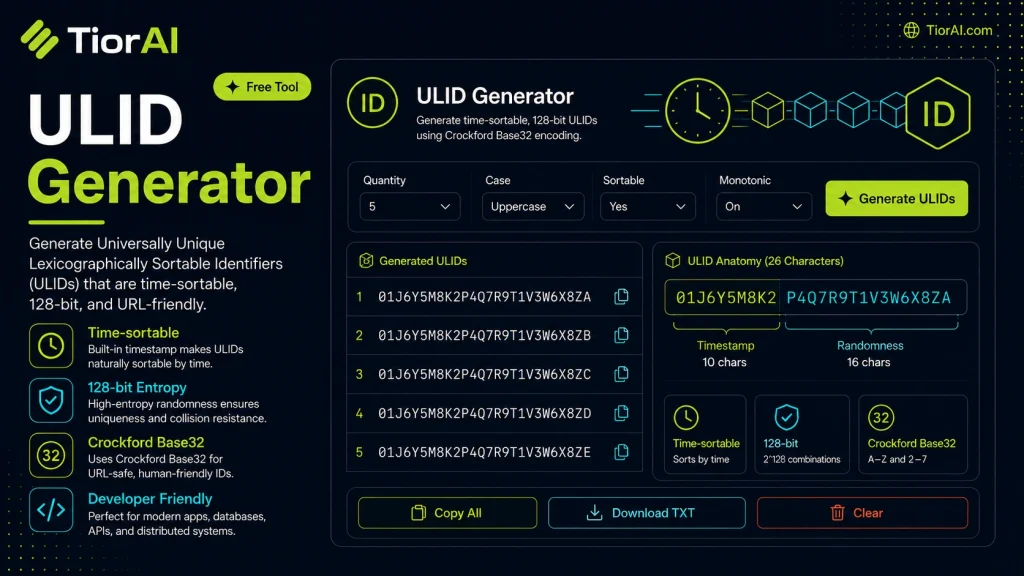
A ULID (Universally Unique Lexicographically Sortable Identifier) is a type of identifier designed to be unique across systems and sortable by creation time. Unlike traditional UUIDs, ULIDs encode a timestamp component along with randomness, allowing them to be sorted chronologically while maintaining uniqueness.
Why use ULIDs? They solve common problems in distributed systems where you need unique IDs that also reflect creation order. This is useful for databases, logs, or any system where sorting by creation time is important.
How ULIDs work:
- The first 48 bits represent a timestamp in milliseconds since Unix epoch.
- The remaining 80 bits are random, ensuring uniqueness even if multiple ULIDs are generated in the same millisecond.
- ULIDs are encoded in Crockford’s Base32, making them case-insensitive and URL-safe.
This combination allows ULIDs to be generated independently on multiple machines without coordination, while still being sortable and unique.
Understanding ULIDs
ULIDs (Universally Unique Lexicographically Sortable Identifiers) are unique identifiers designed to be both unique and sortable by creation time. They combine a millisecond-precision timestamp with a random component, encoded in a case-insensitive Base32 format. This makes ULIDs ideal for systems that require unique IDs that also reflect the order in which they were created.
When to Use a ULID Generator
- Generating database keys that need to be sorted chronologically.
- Creating unique event IDs in distributed systems without central coordination.
- Producing URL-safe identifiers that are shorter and easier to handle than UUIDs.
- Implementing high-throughput ID generation where ordering matters.
Common Mistakes to Avoid
- Assuming ULIDs are case-sensitive, which can cause mismatches when comparing or storing them.
- Ignoring the timestamp aspect and treating ULIDs as purely random identifiers.
- Expecting ULIDs to be directly interchangeable with UUIDs without considering format differences.
Understanding the structure and purpose of ULIDs helps in choosing the right identifier for your application, especially when ordering and uniqueness are critical.
Frequently asked questions
Reviews and questions
Whether this tool gave people the answer they needed, and what they asked about it.
Sign in to review this tool.
Sign In to ReviewNo reviews yet
Be the first to say whether this tool gave you what you needed.
Ask how to read the result, or what the tool does with an edge case — or answer someone else.
Sign In to AskNo questions yet
Not sure how to read a result? Be the first to ask.