

URL Rewrite Generator
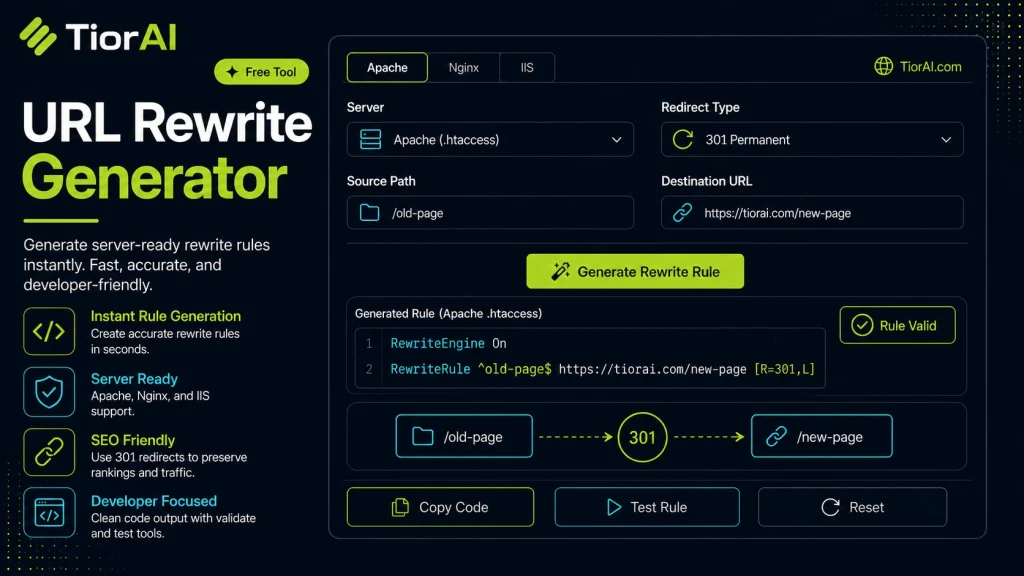
URL rewriting is a technique used to convert complex URLs with query parameters into simpler, more readable formats. This improves both user experience and search engine optimization by making URLs easier to understand and remember. For example, instead of a URL like example.com/page?id=45 , a…
How to use it
- Paste or Enter Your Input Paste your code, text, or data into the input field. The tool supports large inputs without performance issues.
- Process and Analyze Click the action button or let the tool auto-process your input. Results appear in real time with highlighted details.
- Copy or Download the Output Review the results and copy the output to clipboard or download as a file for use in your project.
Tip Keyboard shortcut: Ctrl+V to paste input, then Ctrl+C to copy output - saves time in repetitive workflows.
Understanding URL Rewriting
URL rewriting is the process of modifying the appearance of URLs to make them more readable, user-friendly, and often more SEO-friendly. Instead of displaying complex query strings or parameters, URLs are transformed into cleaner, descriptive paths.
This technique is commonly used in web development to improve navigation, enhance security by hiding underlying technology details, and create URLs that are easier to remember and share. For example, a URL like example.com/product?id=123 can be rewritten as example.com/product/123 or example.com/product/widget.
URL rewriting is typically handled by web server configurations (like Apache’s .htaccess files or Nginx rewrite rules) or application-level routing. A URL rewrite generator helps automate the creation of these rewrite rules by converting user-friendly URLs into the correct server instructions.
Common situations for URL rewriting include:
- Improving SEO by including keywords in URLs
- Hiding query parameters for cleaner URLs
- Redirecting old URLs to new ones after site restructuring
- Enabling RESTful URL patterns in web applications
What is URL Rewriting?
URL rewriting is a technique used to convert complex URLs with query parameters into simpler, more readable formats. This improves both user experience and search engine optimization by making URLs easier to understand and remember.
For example, instead of a URL like example.com/page?id=45, a rewritten URL might look like example.com/page/45. This is achieved by configuring web server rules that map the clean URL back to the original resource.
When to Use a URL Rewrite Generator
- When you want to create SEO-friendly URLs that include meaningful keywords.
- To simplify URLs by removing query strings or technical parameters.
- When migrating a website and needing to redirect old URLs to new paths.
- To implement clean, RESTful URLs in web applications for better user experience.
Common Mistakes to Avoid
- Not testing rewrite rules thoroughly, which can cause broken links or redirect loops.
- Confusing URL rewriting with URL redirection; they serve different purposes and require different configurations.
- Using overly complex rewrite rules that make server maintenance difficult.
Using a URL rewrite generator helps automate the creation of these rules, reducing errors and saving time. However, understanding the basics of how rewriting works and testing the generated rules in your environment is essential for smooth operation.
Frequently asked questions
Reviews and questions
Whether this tool gave people the answer they needed, and what they asked about it.
Sign in to review this tool.
Sign In to ReviewNo reviews yet
Be the first to say whether this tool gave you what you needed.
Ask how to read the result, or what the tool does with an edge case — or answer someone else.
Sign In to AskNo questions yet
Not sure how to read a result? Be the first to ask.
AI tools related to this topic
Tools from the TiorAI directory that work on the same kind of job.

ChatGPT
ChatGPT is an AI chatbot by OpenAI powered by GPT-4o. It handles writing, coding, research, data analysis, and natural conversation. Free tier available, Plus at $20/month.