

URL Parser
Understanding URL Parsing A URL parser is a utility that breaks down a web address into its fundamental components. URLs consist of several parts such as the protocol (e.g., https ), domain name, port number, path, query parameters, and fragment identifiers. Parsing these parts is…
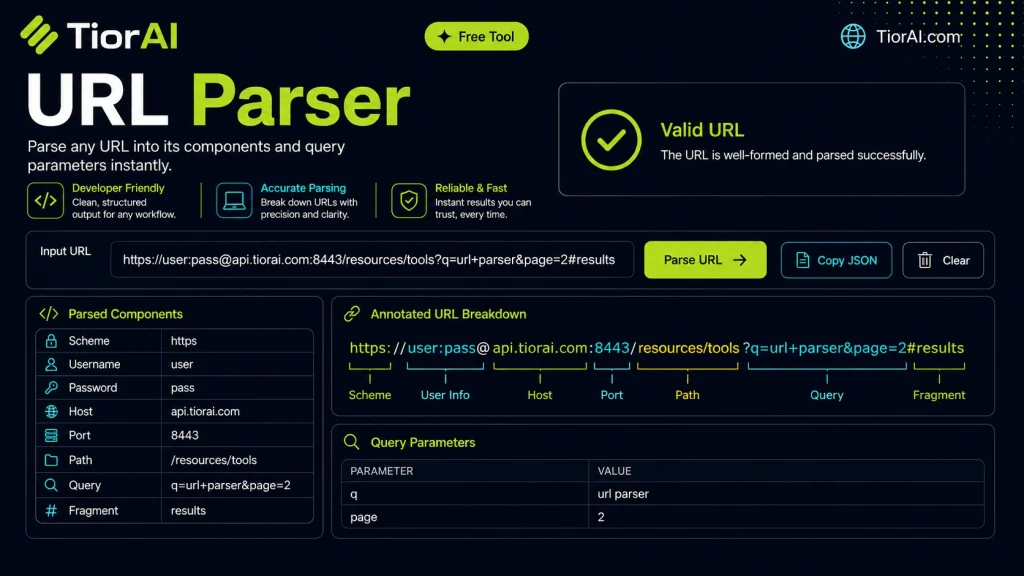
| Property | Value |
|---|
How to use it
- Paste or Enter Your Input Paste your code, text, or data into the input field. The tool supports large inputs without performance issues.
- Process and Analyze Click the action button or let the tool auto-process your input. Results appear in real time with highlighted details.
- Copy or Download the Output Review the results and copy the output to clipboard or download as a file for use in your project.
Tip This tool preserves your input formatting. Check format settings if the output differs from expected.
About URL Parser
A URL parser is a tool or software component that breaks down a Uniform Resource Locator (URL) into its individual parts, such as the protocol, hostname, port, path, query parameters, and fragment. URLs are structured strings that specify addresses on the web, and parsing them is essential for understanding or manipulating these addresses programmatically.
Parsing a URL involves extracting meaningful components from the string so that applications can process or modify them. For example, a web browser uses URL parsing to determine which server to contact, which resource to request, and what parameters to send. Developers use URL parsers to validate URLs, extract query parameters for processing, or reconstruct URLs after modification.
Why URL Parsing is Needed
- Data extraction: Retrieve specific parts like domain names or query parameters.
- Validation: Check if a URL is well-formed and usable.
- Modification: Change parts of a URL, such as adding or removing query parameters.
- Routing: Web frameworks parse URLs to route requests to the correct handlers.
Common Use Cases
- Extracting search terms or filters from query strings in web applications.
- Validating user input URLs before processing or storage.
- Debugging or analyzing URLs during development.
- Building tools that manipulate URLs, such as URL shorteners or redirect services.
Understanding URL Parsing
A URL parser is a utility that breaks down a web address into its fundamental components. URLs consist of several parts such as the protocol (e.g., https), domain name, port number, path, query parameters, and fragment identifiers. Parsing these parts is essential for applications that need to analyze, validate, or modify URLs.
For example, a web application might extract query parameters to filter search results or validate that a URL is correctly formatted before processing it. URL parsing is also critical in routing requests to the appropriate handlers in web frameworks.
When to Use a URL Parser
- Extract specific parts of a URL for processing or display.
- Validate URLs to ensure they meet expected formats.
- Modify URLs by adding or removing query parameters or path segments.
- Debug or analyze URLs during development or troubleshooting.
- Implement routing logic in web applications based on URL components.
Common Mistakes to Avoid
- Assuming the parser automatically decodes percent-encoded characters; decoding often requires an extra step.
- Failing to handle URLs missing certain components, which can lead to incorrect parsing.
- Confusing the extraction of the query string with parsing its key-value pairs; these are separate processes.
Understanding how URL parsing works and when to use it helps developers handle URLs efficiently and avoid common pitfalls in web development and data processing.
Frequently asked questions
Reviews and questions
Whether this tool gave people the answer they needed, and what they asked about it.
Sign in to review this tool.
Sign In to ReviewNo reviews yet
Be the first to say whether this tool gave you what you needed.
Ask how to read the result, or what the tool does with an edge case — or answer someone else.
Sign In to AskNo questions yet
Not sure how to read a result? Be the first to ask.
AI tools related to this topic
Tools from the TiorAI directory that work on the same kind of job.

ChatGPT
ChatGPT is an AI chatbot by OpenAI powered by GPT-4o. It handles writing, coding, research, data analysis, and natural conversation. Free tier available, Plus at $20/month.